Helen Elizabeth Macvean’s Photo Album
Banner Image: Courtesy of The Thanatos Archive Store https://store.thanatos.net/products/180cdv
We are so lucky! I found one more photo in Helen’s collection with a name written on it.
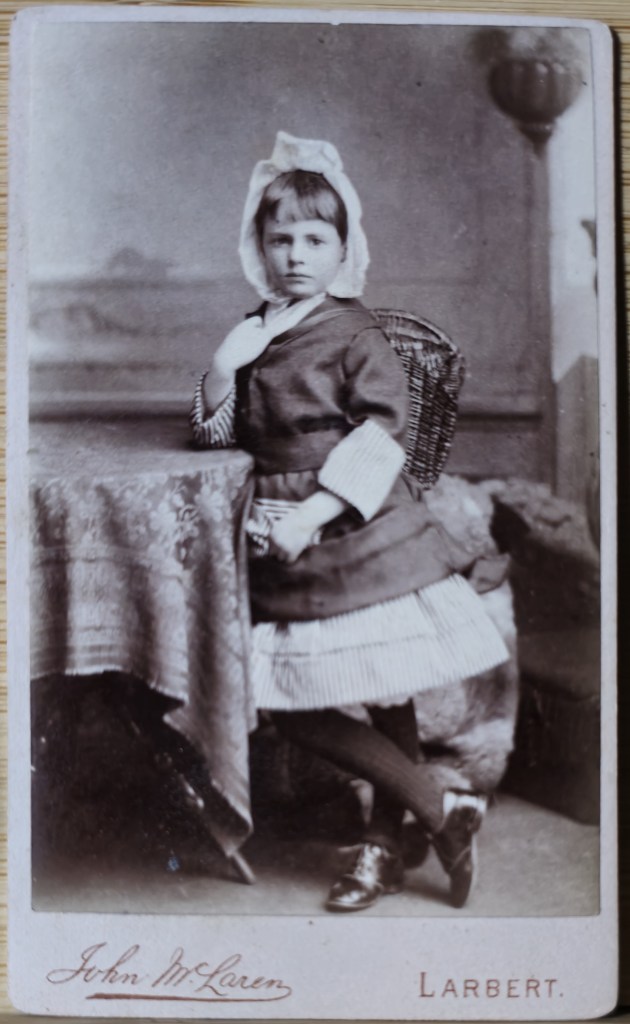
Figure 1: Courtesy of the Macvean Family Archives

Taking into account that this is another John McLaren photo taken in Larbert, which are the same details as the photograph for Mrs D. C. Macvean, (Figure 34: Part One) I’m fairly sure May is, Margaret Cameron Macvean (1880-1903) daughter of Mrs Duncan Cameron Macvean and the Rev. Duncan Cameron Macvean. Which makes May, sister to Dr Donald Alexander Macvean (Figure 35: Part One)
May is born on the 14th May, 1880, this means she is sitting for this photo with John McLaren in March of 1884.
May doesn’t follow her brother to Australia but rather ends up in India. This is the only piece of information I can track down for her at the moment. Her probate listing.

May passes away at the age of 22 in Benares, India. I hope I will be able to discover more of her story soon.
So now to the rest of Helen’s collection, which unfortunately have no names marked on them, so they are unknown at this stage. If you think you recognise a face from a photo you have or might have seen, please let me know and we will see if we can get some of them identified.
Some of the photos have the photographer’s details provided. I have posted a copy of these as well because from what I have read so far, this can sometimes help with the identification process. You will notice I have made a few guesses where I thought I might be able.
So here we go with our first photograph and its from Scotland.
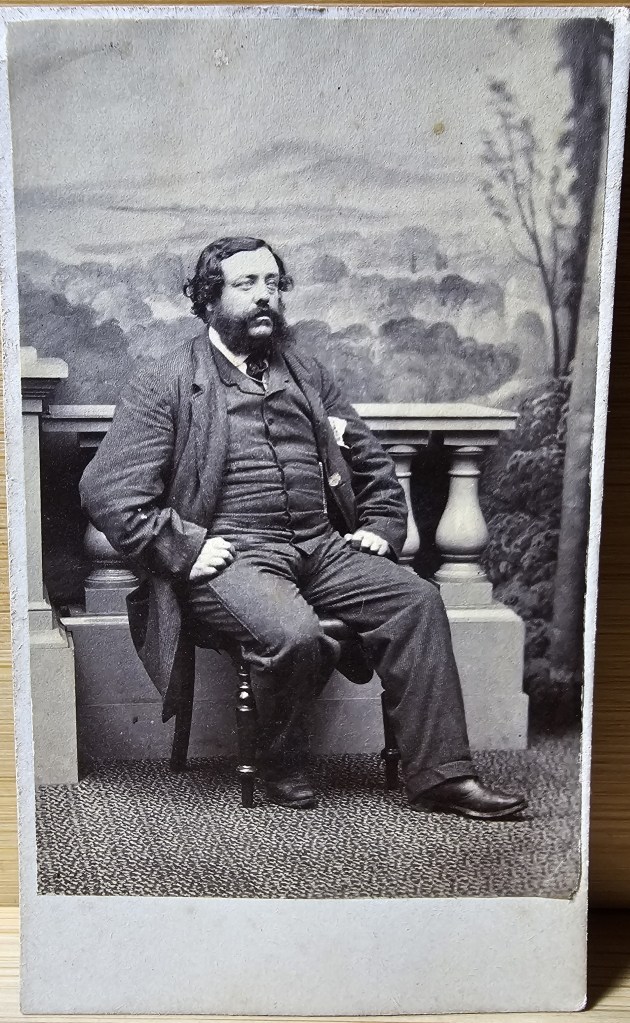

I mean, this has got to be another Macvean brother doesn’t it? Perhaps the Rev. Duncan Cameron Macvean (1835-1882) or Donald Macvean (1822-1874). They are the only two brothers out of the eight that we don’t have a photo attributed to. If this photo was taken in the late 1860s to mid 1870s then Duncan is aged in his late 20s early 30s and Donald is late 30s early 40s, so this fits with the look of this guy above.
The photographer of this potential brother, was William Dickson in Glasgow and thanks to the Scottish Post Office Directory we can confirm a specific date range for when this photo was taken.
This is the earliest listing that appears for William at this address.

Figure 3a: Courtesy of the National Library of Scotland
https://digital.nls.uk/directories/browse/archive/83927020?mode=transcription
In the photo below, 16 St. Enoch Square is roughly in where the white building on the very left of the photo is.
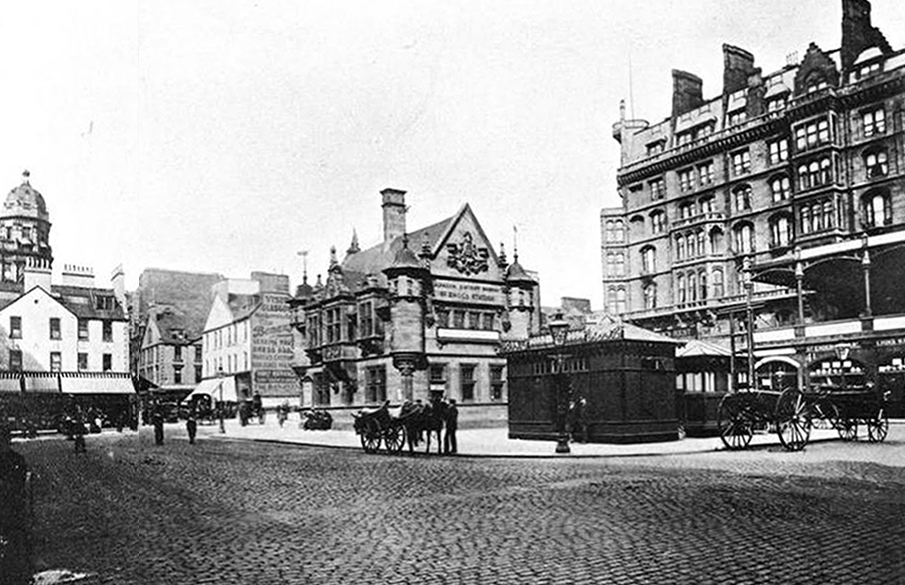
Figure 4: Courtesy of Past Glasgow, Glasgow Then & Now
https://www.pastglasgow.co.uk/st-enoch-square-various/
And the final listing for William at this address appears in the 1873-1874 directory.

Figure 4a: Courtesy of the National Library of Scotland
We can be certain of this time frame because as of the next directory listing in 1874-1875, William has moved his business to a new address.

Figure 4b: Courtesy of the National Library of Scotland
The next photo is my pick for best facial expressions of the time. It is a result of the fact that the subjects had to sit completely still for so long, for the exposure times of the film. Often up to a minute depending on the process that was being used. https://rmc.library.cornell.edu/DawnsEarlyLight/resources.html


You might have noticed that there seems to be an Irish connection in Helen’s photos, especially when you take into account that she had a photo of the Lord Chief Justice of Ireland, James Whiteside in her collection. (Figure 48, Part One) I have found no link between them by the way.
While searching for information on this photographer, Julius Ahlborn, I could only find this one listing for him conducting business from this address in 1863. So I am unable to confidently give a date range for the photo.
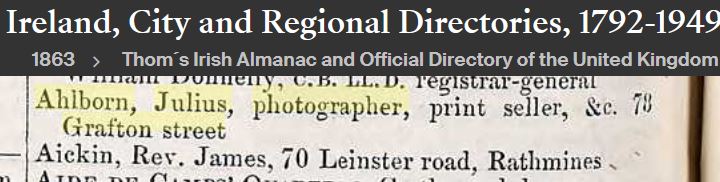
If you look at the top of the photo below, you will notice the end of Portraits painted on the edge of the white topped building and then under that you will see the number 79. Number 78 is the building under that where Julius had his studio.

Figure 5b: Courtesy of Wikimedia
https://boudewijnhuijgens.getarchive.net/media/79-grafton-street-8248610379-70571d
One thought I had was, is this a photo of Helen saying goodbye to some younger family members before immigrating? But then the children have such a strong resemblance to the woman, that maybe not.
Helen is 22 years of age in 1863 and just about to step onboard the clipper, Lightning, with her Aunt, Elizabeth Hunter, bound for Melbourne. We are so lucky, I managed to find their passenger listing on Ancestry.

Figure 5c: Courtesy of Ancestry.com.au
Again it is only speculation but the link with Ireland could be with Helen’s parents, Mary Aimee Hunter née Carmichael (1818-1850) and Thomas Griffith (1805-1848). Both were born in Bailieboro in the County of Cavan. As they were both dead at the time Helen was about to board the Lightning, I checked out their siblings and there is only one option out of all of them that might be this woman in (Figure 5). Helen’s aunt by marriage, Esther Hunter née Adams ( 1835-1891), married to her mother’s brother, Thomas Hunter (1835-1860).
Esther and Thomas marry in 1852, so definitely enough time to have two children the age of these two in the photo. The only problem, I can’t find any records of them having children. Remember, they are only guesses I’m making.
We now leave Ireland and head to Melbourne Australia for our next photograph.

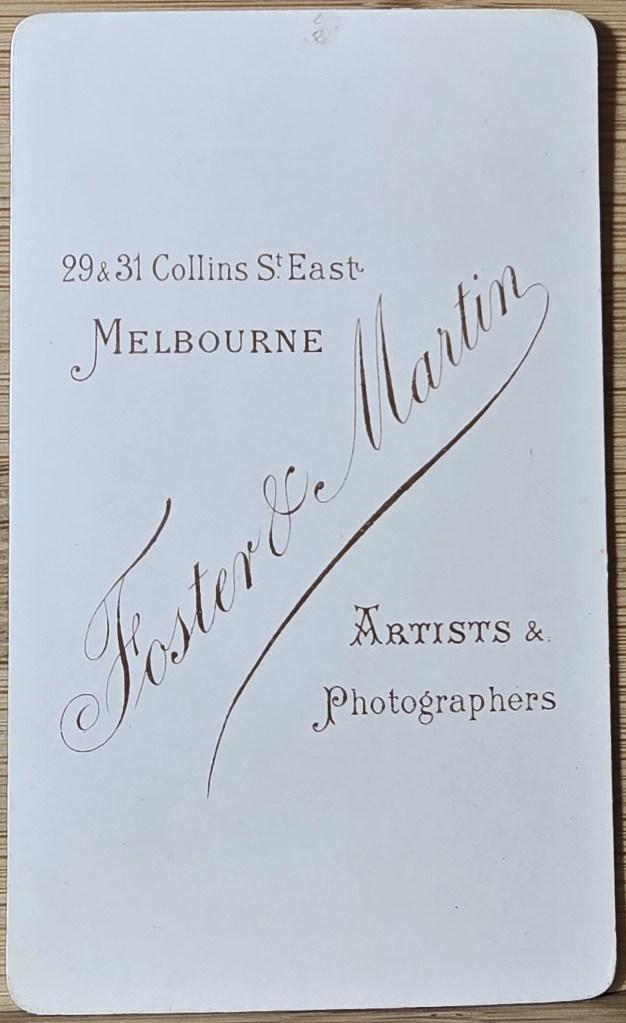
We may not know who this woman is but we can date the photo to 1881 with some confidence. According to “photoria.com.au” the reverse of this card displays the new Foster and Martin logo introduced at that time. The example they provide, shown below, matches ours perfectly.

https://photoria.com.au/portfolio/martin-eliza/
We can also give a date range on this particular photo now of between 1881 and 1890. This is because I just discovered that the firm ceased trading at the 29-31 Collins St address in 1890 and moved to 262-264 Collins St. They continued trading at this new site till 1900. https://photoria.com.au/portfolio/martin-eliza/
Martin by the way, was Eliza Russell Martin or Mrs Thomas Harrison. One of Australia’s pioneering woman photographers. Foster, was John Foster and they were in business together from 1877 -1900. https://trove.nla.gov.au/people/1821314
Wouldn’t it be amazing if we could confirm that this was in actual fact a photo of Helen. There is nothing to support my theory here just me bouncing it around. In 1881, Helen would have been 41 years of age and this woman looks to me about that vintage.
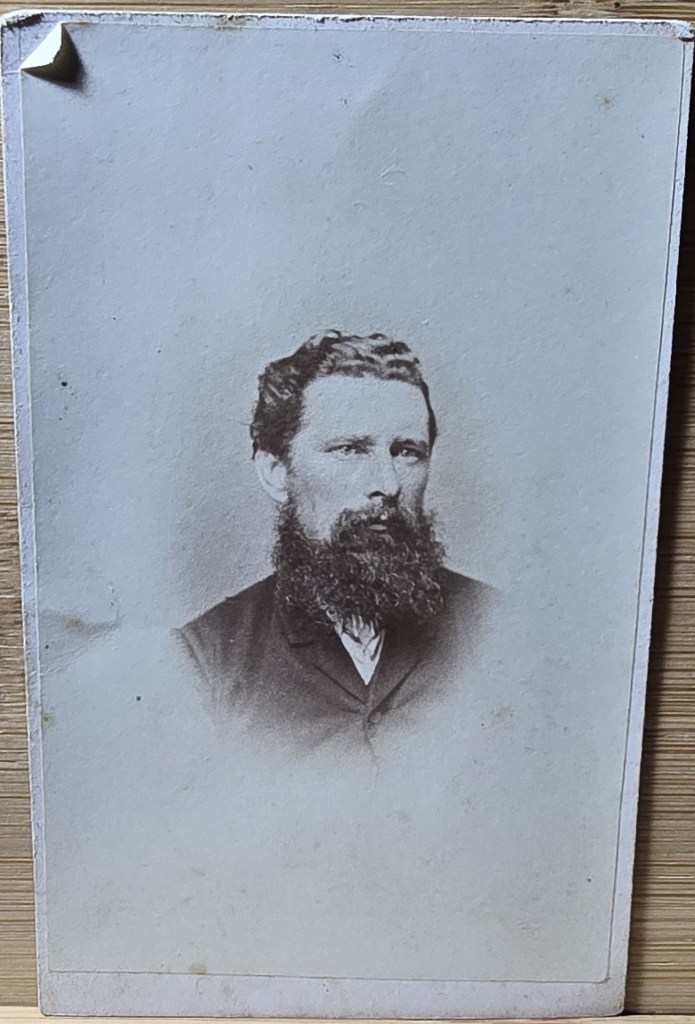

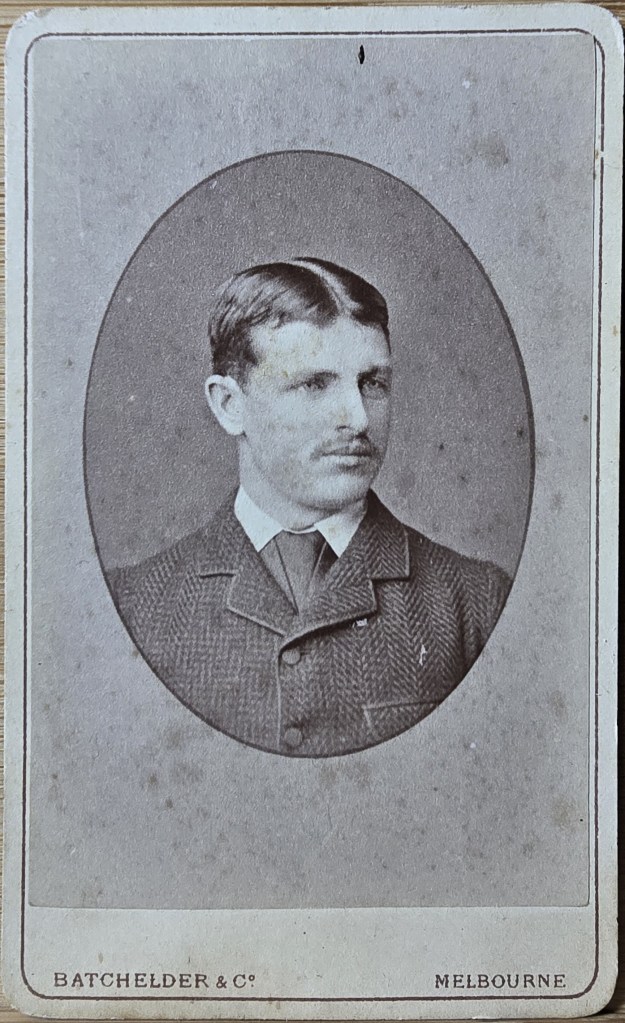
This guy above looks so familiar, I’m just willing some long faded writing to appear to tell us who it is. It hasn’t happened as yet.

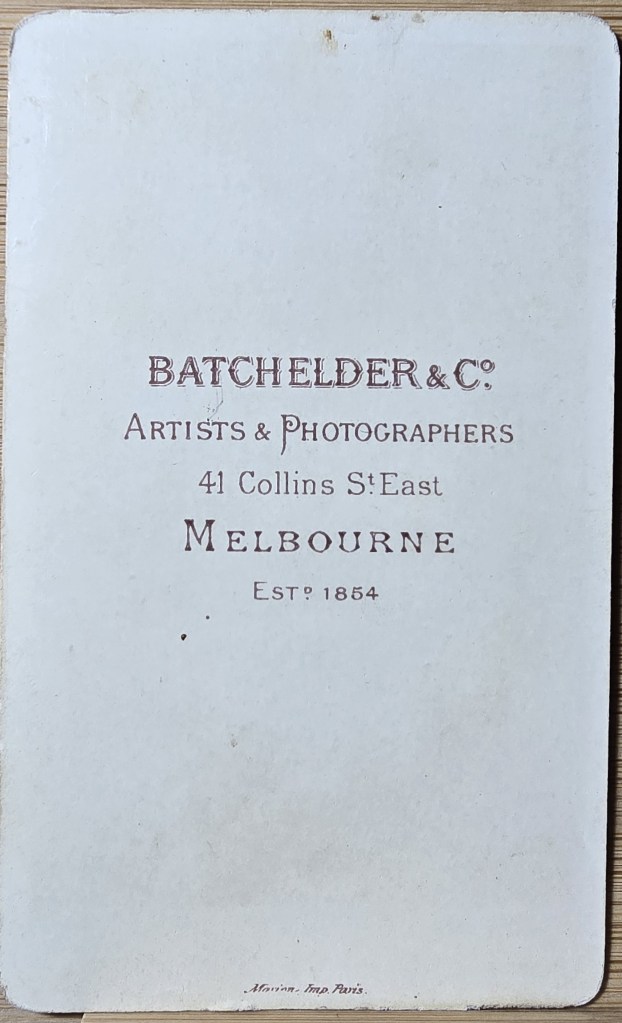
The Photographers, Batchelder & Co had been in business since 1854 and were still advertising as late as 1892, as shown below.

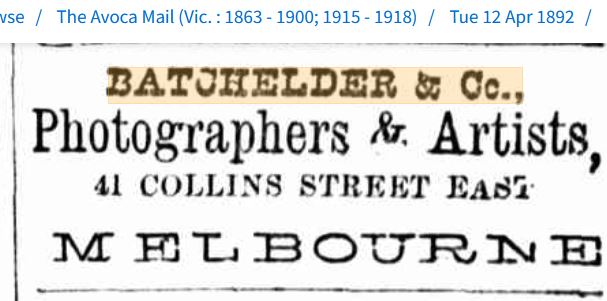
We can be a bit more specific with the dating thanks to an amazing online archive that a Dr Marcus Bunyan created. In his post for Artblart.com he shares that it was in early 1865 that Dunn, Wilson and Botterill, listed above on the photo, took over the business and continued trading with the Batchelder name at the 41 Collins Street premises. https://artblart.com/tag/early-australian-photography/
As for suggesting who this gentleman might be? I’ve got nothing. There were too many Macvean’s running around Melbourne at that time.
With the next photo, I’d suggest with my vast knowledge now gained from Googling, “Men’s Fashion, 1850s-1900s” that this next young gentleman is having his photo taken sometime in the mid to late 1880s. According to the “Fashion History Timeline” website most men’s jackets buttoned very high through this decade and featured a bow tie or knotted necktie. https://fashionhistory.fitnyc.edu/1880-1889/
I would suggest that this young man, if he is related, might be one of Helen and Peter’s nephews. A son of one of Peter’s siblings, Annie, Elizabeth, John Hugh, Allan, Hugh or John. Out of the remaining two sibling’s, Margaret Cameron’s three son’s were born too early, in the 1840s and 1850s and Mary Hill only had daughter’s so that puts her out of the picture too.
This next photo is an example of a Tintype or Ferrotype, popular from 1856 to around 1900. This particular photo is a “Gem” a postage stamp size Tintype. They were cheap to produce and popular with traveling photographers to regional areas. https://blogs.slv.vic.gov.au/family-matters/whos-that-girl-dating-a-19th-century-photograph/


This particular photo I’m pretty sure we can date. The first advertisement for Allen & Gove at the 95 Swanston Street address appears in November 1879 and the last is in February 1880.

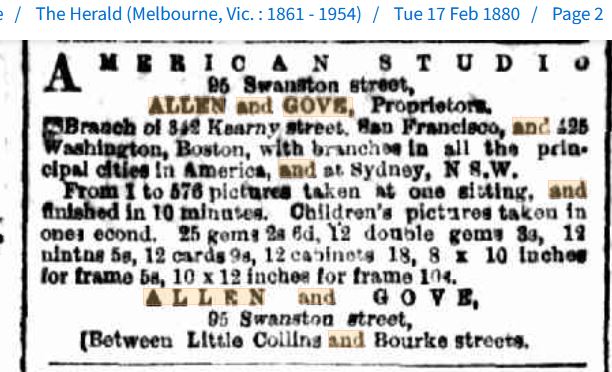
The firm then branched out to Williamstown, Bendigo and Kyneton. All their studios ceased trading by 1886. https://www.artgallery.nsw.gov.au/collection/works/506.2014/#about
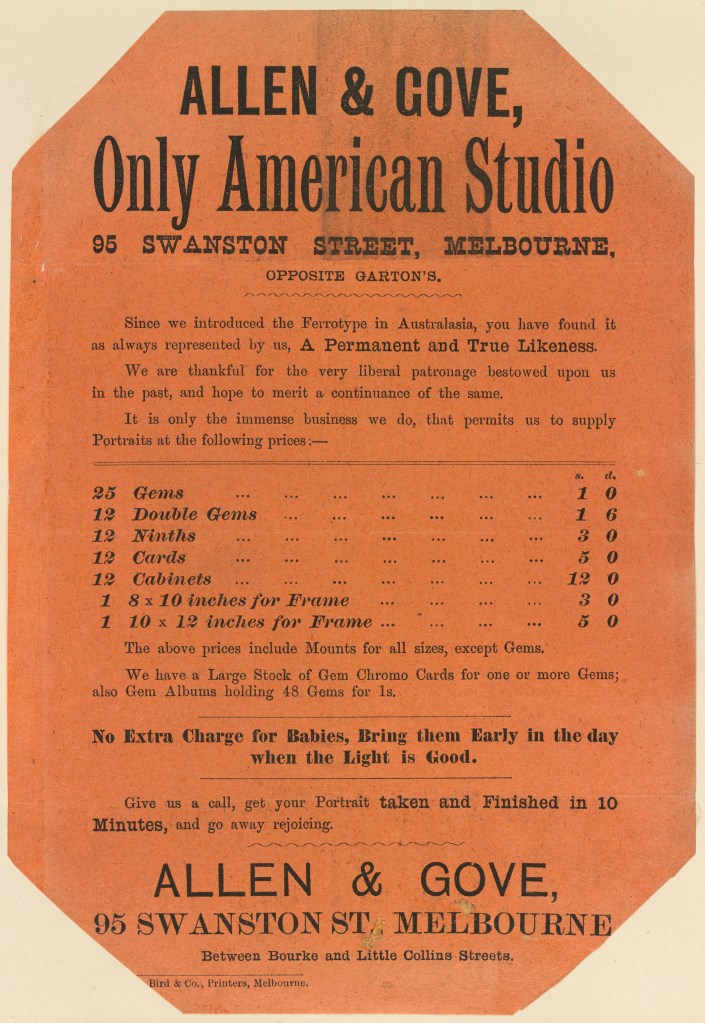
http://handle.slv.vic.gov.au/10381/246640
As for suggesting who this lady might be, perhaps Helen herself or her aunt, Elizabeth Hunter. Both are early 40s at the time. I was just comparing this lady’s face with that of the one in (Figure 6) and there could be a family resemblance.
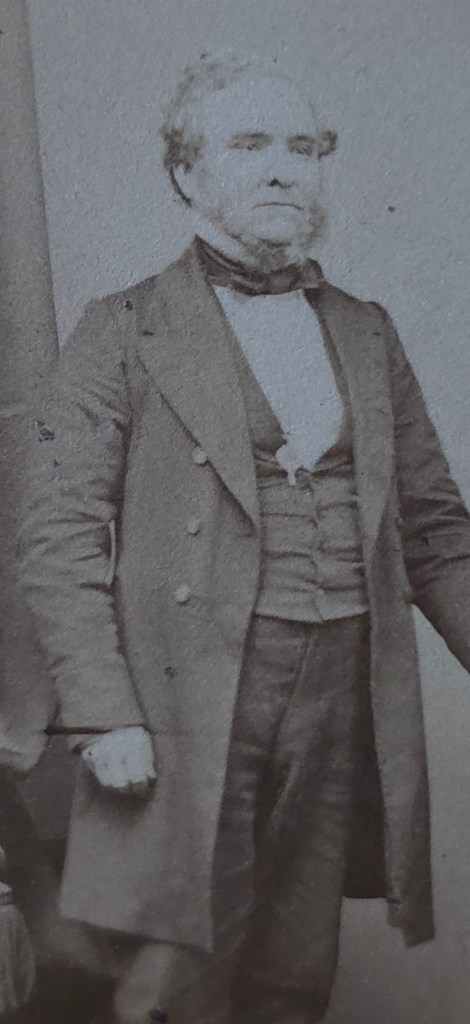
This next photo we can date quite specifically to somewhere between May 1862 – July 1885.

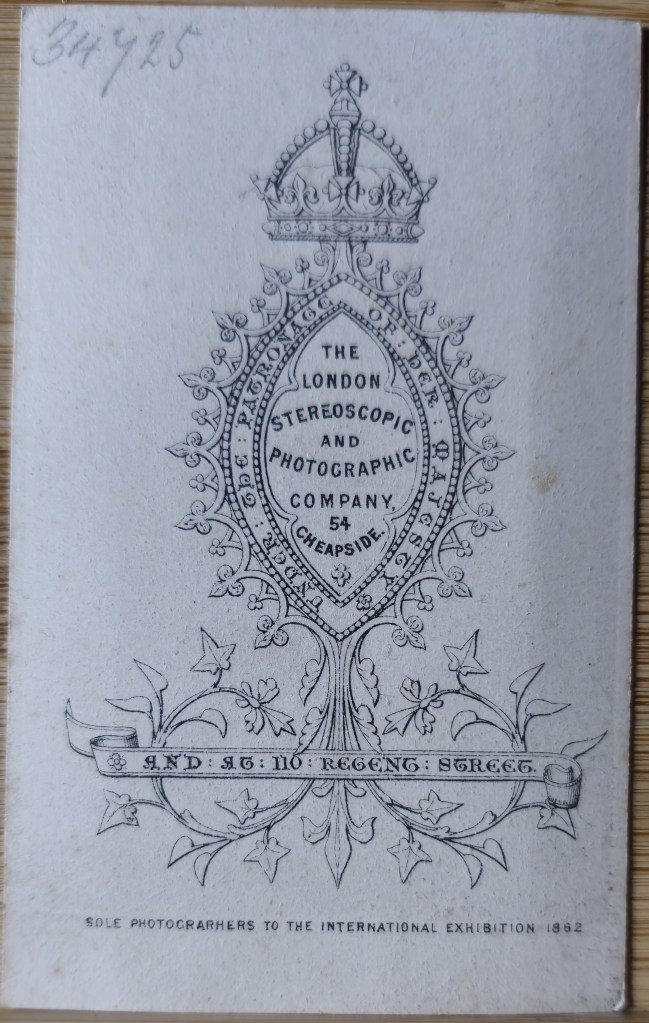
The reason for this specific dating? That small printed byline that the London Stereoscopic and Photographic Company, were the sole photographers to the International Exhibition in 1862.
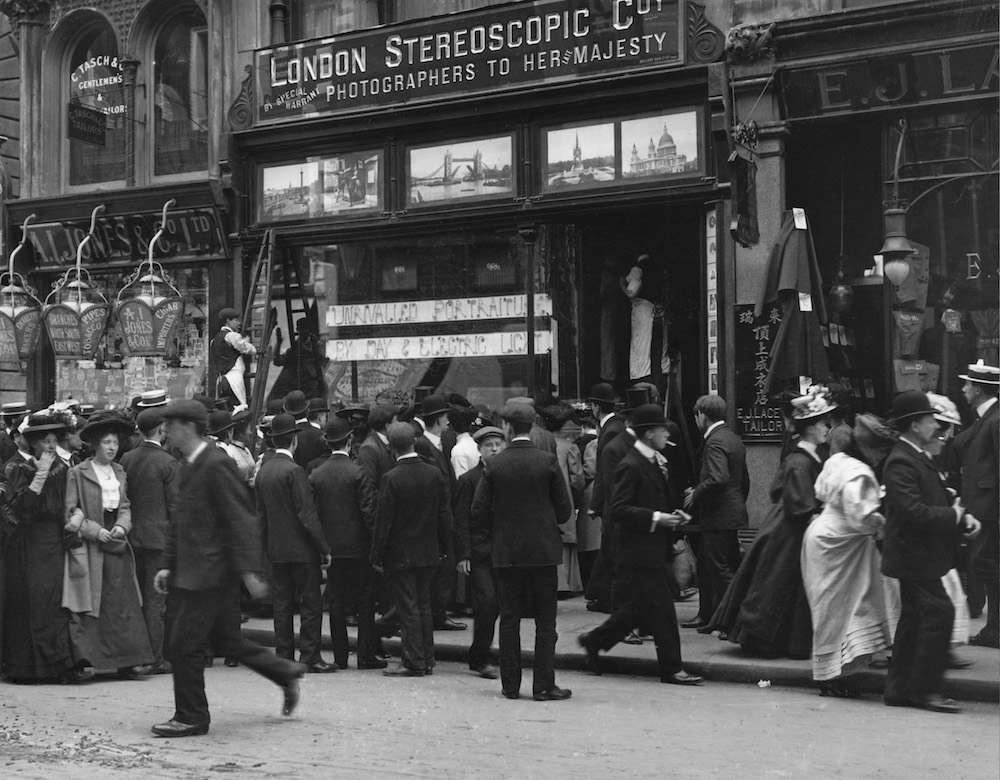
Figure 11a: Courtesy of Flashbak
https://flashbak.com/london-stereoscopic-company-2/
Yes I know, they could be advertising prior to the opening of the exhibition but I don’t think it would have been too much earlier. Plans for the exhibition only commenced in March 1858 when the Society of Arts first discussed their desire to have an exhibition in 1861. https://www.british-history.ac.uk/survey-london/vol38/pp137-147 So at most, three years earlier.
The end date comes from the fact that with the death of the owner, George Swan Nottage, the company became incorporated and changed it’s name to the London Stereoscopic and Photographic Co. Ltd. http://historiccamera.com/cgi-bin/librarium2/pm.cgi?action=app_display&app=datasheet&app_id=1857
And you can see that our photo does not have the Ltd added to the title of the company.
The suit shown in the photo also helps us to narrow down the dating even further. This particular style suggests that it is more likely to have been taken in the 1860s-1870s. Frock coats at this time tended to be a more generous cut with a full skirt and looser fit through the arms and chest. It is also a double breasted frock coat made popular at the time by Queen Victoria’s consort, Prince Albert. The cravat is also a good way to date the photo. Cravat’s had moved on from the elaborate neck embellishments of earlier decades and were now often styled into bow ties which grew in size by the mid 1860s, such as the example above. https://www.historicalemporium.com/mens-early-victorian-clothing.php
It still doesn’t answer who the man was but at least we now know where he was and at roughly what time period.
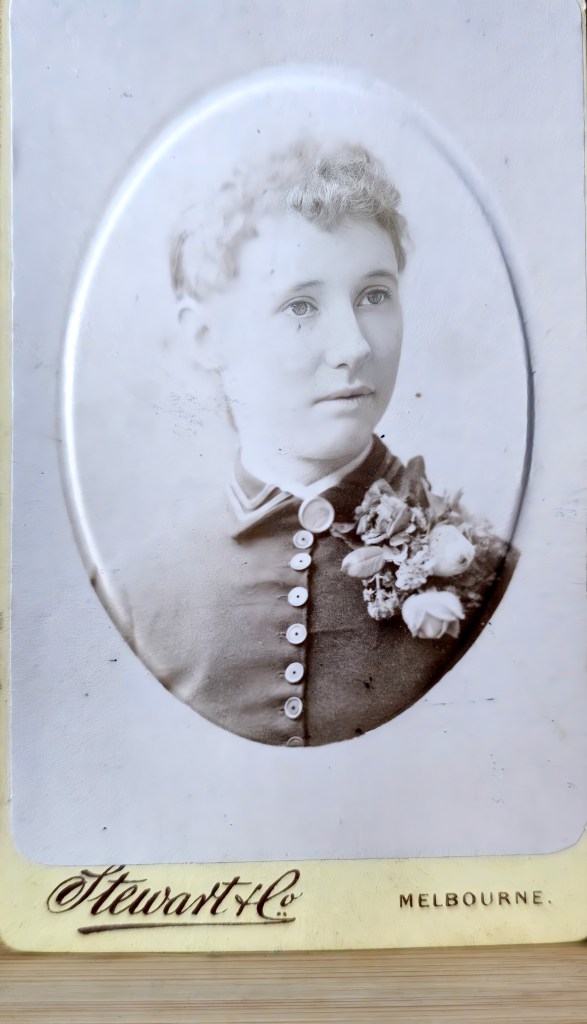
This next photo is a Stewart & Co from Melbourne creation.

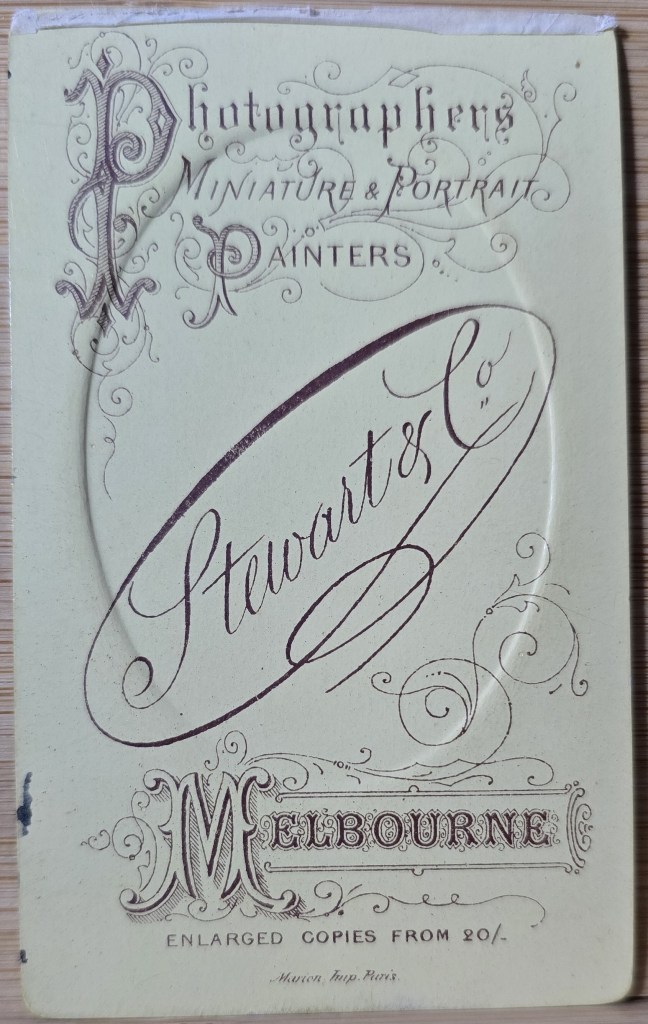
I tried this particular photo out on one of the new AI Photo Enhancer Apps, “YouCam Online Editor“. I think it did an amazing job clearing up the image.

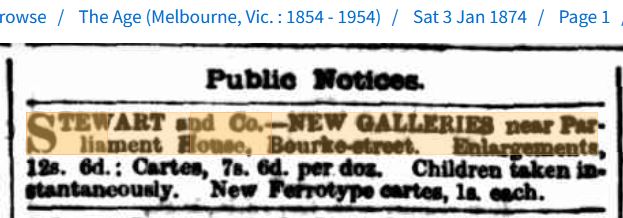
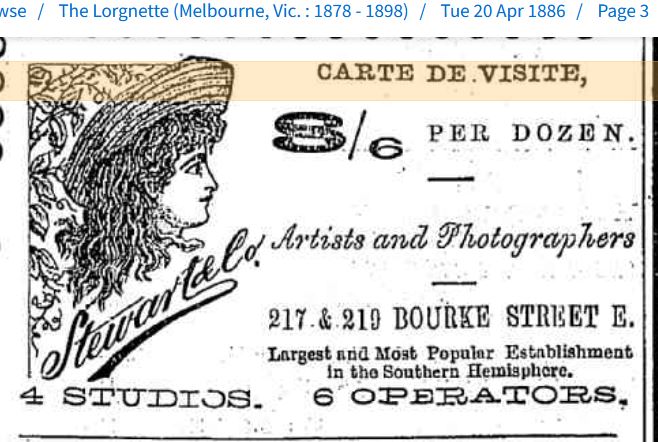
The first advertisement for Stewart and Co that I can find on Trove is in “The Age” from the 3rd of January 1874 and the last is in “The Lorgnette” on the 20th of April 1886.
The hair style this young lady is wearing also helps with dating. It is a widely held view that this type of hair style became popular in the 1880s. It was often referred to as the “Alexandra Fringe” after Princess Alexandra of Denmark, the Princess of Wales and future Queen of England. https://en.wikipedia.org/wiki/Bangs_(hair)

Figure 14c: Courtesy of Pinterest
https://www.pinterest.com.au/pin/378583912416631549/
These next three sets of photos are fantastic as they are obviously of the same family members but there is not one hint of information on where they were or who they might have been. Damn!

In terms of dating these photos, the hair style of the Mum doesn’t help us much. The center part pulled back in a bun had been in fashion since Queen Victoria took the throne and continued in fashion until the early 1880s. https://www.whizzpast.com/victorian-hairstyles-a-short-history-in-photos/


Her dress however is much more useful at dating these photos. According to the Fashion History website again, the location of women’s waistlines moved higher during the mid 1860s creating a short waisted effect, such as above. The other factor that helps with dating is that around the same time it became common for the topmost skirt layer to be drawn up to reveal the underskirt or petticoat layer. Again clearly seen on this dress. https://fashionhistory.fitnyc.edu/1860-1869/
We have to make mention of the hat and the handbag, they are fantastic. I bet they were prized possessions.
I’m calling this next guy the “Grandad”, he is the first smile we have seen so far apart from the slight smirk of the “Mum” in the family photo above. What a character!
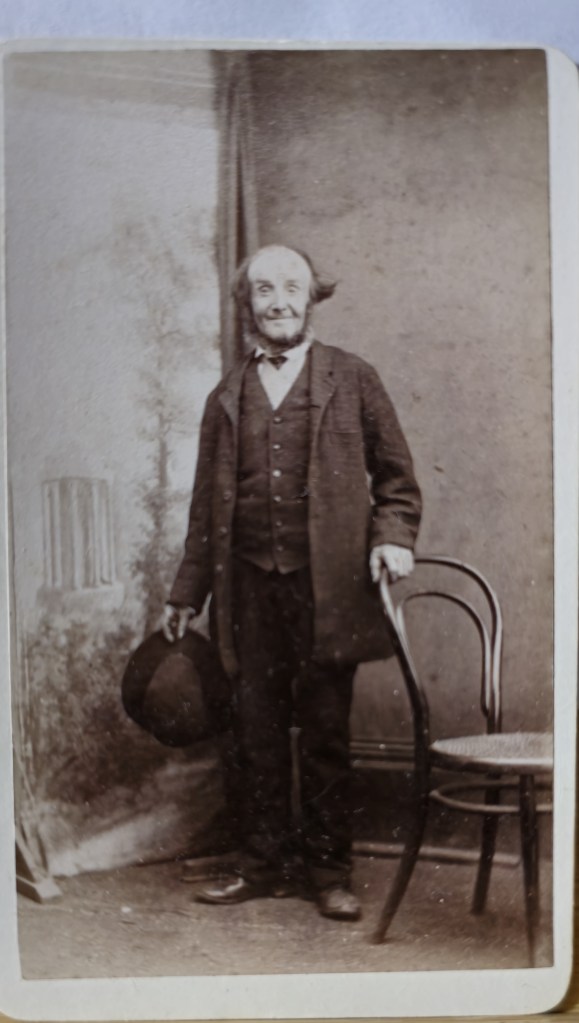
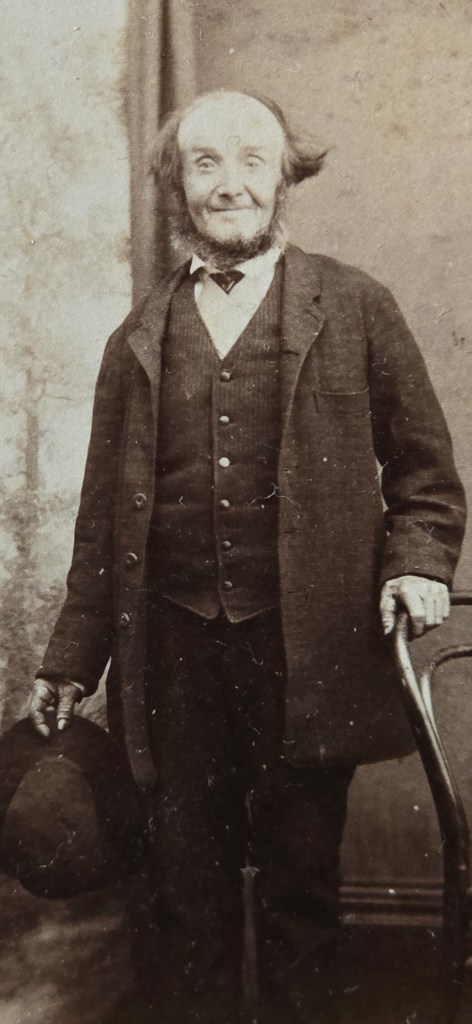
This next gentleman, wow, what a pose and what a look. Again we have no photographers mark or place name to go by but the look gives me “Plantation Owner” vibes.
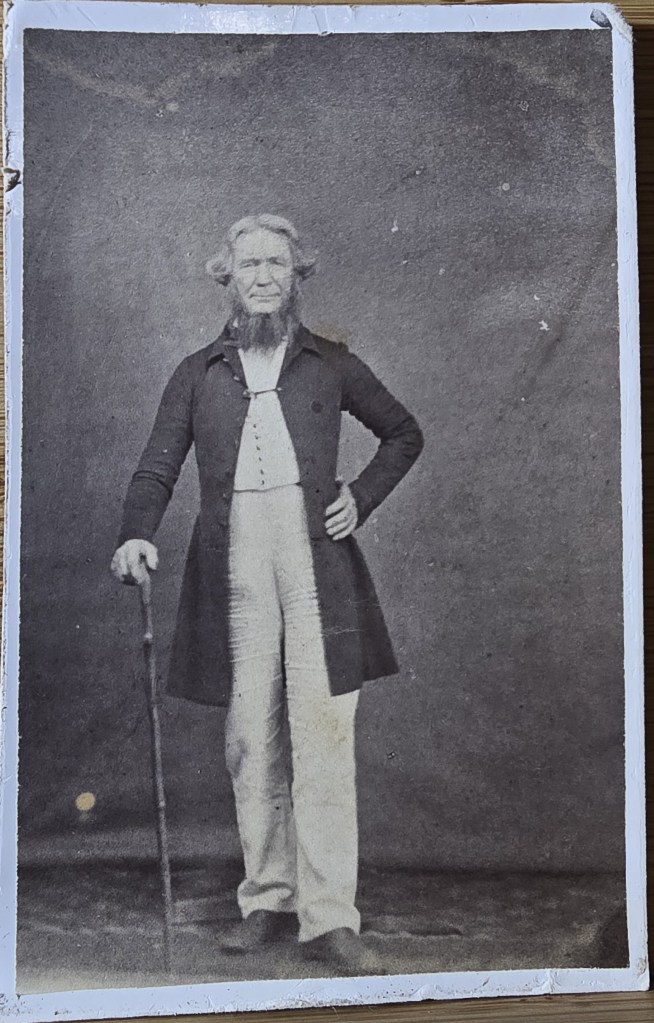
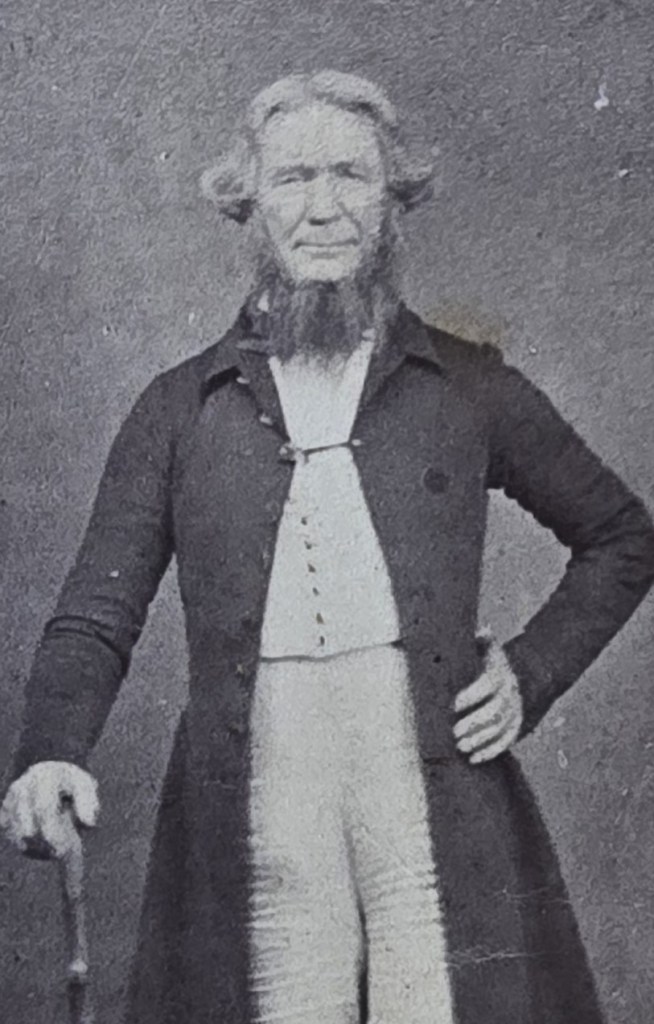
I have nothing to back this up but I’m wondering, could this be a photograph of Helen’s father, Thomas Griffith (1805-1848). I know he is only 43 years of age when he dies and the question is, could this bloke pass for that age?
Don’t forget, he was a Plantation owner on an island in the Caribbean, Saint Croix (Kroy). On close inspection of the face on the right, it doesn’t appear old to me but more rugged and worn. Also when I did a bit of digging on life expectancy for the 1850s I found figures confirming for a male at that time life expectancy was 40 years of age. Wow. https://www.statista.com/statistics/1040159/life-expectancy-united-kingdom-all-time/
The clothes of this gentleman also places him firmly in the era of the 1840s to 1850s. He is sporting the frock coat of the era defined by its waistline seam at the back and full skirts hanging to just above the knee. https://fashionhistory.fitnyc.edu/1840-1849/
Following are two fantastic examples that confirm the time period for us. The first is actually an outfit housed in the Los Angeles County Museum of Art. It is an unknown designer from Northern Ireland. Ca. 1852
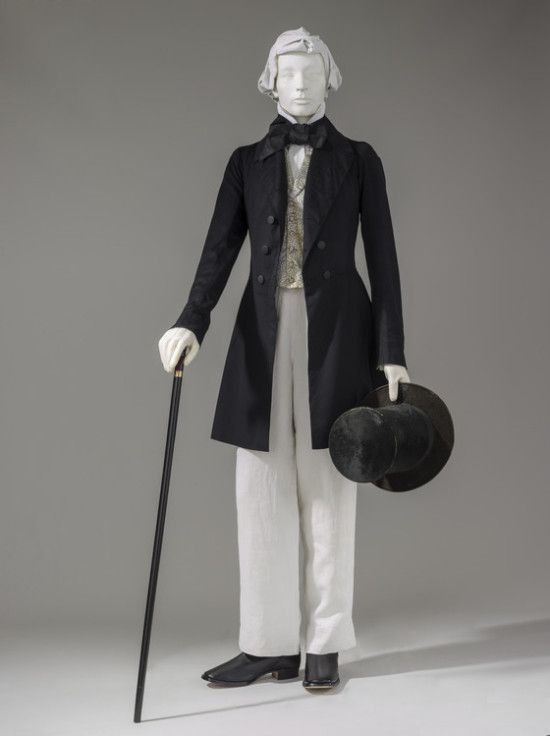
Figure 18a: Courtesy of Los Angeles County Museum of Art
https://collections.lacma.org/node/220990
What a match to our gentleman in (Figure 18). You can see that behind his beard is the stiff white collar and bow tie.
The next example is a fantastic photo of french poet and dramatist, Fléix Arvers (1806-1850) this photo was taken sometime in the late 1840s. The outfit is a perfect match for the time period and Felix is a definite contemporary of Thomas’s with their birth and death dates within a couple of years of each other. But comparing Felix’s image to our potential Thomas’s image above, I think it has just blown my theory, of this being Helen’s dad, out of the water.

https://geudensherman.wordpress.com/2021/07/05/felix-arvers-1806-1850/
No photographer’s name or business address is marked on this next photo either. In terms of dating, this lady’s clothing helps us tremendously again. By the 1850s the dropped waistline of the 1840s had risen to the natural position of the waist as you can see in the photo, this ladies belt buckle is sitting right at that line. A high neckline coupled with a wide white collar is what distinguished the day dresses of this era, just like our lady is wearing. https://fashionhistory.fitnyc.edu/1850-1859/


I think with the information I have gathered so far on dating photos we might be able to hazard a good guess at when this young lady below might have sat for her portrait. The 1850s- early 1860s. She is sporting the classic look in her dress of these decades with the drooping shoulders, small waist and voluminous skirt. Another interesting design that helps date this photo is the bodice decoration. It is the “…V shaped “bretelles” that spread from the center of the waist to the outer edges of the dropped shoulders.” https://fashionhistory.fitnyc.edu/1850-1859/
These “bretelles” can clearly be seen on the bodice of this young lady.

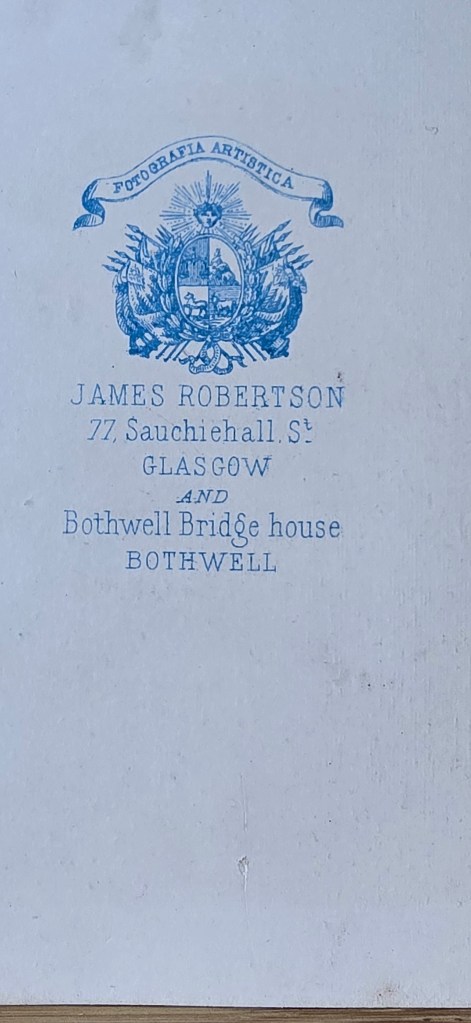
The photographer, James Robertson according to the National Portrait Gallery in the UK was active between the years of 1859- 1875. https://www.npg.org.uk/collections/search/person/mp82158/james-robertson?role=art
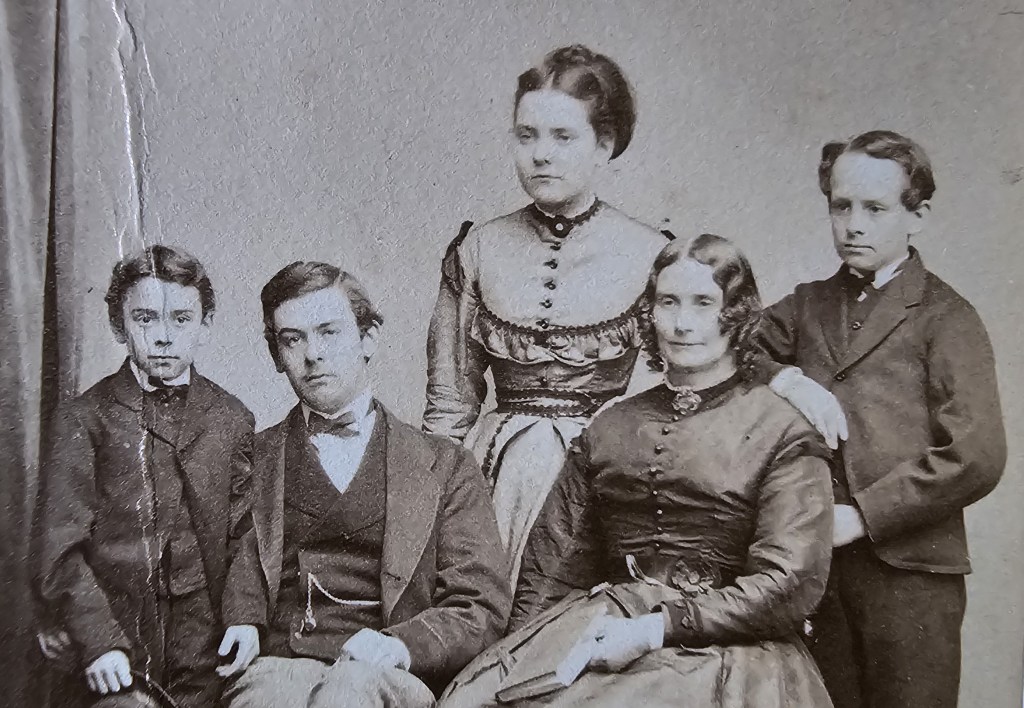
This next photo is also a real surprise. In regards to the Macvean side of the family I haven’t come across anyone from Cardiff, in Wales, so I can’t even hazard a guess as to who this family might be.
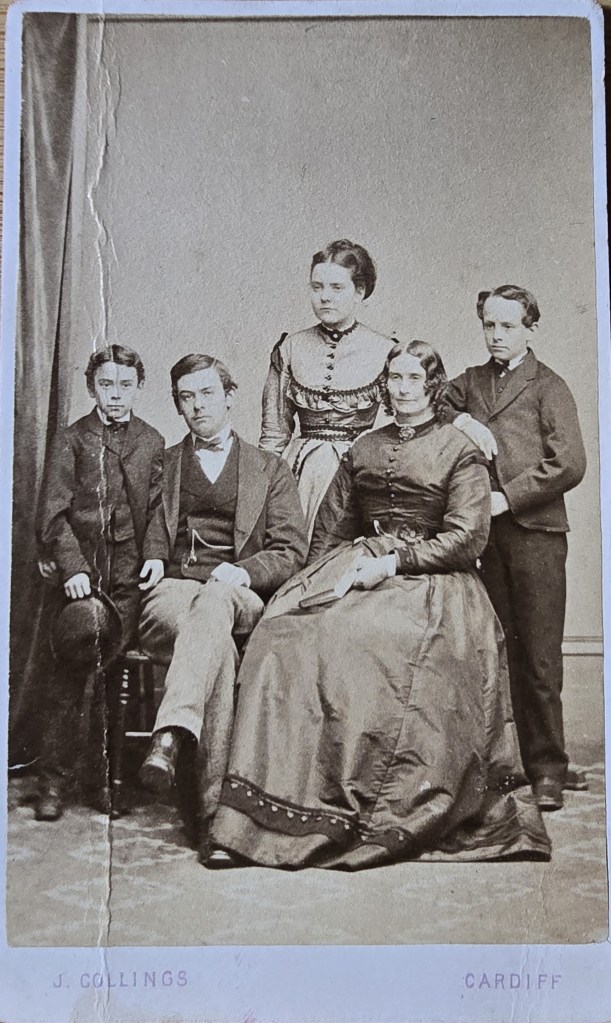
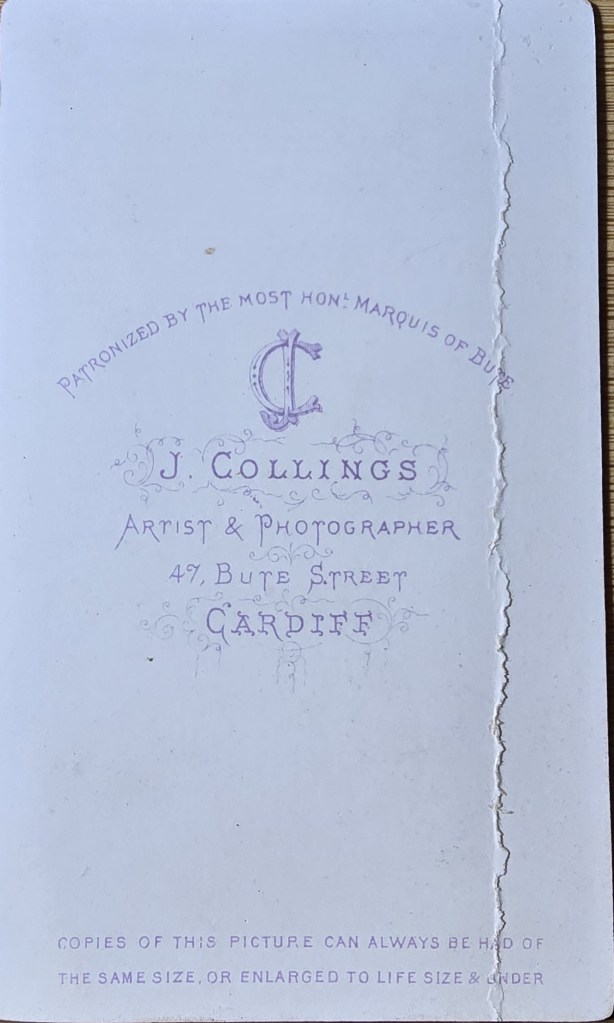

J Collings, the photographer, was Mr Joseph Collings and was a renowned photographer in the Cardiff area because of his high quality large format views of Cardiff. http://penarth-dock.org.uk/01_03_160_01.html


http://www.penarth-dock.org.uk/01_03_03_03.html
He was professionally active from the early 1860s until his death in 1875 when his wife took over the business. http://www.penarth-dock.org.uk/01_03_03_03.html
With our next photo we are back to Stewart and Co and as we have already discussed, they were advertising from 1874 so we can date this lady’s photo from then. She is also sporting that drooping shoulder line from the 1860’s that obviously held on till the 1870’s.

I just read of another interesting factor that can help with dating an old photo like this and I think it definitely holds for this lady above. Apparently it was common for more mature women in the 1870s to wear their hair higher on the back of the head coupled with a few ringlets draping down and framing the face. https://vintagedancer.com/victorian/victorian-hairstyles-1840-1890/


Joseph Youdale was a photographer who was based in West Maitland for about 25 years. After a number of financial and personal tragedies, such as the death of his wife and son he ends up remarrying and living in Victoria for about 10 years in the 1880s. https://trove.nla.gov.au/newspaper/article/155386491?searchTerm=%22joseph%20Youdale%22
Perhaps it is in this time that this young potential Macvean relative has their portrait taken by Joseph.
Even though we don’t know who this next young lady is we can date this particular photo to a very narrow time period thanks to the photographer’s details.


You can just make out on the back of the photo, printed diagonally, “Bardwell Melbourne”. This refers to Mr William Bardwell who initially operated a studio from Ballarat but then moved to Melbourne in 1876.
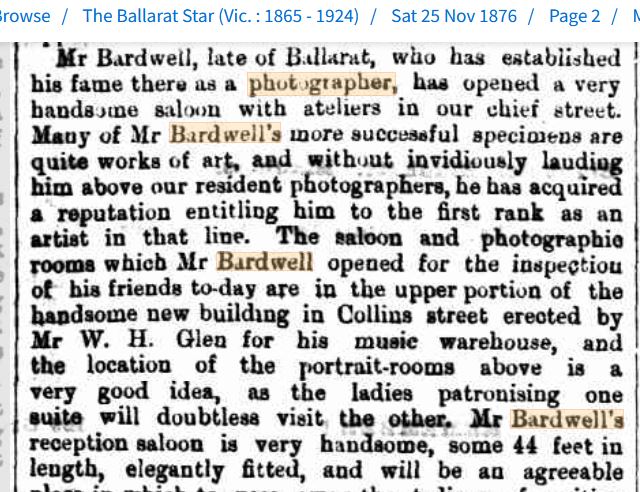
Unfortunately William’s Collins Street studio doesn’t last very long and hence the reason we can be so specific with the dating range on this lady’s photo. William goes bankrupt at the end of 1879 after a number of disastrous financial decisions. That narrow time period is four years, 1876- 1879.
I’m just going to put it out there with this next one, I wonder if this might be a photo of Helen? My thinking below.

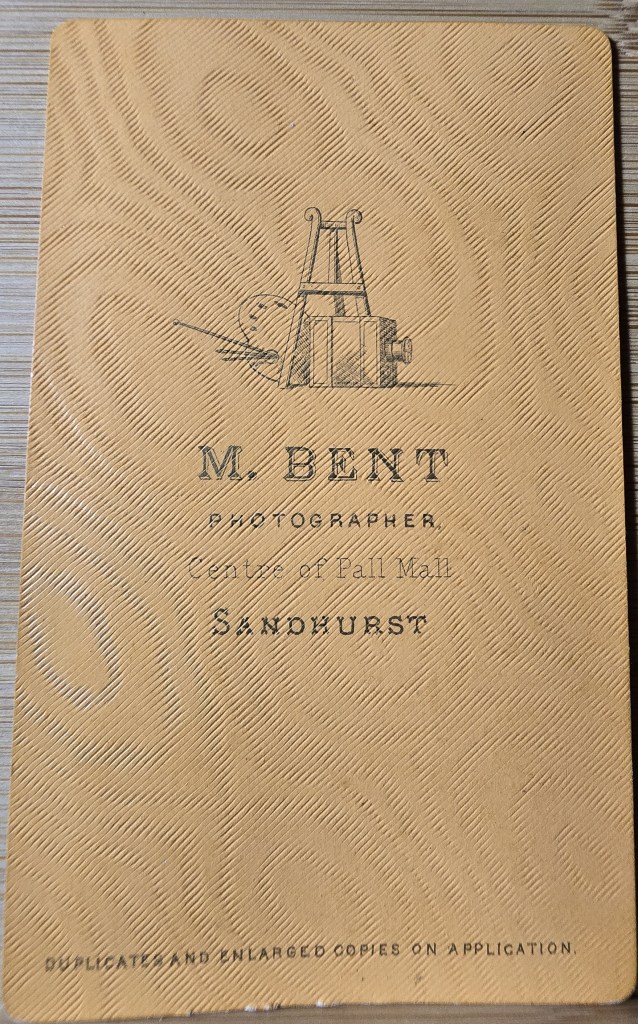
This women is clearly showing off the wedding ring on her right hand. The photographer, M. Bent was Mr William Mariner Bent and Sandhurst was the original name for the Victorian town of Bendigo. Wedderburn where Helen and Peter were living, is just 50 miles to the north west of Sandhurst.

I could imagine that Sandhurst (Bendigo) would have been their go to town in the region to get their supplies and to visit the local photographic studio.
With regards to dating this photo, first off Mr Bent is operating under this name, “M. Bent” as printed on the back of the photo from 1872 and then the last advert I can find for him on Trove is from April 1887. So that is a period of 15 years that he is professional active for in Sandhurst.


And look what I found, the most fantastic photo of Pall Mall from exactly the time that Helen and Peter would have been visiting. Mr Bent’s studio is roughly in the area of the very farthest building at the other end of the road.

Figure 25d: Courtesy of State Library of New South Wales
https://printshop.sl.nsw.gov.au/pall-mall-sandhurst-bendigo-1874/
The other thing that helps us with dating this photo and suggesting that it might be Helen, is the fashion. You can clearly see that the dress this woman is wearing falls much flatter on the front of the body and the volume of the petticoats is now focused in the back. These are well known traits of women’s fashion from the mid 1870s and developing through out the decade resulting in the bustle. https://fashionhistory.fitnyc.edu/1870-1879/
My final thought in thinking this might be Helen is that at the beginning of the 1870s Helen is 30 years of age. I don’t think it is a stretch to suggest that this woman looks like she could be in her 30s.
This next photo takes us back to Mr Ahlborn in Dublin and although I couldn’t confirm a date range of his operation apart from that one advert from 1863 I think this photograph is much earlier.
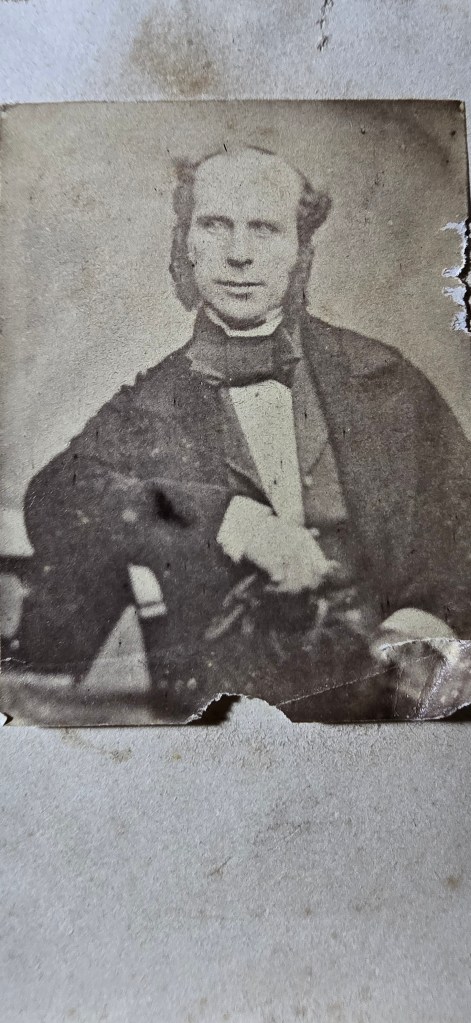

This photo has a mottled and grainy quality to it and these are classic examples of a Calotype, an early photographic technique that used paper coated with silver iodide. https://www.britannica.com/technology/calotype
It was introduced in 1841 by William Henry Fox Talbot and used up until 1860. The paper used is quite rough and has a matte finished to it which is definitely how I would describe this particular photo. https://blogs.slv.vic.gov.au/family-matters/whos-that-girl-dating-a-19th-century-photograph/
As to who it might be? Maybe Helen’s father, Thomas on a trip back from St Croix to Ireland. He certainly appears to be a better match age wise for Thomas than the man in (Figure 18) Or perhaps it is her maternal Uncle, Thomas Hunter married to Essie who I thought might be the woman in (Figure 5).
With this next photo, we now know from our earlier discussion that this is an example of Foster & Martin’s later photographer’s details used from 1881. So we can confidently say that this woman is sitting for this photo sometime after that date.

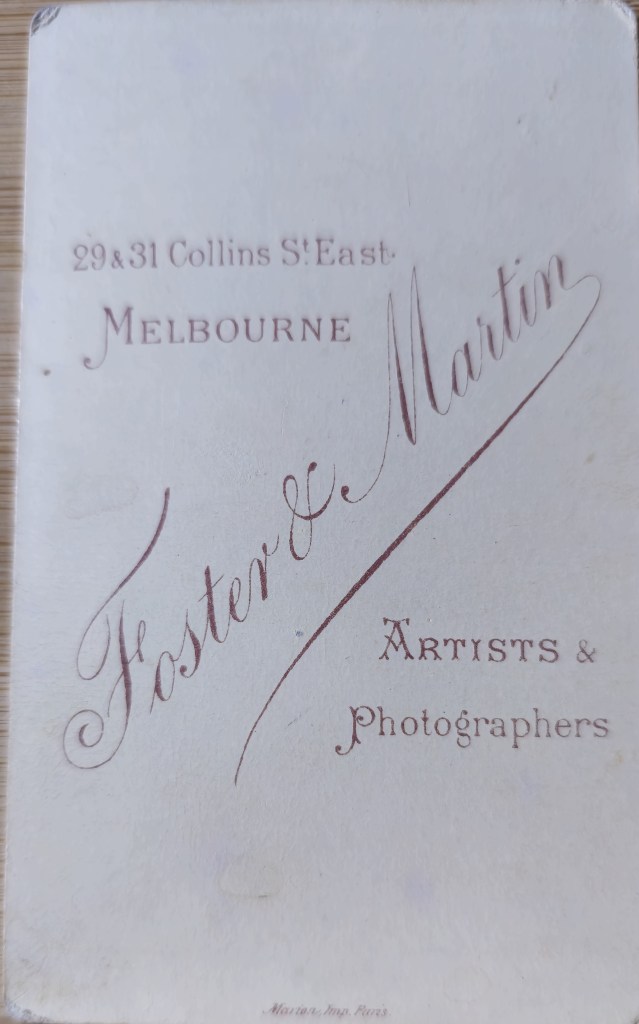
This lady is also sporting the “Alexandra Fringe”. I think she also has a distinct resemblance to one of the Rev. Allan and Catherine Macvean’s daughters.


Figure 27a: Courtesy of the Macvean Family Archives Generously shared by Sally M (Cousin)
This photo of the dog following, is really just a scrap of paper stuck to a piece of what I would imagine is a part of the original photo album’s pages. There of course is no way to know when or where this was taken but putting my imagination to work again I wonder if this might be a photo of a favored dog of Helen and Peter’s.
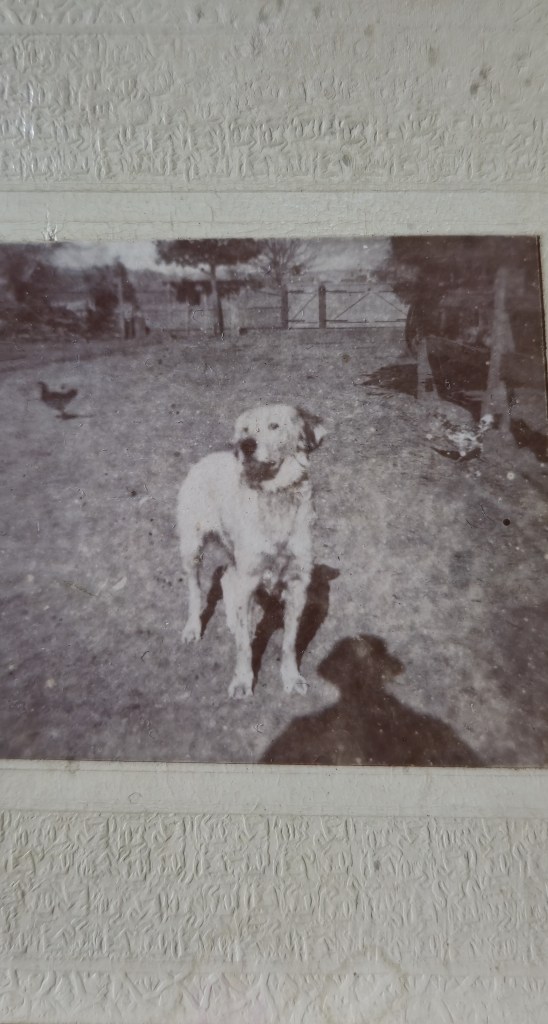
You might be wondering how did Helen and Peter manage to capture this image, as at the time camera’s used cumbersome glass plate negatives. I think the shadow above gives us a clue. That looks like someone holding something against their chest to take the image.

Yes, George Eastman the founder of Kodak had invented the Kodak No 1 Camera, that was lightweight, held in the hands and used a roll of flexible plastic film. https://museumsvictoria.com.au/article/the-cameras-that-brought-photography-to-the-people/
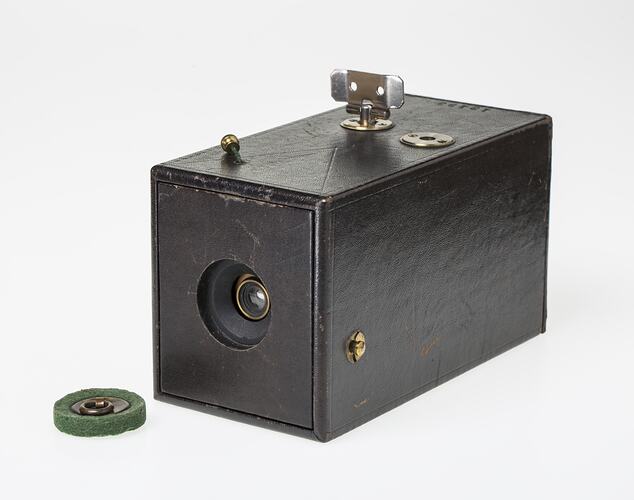
Figure 28b: Courtesy of Museums Victoria https://museumsvictoria.com.au/article/the-cameras-that-brought-photography-to-the-people/
I also wonder if the ghost image of the home that can just be made out at the very top of the photo, might be of the Homestead that Peter and Helen lived at. Torpichen Station, just outside of Wedderburn.
I went searching to see if I might be able to find where the property was situated and wow talk about lucky. I found it on the first map I came across on the State Library Victoria’s site.

Figure 28a: Courtesy of State Library of Victoria
http://handle.slv.vic.gov.au/10381/140349
These lands Peter was holding, are the traditional lands of the Dja Dja Wurrung People who have cared for this land over many thousands of years. https://djadjawurrung.com.au/
You will notice the original lessee’s name, D. Peters, well he sold the property in 1862 to my 3x great-grandfather, John Hugh Macvean, Peter’s brother.

John must have passed it on or sold it to Peter sometime after that and before his and Helen’s wedding in 1867 as their marriage notice stated that Peter was from Torpichen Station.
We can once again be very specific on the dating of this next photo thanks to the details printed on the back.
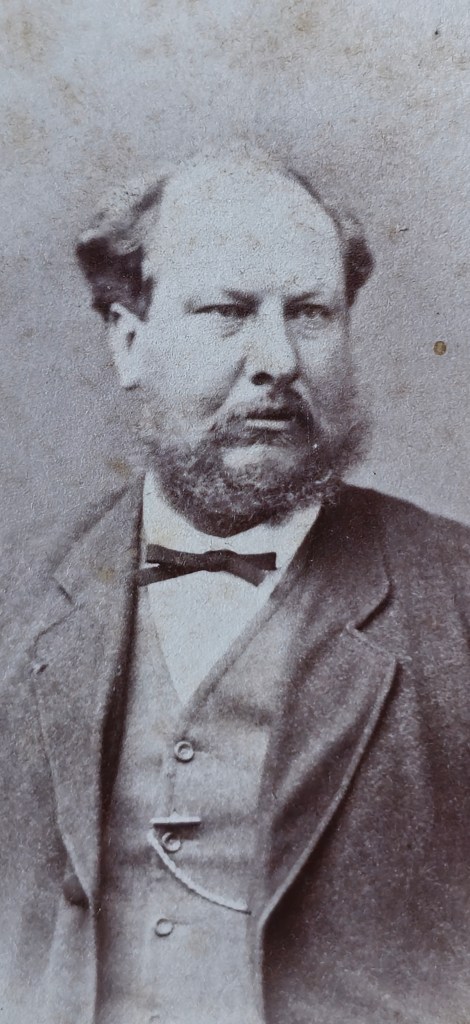
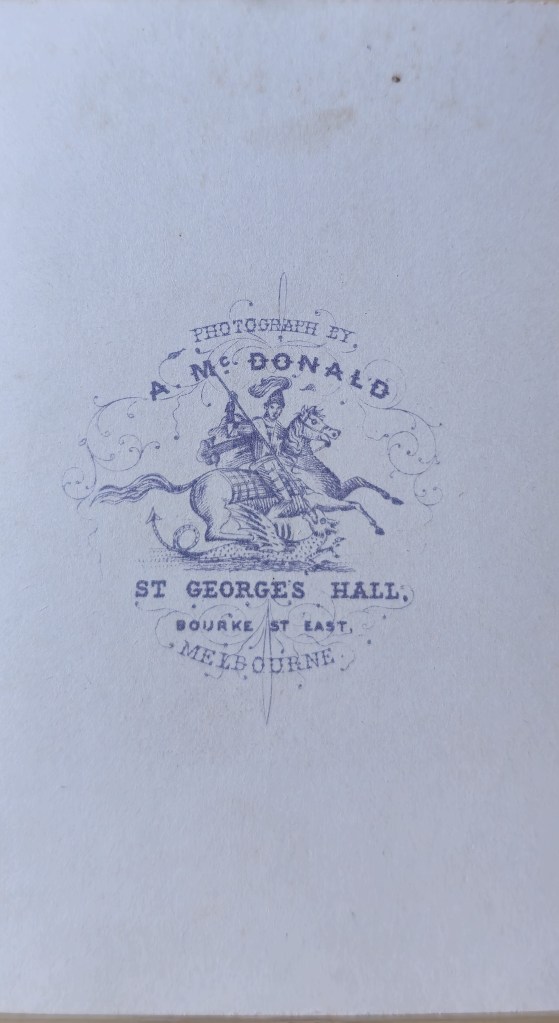
“A McDonald” was Mr Archibald McDonald and after arriving in Australia in 1842 and being involved in a number of professional partnerships, he sets up his own studio in St George’s Hall in Bourke Street in 1864. Archibald was still operating from these premises when he died in 1873. https://artblart.com/tag/st-georges-hall-photographic-co/
So this potential Macvean relative (and he so has that Macvean look in my opinion) was sitting for this portrait somewhere in that nine year period. Perhaps it might even be Peter Macvean we are looking at. Peter was early 30s to mid 40s in that time frame. If Peter was sitting for this portrait at the later end of that nine years, in the early 1870s this could fit with the apparent age of this bloke above.
Here is the only known photo we have of Peter for comparison.

Generously shared by Sally M (Cousin)
We last discussed Mr Joseph Youdale back in relation to the child in (Figure 23) since then I have found out a little more about Joseph that might help to date these next two photos.
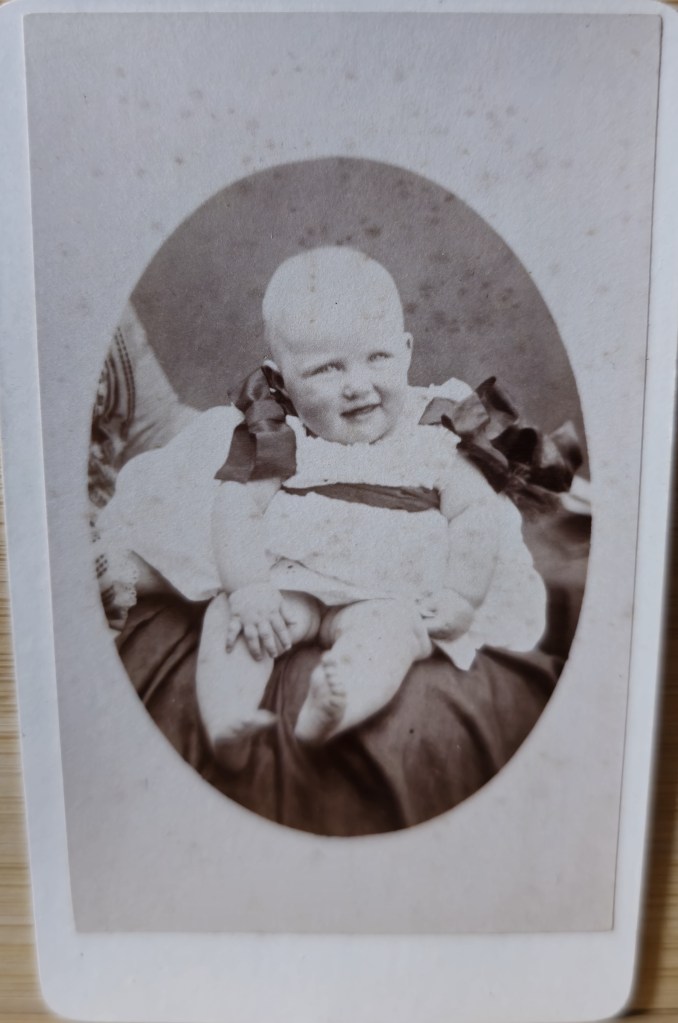

Joseph remarries in 1882 to a Miss Elizabeth Latimer but then he disappears from print until July 1886 when he turns up advertising a photographic business in Shepparton, Victoria. The advert from July 1886 in Trove is very faded so I have put this one in from December of the same year as an example. His last advert is in July 1887 and it is exactly the same copy as shown below.

Shepparton has me stumped. It is 115 miles to the east of Wedderburn and even though Joseph states he takes views “…in town or country“, I can’t imagine that he would have traveled this far to take photos.
Maybe this guy might be the father of the smiling baby above.
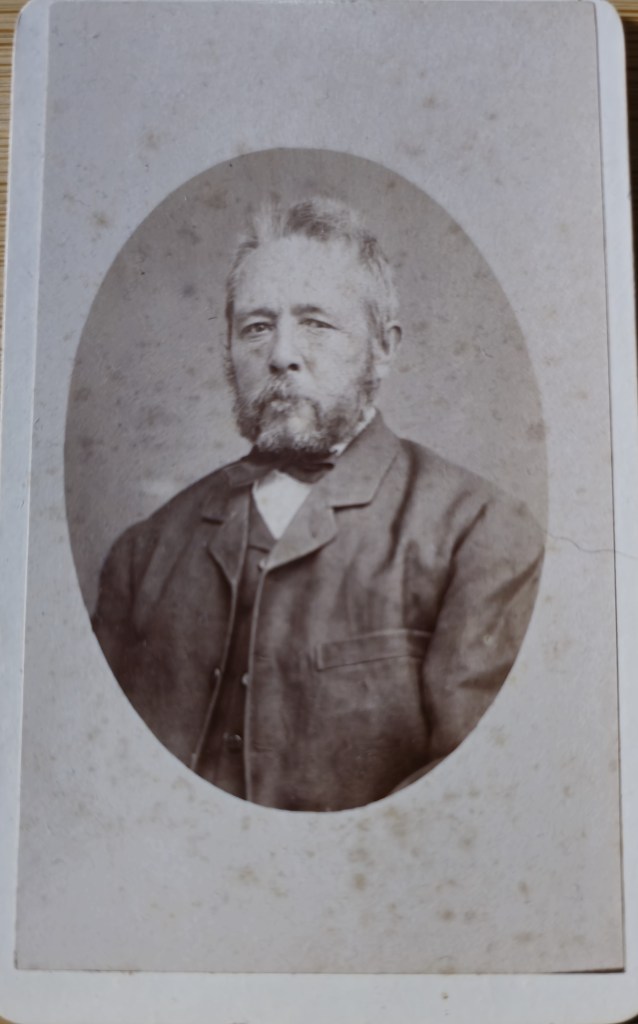

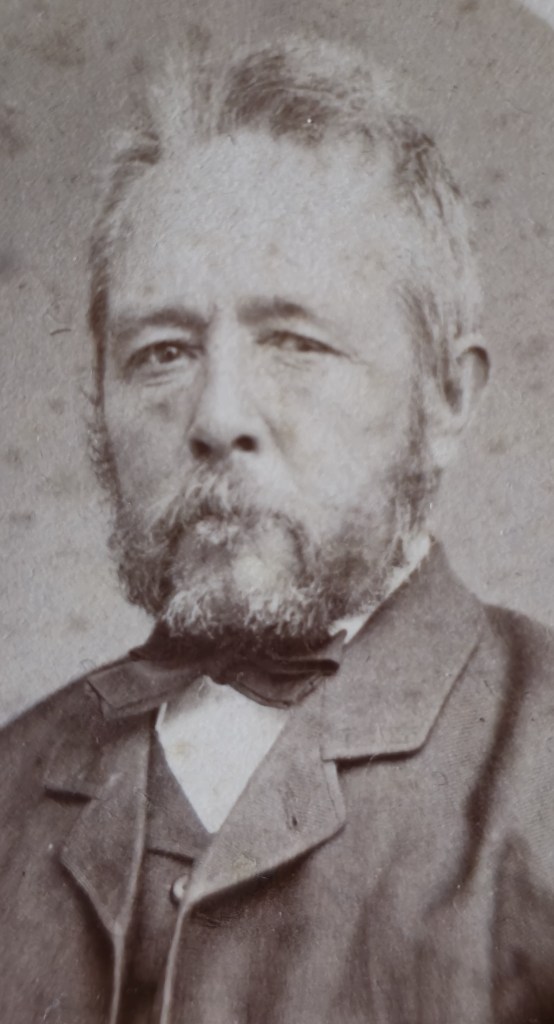
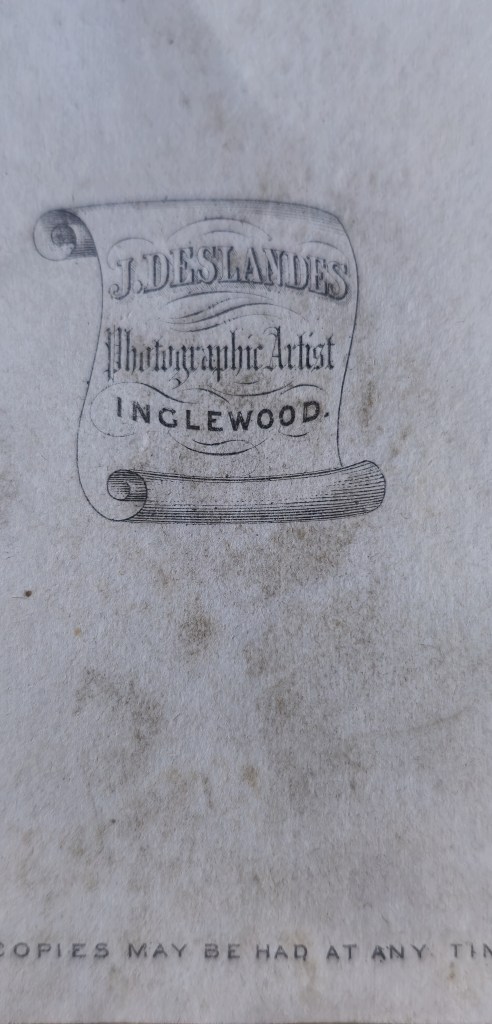
The photographer, of our next photo, John Deslandes was professionally active from around 1866 and based in Inglewood, Victoria. https://auctions.leski.com.au/lot-details/index/catalog/494/lot/146521/DESLANDES-John-VICTORIAN-GOLD-RUSH-Carte-de-visite-format-albumen-print-photograph-of-a-gold-nugget
I think we can probably guess at the range of dates John was operating professionally between, thanks to this next article I found in Trove.

Bankruptcy seems to have been the killer of John’s business as there are no further advertisements for him after this time. So this next gentleman is sitting for this portrait somewhere between 1866 and 1878.

Inglewood is just 19 miles to the south east of Wedderburn and I have a candidate for who this gentleman might be.
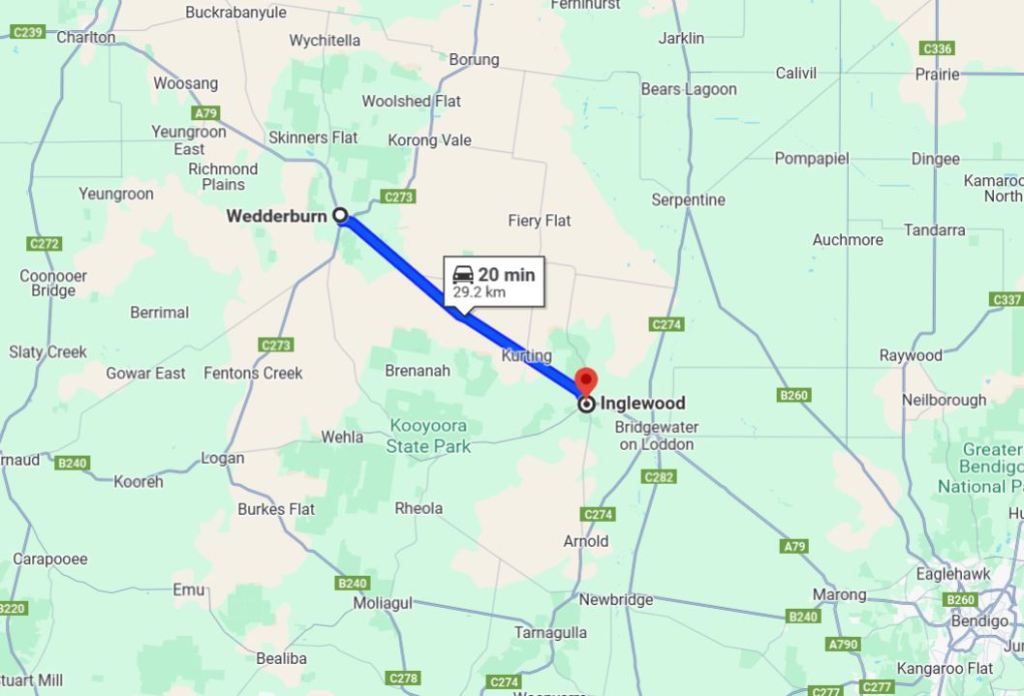
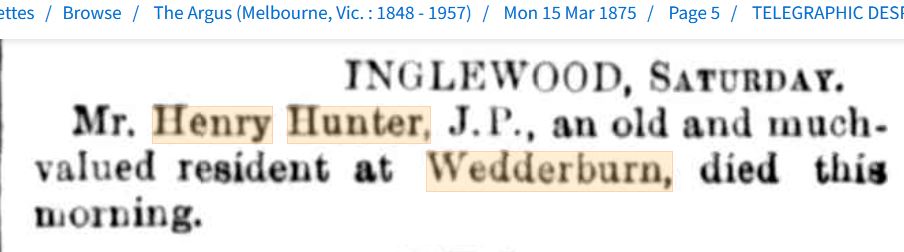
Mr Henry Hunter, Helen’s uncle. Henry was brother to Mary Anne Hunter, Helen’s mother. He is 46 years of age in 1866 and this man in the photo looks like he could be in his 40s. Henry is also mentioned in Helen and Peter’s wedding notice, as it is his home that they marry in.

Would you believe, State Library of Victoria had a photograph of Henry’s home in their collection.

Figure 32c: Courtesy of State Library of Victoria
http://handle.slv.vic.gov.au/10381/283042
Henry dies at the age of 56 on the 13th March 1875.
Next up we have a James Robertson photo again. Like the young woman in (Figure 20) this gentleman could be sitting for this portrait between 1859-1875, the years James was active in his photographic business.


I wonder if this might be a photograph of Helen’s uncle, Thomas Griffith, her mother’s brother? It might be the woman in (Figure 20) is his wife Essie. If they were sitting for these photos in 1859, they would both be aged 24 years old. It would have been a great memento of Thomas too if it was him as he dies the very next year in 1860.
Even though we know that Batchelder & Co were working from as early as 1854 and as late as 1892, I think the style of this particular photo below can help narrow down a time period of when this and the following photograph might have been taken.


According to a fantastic blog post from the State Library of Victoria, on helping to date photos, this type of photo, the head and shoulders or vignette style was the most popular style of portraiture in the 1890s. https://blogs.slv.vic.gov.au/family-matters/whos-that-girl-dating-a-19th-century-photograph/
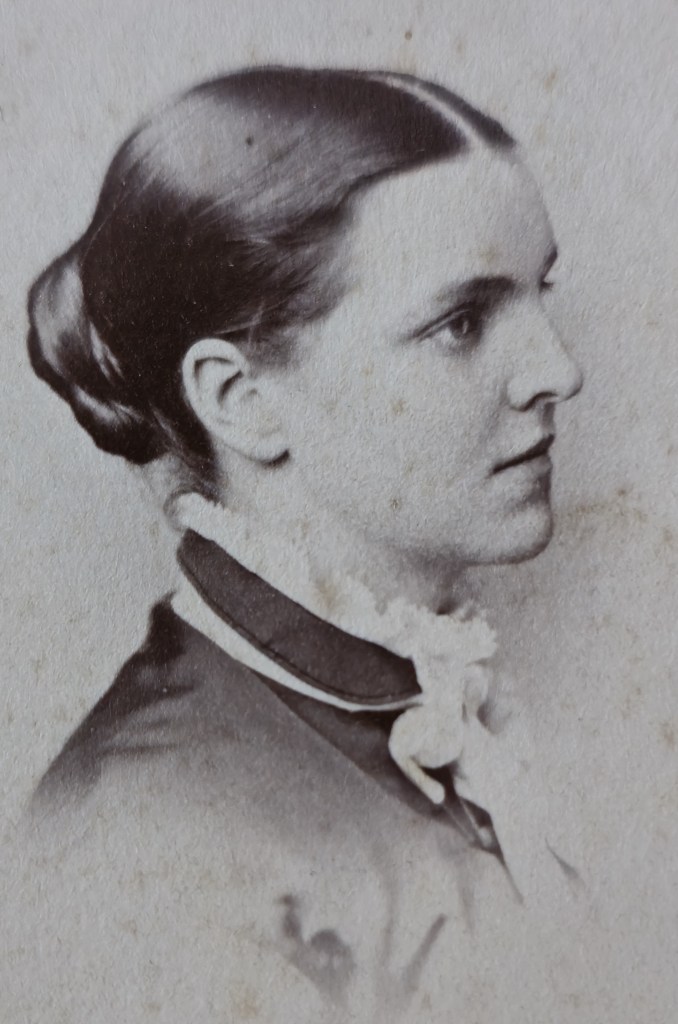

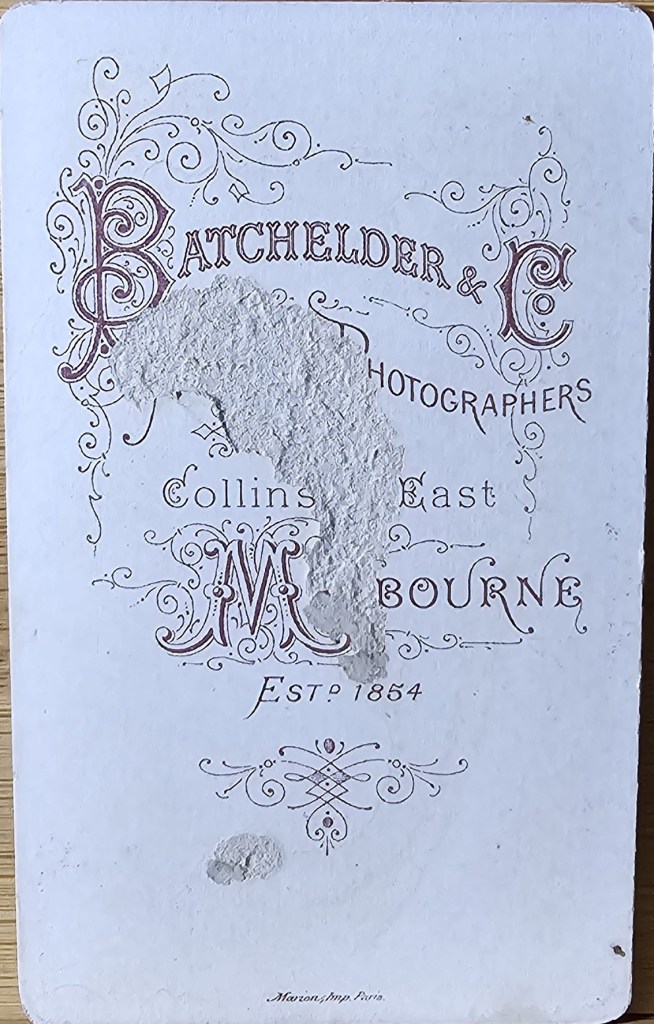
So it is probably safe to say these two photos were taken sometime in the 1890s. I’m loving the 1890s graffiti by the way. Very subtle but says heaps, I think.
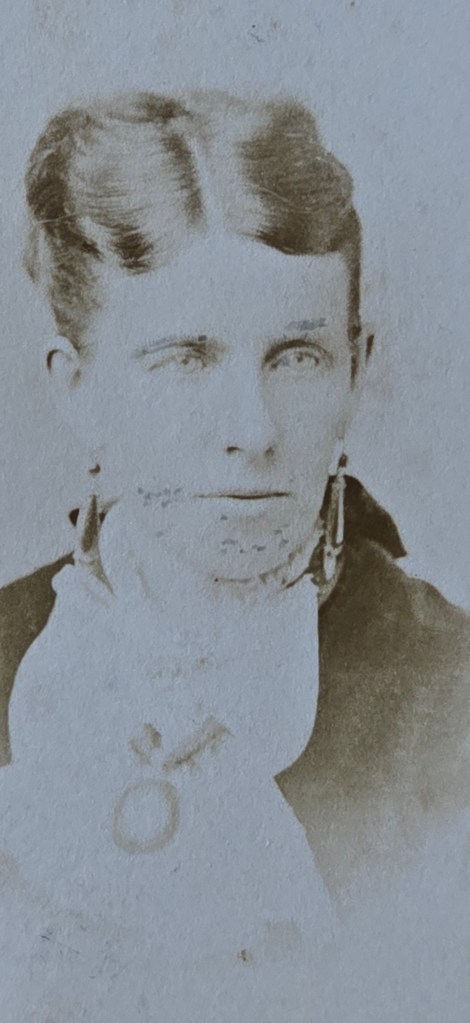
Our next photo takes us back to Dublin and back to the 1860s. This young lady is sporting the 1860s cage crinoline or hoop skirt look. She also has the accompanying higher waistline and dropped shoulders on the bodice. https://fashionhistory.fitnyc.edu/1860-1869/


The photographer’s details match with our fashion dating. Edmond Lauder set up in Dublin in the 1850s trading as Lauder Brothers. With the invention of the new, relatively inexpensive photograph on paper, “carte-de-visite” in the 1860s, he was able to expand his business. This is when he took on the 32 Westmoreland Street site. https://www.dib.ie/biography/lauder-james-stack-jacques-lafayette-a9209

Perhaps this is Helen’s aunt, her mother’s sister, Elizabeth Grace Jane Hunter who accompanies Helen on her journey out to Australia. Elizabeth is 23 years of age in 1860 and this young woman definitely looks like she could be in her 20s.
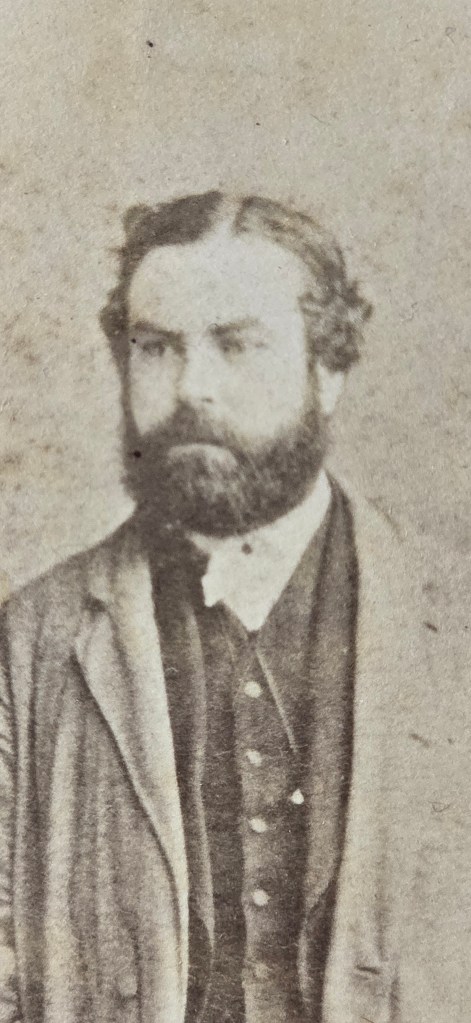
Oh, wow, with this next photo, I wonder if we have found the Rev. Duncan Cameron Macvean? This gentleman has the Macvean look and the fact that he is having his portrait taken by John McLaren in Larbert adds credence to my suggestion. John is the same photographer that has taken Duncan’s wife’s photo (Figure 34, Part One) and his daughter’s (Figure 1) of this post.


The top hat is beautiful too. What a shame we can’t see the whole thing.
This next young man is sitting for his portrait somewhere between 1874-1886. This is the time that we know Stewart and Co were professionally active in Melbourne, as we have highlighted above.


F. B. Mendelssohn is the photographer responsible for the next photograph. This company was established in 1880 by a man named Walter. His last name was unknown. A young woman named Theresa Solomon started working with him at an early age and eventually took over the business on Walter’s death in 1892. Theresa continued the business well into the 1920s at this address in Queens Walk. https://ozvta.com/wp-content/uploads/2012/10/mendelssohns-studios-1612015.pdf


We can see that this another example of that classic vignette style of the 1890s, so I think we can safely say that this formidable looking woman was sitting for this photo somewhere in that time period.
Oh I so wish we knew who she was. Could it be Helen herself? She turned 50 in 1890. Is there a slight resemblance with the younger woman in (Figure 25)? Or maybe it is Helen’s aunt Elizabeth. She herself is only a few years older than Helen, so fits this depiction of this woman below. Elizabeth was Mrs Thomas Johnston by this stage having married Thomas in 1866.

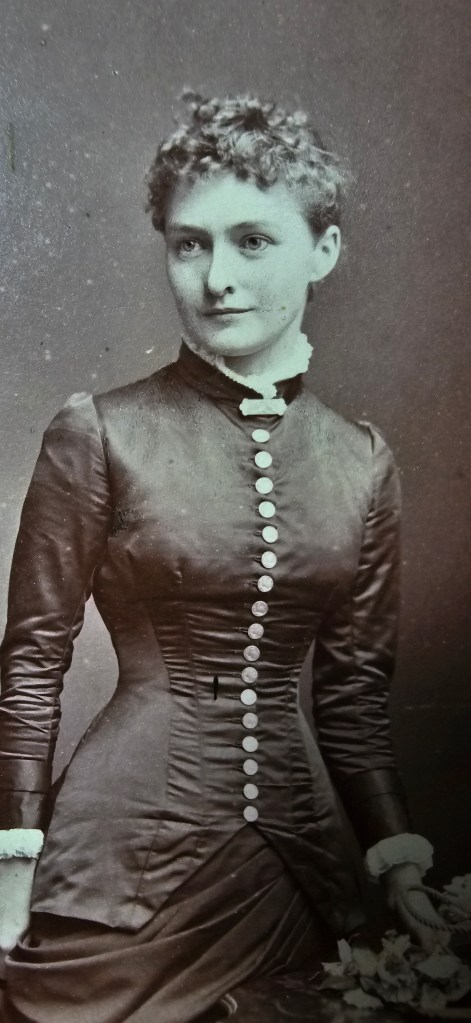
These next two photos are absolutely stunning and obviously of the same young woman. She is sporting the classic Princess Alexandra look, and the dresses are the “princess line” that was favored in the 1880s. This line created a slim body hugging look by having a tightly fitted bodice that extended over the hips. Clearly seen in (Figure 42) below. https://fashionhistory.fitnyc.edu/1880-1889/
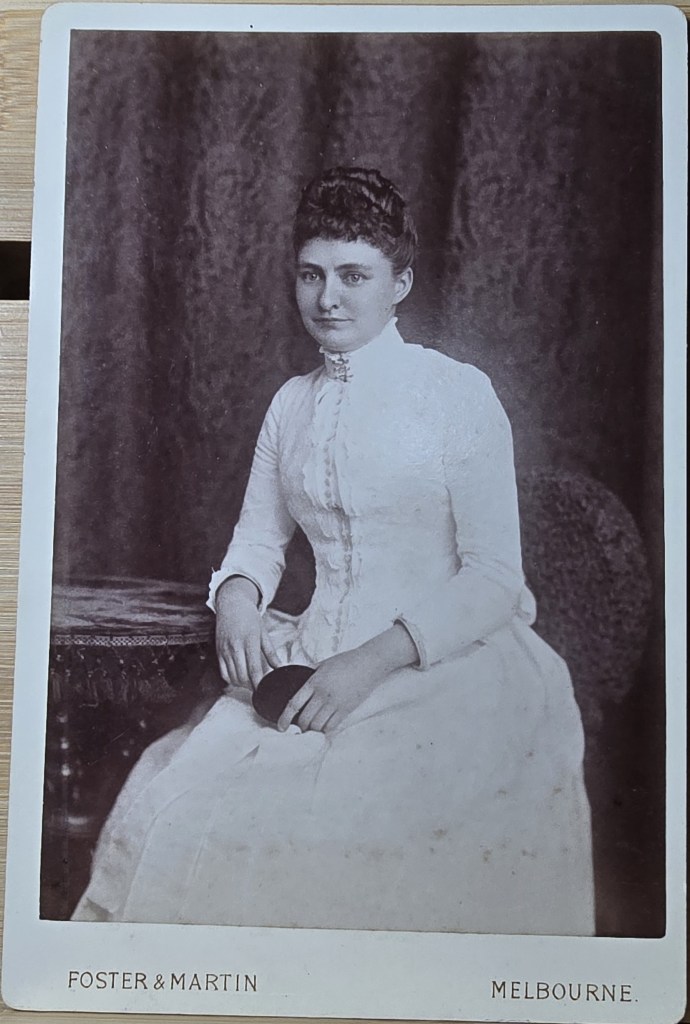

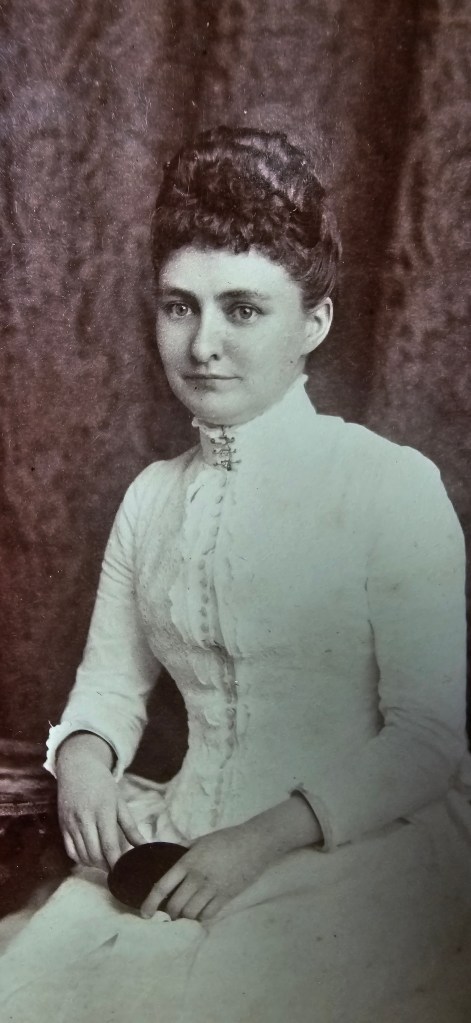


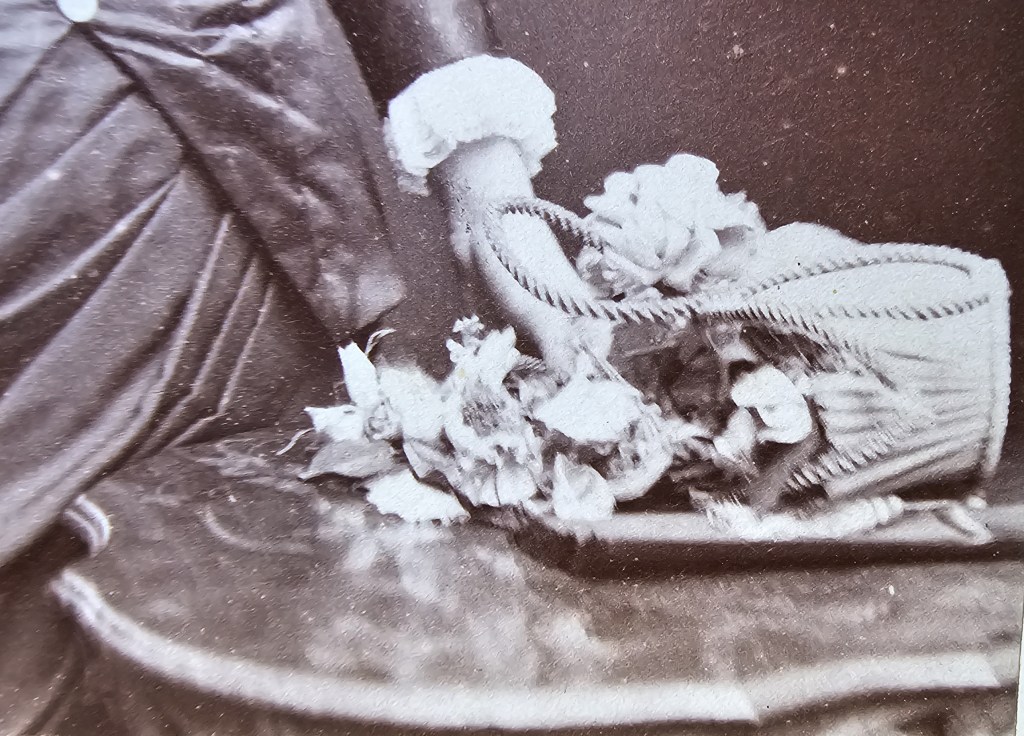
The use of props is very interesting in photography of this time. There are a number of essays online discussing their use, I’m not going to go into too much detail but is interesting to note here, with the use of the handbag of flowers. In a research essay by Emily Wehby from Columbia University she quotes other published research that people at this time wanted to portray themselves in a successful and prestigious light in their portraits and that this was done with the use of furniture, props and poses. https://projects.mcah.columbia.edu/ma/2021/essay/draft-studio-props-and-posing-furniture-twelve-portraits-unknown-women-and-men
The next photo is by the Bartlett Bros. in Sandhurst (Bendigo). They set up in View Place in August of 1882.

A quick scan of Trove confirms that they were active right up to the teens of the new century.

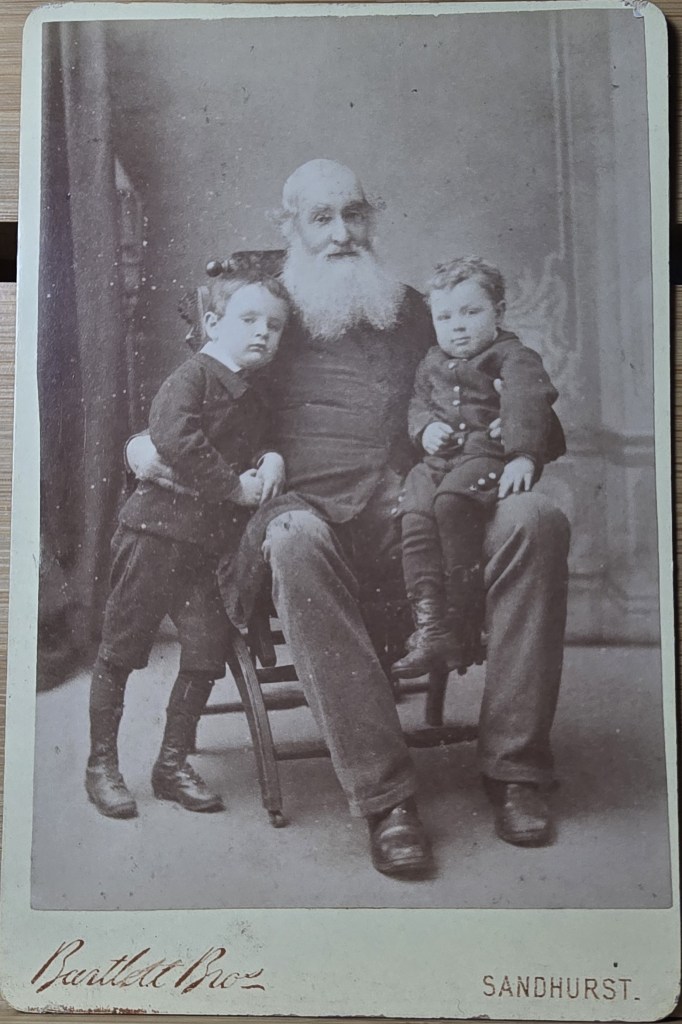

It looks as though these boys are posing with their grandfather in the 1890s or 1900s. Again, doing the imagination thing and putting a few facts together I might have a suggestion for who this might be.
The fact that it is in Helen’s album is the big clue, it is obviously someone of importance to her. I started looking at who was left in the family at the time, that was in the area, Sandhurst, or close to it and who might have had two boys of a young age such as these two above.
I first of all came up with Helen’s uncle by marriage, Thomas Kidd Johnston as a potential match with this older gentleman. As we just discussed above, he marries Elizabeth, Helen’s aunt in 1866.
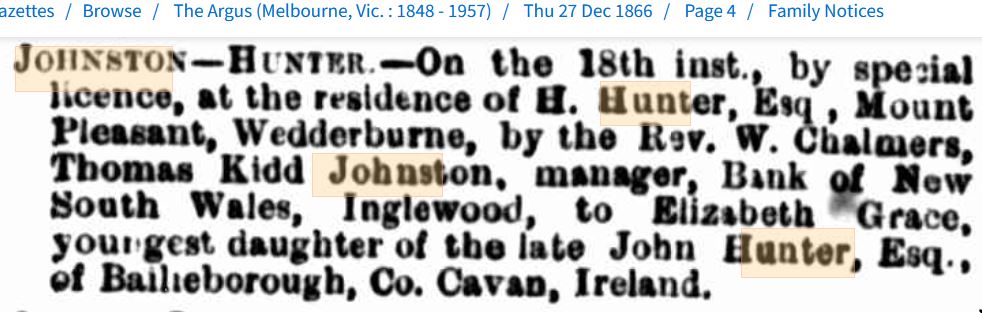
And just look at where they have their wedding, Mount Pleasant. This is just eight months before Helen and Peter marry there. Of course Henry Hunter is Elizabeth’s brother so it makes sense that she would be marrying at his home. And there is the link to Inglewood again.
Thomas is still alive at the time the photo was taken, so potentially could be the grandfather figure above. He passes away in 1905, drowning in the baths of Woollomoolloo Bay when visiting Sydney on his Christmas vacation.

The two boys in the photo might be the sons of Helen’s brother Thomas Hunter Griffith. My reasoning for this choice, Thomas and his wife Elizabeth Dewhurst have three sons by the early 1880s, anyone of them could be these two. Plus they also live in the area as their son, Charles Hunter Griffith’s birth notice below confirms.

Concordia, Lower Loddon is referring to the fact that Thomas and Elizabeth were living just outside of Daylesford on the goldfields, which is just 45 miles to the south of Sandhurst (Bendigo).
The only other choice would be Helen’s other brother, Charles but he and his family are all in Albury in New South Wales by this time, so a much less likely contender.
I also found a link between Thomas Johnston and his nephew, Thomas Griffith which I think suggests that there is a relationship there. They were both executors on the Will of John Dunn the local Butcher in Inglewood.

And how lucky is this? In my searches for the information above I came across an obituary for Thomas Hunter Griffith, printed in the Border Morning Mail and Riverina Times from the 16th Aug 1913. In the obit it mentions that Thomas was mayor of Albury Council on two occasions, I went searching and the council site had a photo of him. Here is Helen’s brother.
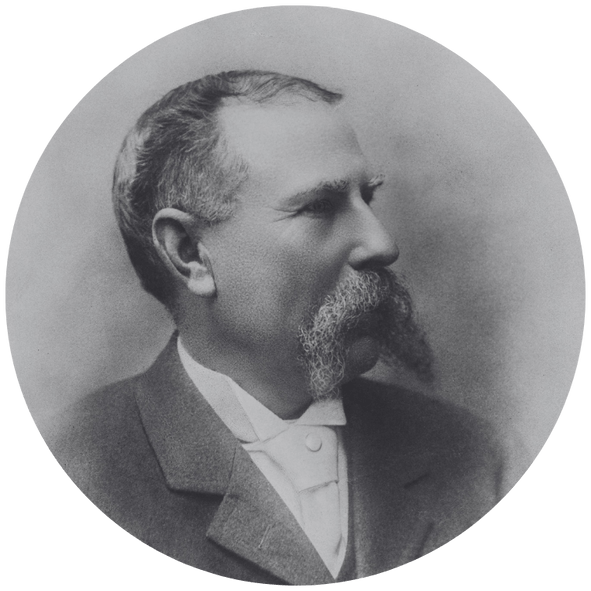
Figure 43e: Courtesy of Albury City Council
https://www.alburycity.nsw.gov.au/council/about-council/councillors/honour-roll-mayors
Don’t forget, I could be completely wrong in relation to (Figure 43). It may not be Thomas Kidd with the boys, I know that, but wow, the information I have been able to dig up on the family just from these random speculations is gold. Of course as always, they are just my opinions.
We are down to the last seven photos in Helen’s collection and the speculations are getting very thin on the ground now.
This next couple, I have nothing. It could be literally anyone in the family in the 1890s or early 1900s. Is it a father daughter combination or an older male relative and his younger wife or fiance? At this stage we don’t know.

What we do know, apart from it being a fantastic photo is that it was from the Crown Studios right in the heart of Sydney. It was established by Mr Mark Blow in the early 1890s and it was the largest photographic studio in Sydney for the next two decades. https://collections.orange.nsw.gov.au/persons/1063

I spoke too soon again. I might have just found some candidates for these two faces. Helen’s other brother, Charles Lucas Griffith and his wife, Isabel Georgina Bunton. They were married in May 1880, Isabel was 18 years of age and Charles was 32 years of age. If they are sitting for this portrait in Sydney in the early 90s that would mean Isabel was in her early 30s and Charles mid 40s.
We are very lucky there is a photo of Charles printed in the Albury Banner and Wodonga Express that accompanied his obituary on the 6th of July 1923. I think there is more than a passing resemblance to the gentleman above.
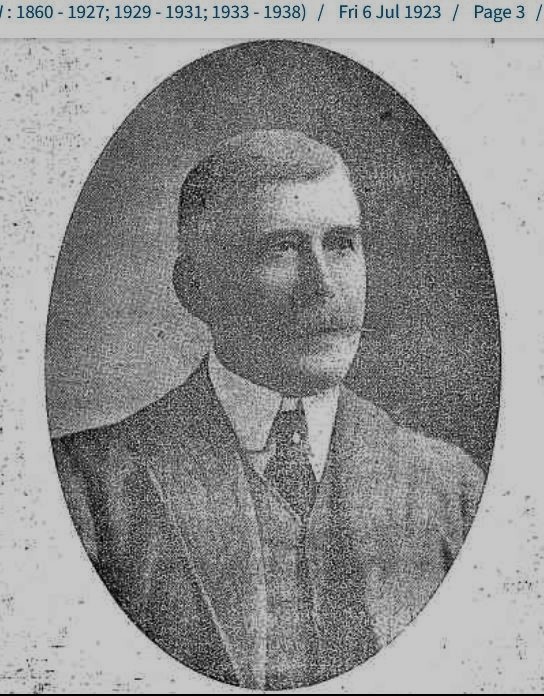
Figure 44a: Courtesy of Trove, National Library of Australia
This next photo is a real mystery. The photographer’s details clearly state that it is Cohen & Co at 65 Rundle Street, Adelaide who created this photo. The only problem, there is absolutely no record of a Cohen & Co operating in Adelaide coming up in Trove. No advertising, no small mentions of building works, changes of address or anything.

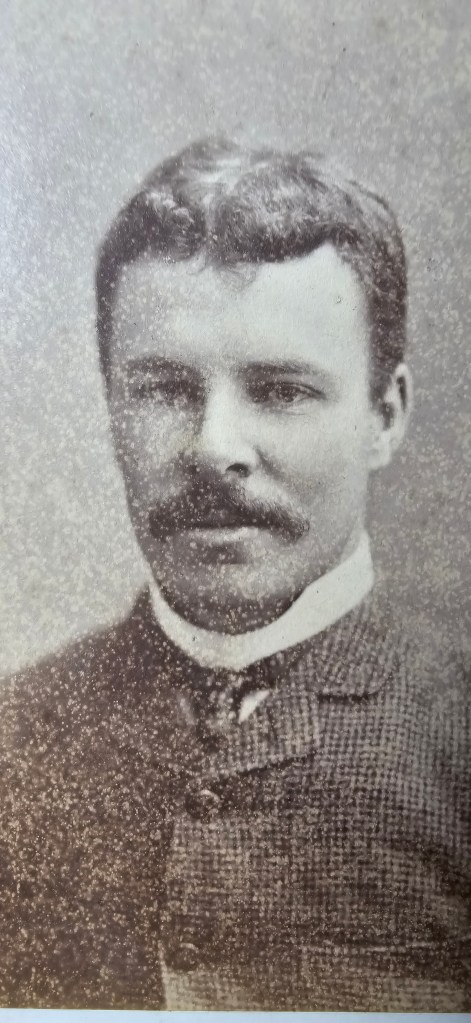
I would suggest that this man was sitting for this portrait anywhere from the 1880s onward. He is sporting the high buttoned jacket and the stiffened collar and knotted necktie both very popular in this time period.
The Adelaide connection had me stumped then I remembered reading that Helen’s uncle, Thomas Kidd Johnston was working in Adelaide for a while. His obituary in (Figure 43b) stated that he was a member of the Adelaide Stock Exchange as well. I also found an article for a business Thomas was running with a Hermann Wilkie that places him there in the early 1880s.
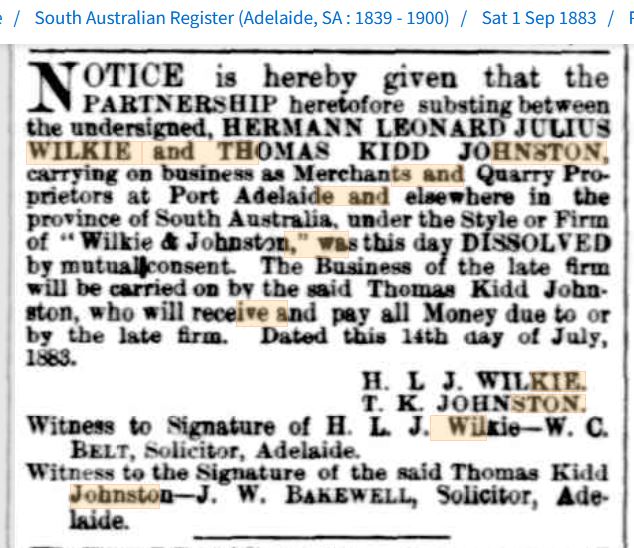
Thomas is mid to late 40s at this time. So I think this might be an actual photo of Thomas Kidd Johnston.
A small aside with Cohen & Co, I had one search result come up from the State Library Victoria website, they have a copy of this photo below in their collection but the details for Cohen and Co state that they were from Cincinnati, Ohio. I know, it clearly has Adelaide printed on the photo. I have sent off a request to the library to ask if they can confirm what this means as there are no details for them in Cincinnati.
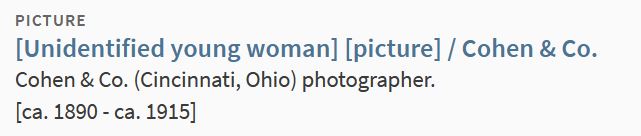

Figure 45b: Courtesy of State Library Victoria
I have just received the most fantastic response from the State Library Victoria answering my inquiry and it was basically an essay of information that Angus one of the Librarians sent to me.
He confirmed that the Cincinnati listing was incorrect and that they were rectifying that. He also pointed out that the Co in the printed company name on the photo is the French version, Cie. Oh I felt like an idiot, I didn’t really pay any attention to that. As soon as you search with Cie you get a hit straight away in Trove.

This advert above was their very first and then their last one was printed in the Express again, on the 18th July 1887 and it was exactly the same copy as shown above.
Their next mention was this notice two months later in September 1887.

That is a six month life span for Cohen Et Cie which means that potential Thomas Kidd Johnston was sitting for this portrait between February and July 1887. Thanks to Angus at Sate Library Victoria for being an absolute boss!
We are back with Stewart & Co in Melbourne with this next photo, which is gorgeous. So dating, as we mentioned early with the other Stewart photos, will be between 1874 and roughly 1886.

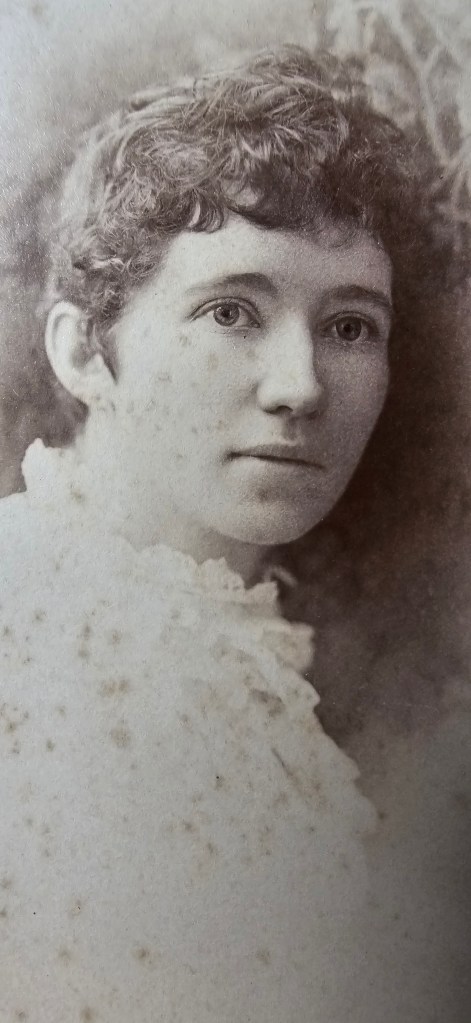
We have looked at a couple of Batchelder photos so far in this post and this one below is a cracker. Like the lady above it is so clear and full of detail. I think this bloke is probably sitting for this in the 1880s, as there is that high buttoned jacket again which we know was a feature of that decade.

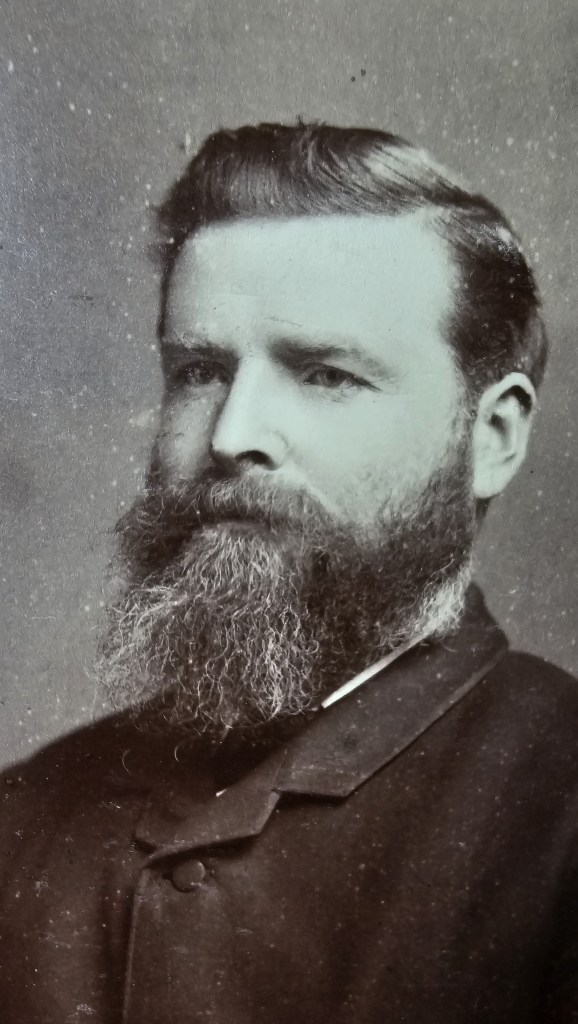
Another mystery for us with this next photo. Rupert Kay the photographer only sets up shop in the Strand in January of 1914.

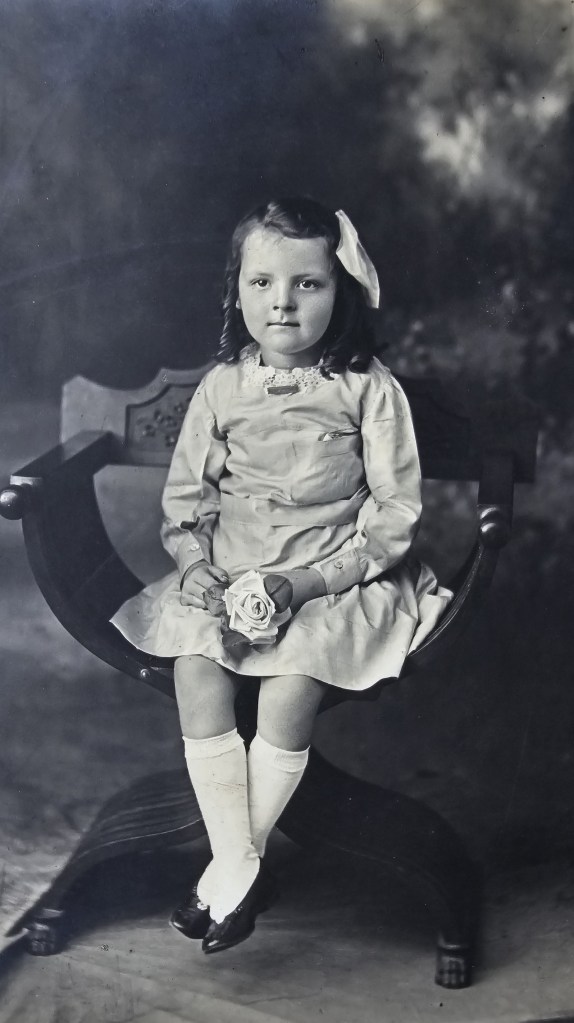
Here is a copy of his first advert appearing in Trove.

And the mystery? Well, Helen passed away in 1911 three years before this photo was taken. So how did it end up as part of her collection? I’m just taking a stab in the dark here but maybe Helen’s album was with another member of the family after she died. It makes sense and that is how this photo is part of the collection. Just which family member?
The Model Studio in Collingwood must have been an exclusive establishment, there are no advertisements for them coming up in Trove. And there are no missed foreign accents involved here either.

There are three mentions of the company between 1908-1913 but they are bylines for photos used accompanying specific articles. So no help.
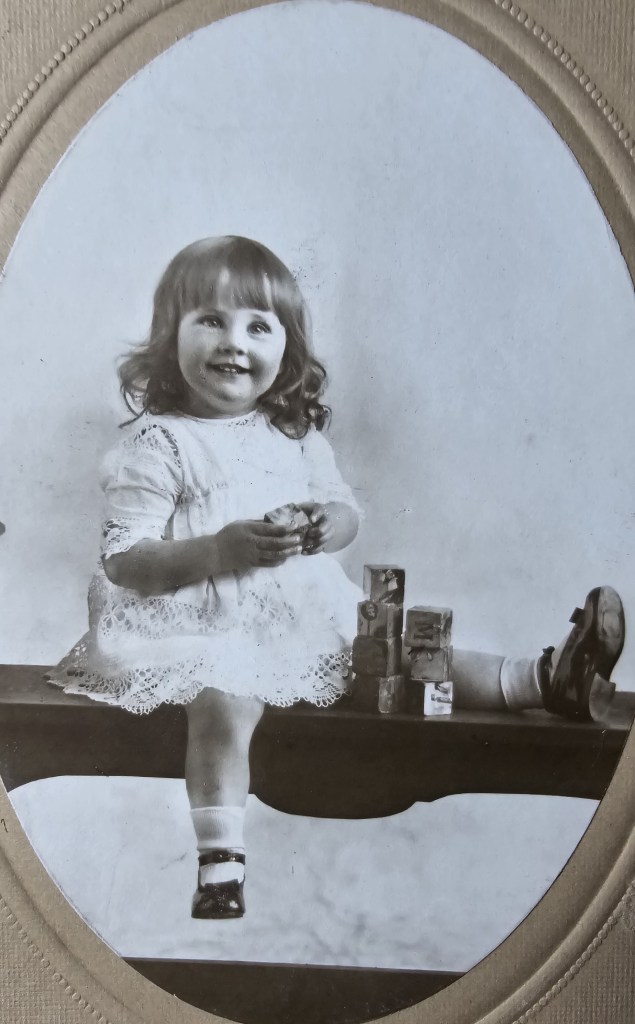
And finally, our last photo in Helen’s collection, a baby.


The photographer’s mark is almost invisible, but you can just make out that it reads, Edgar Evans, Royal Studios, Eaglehawk.
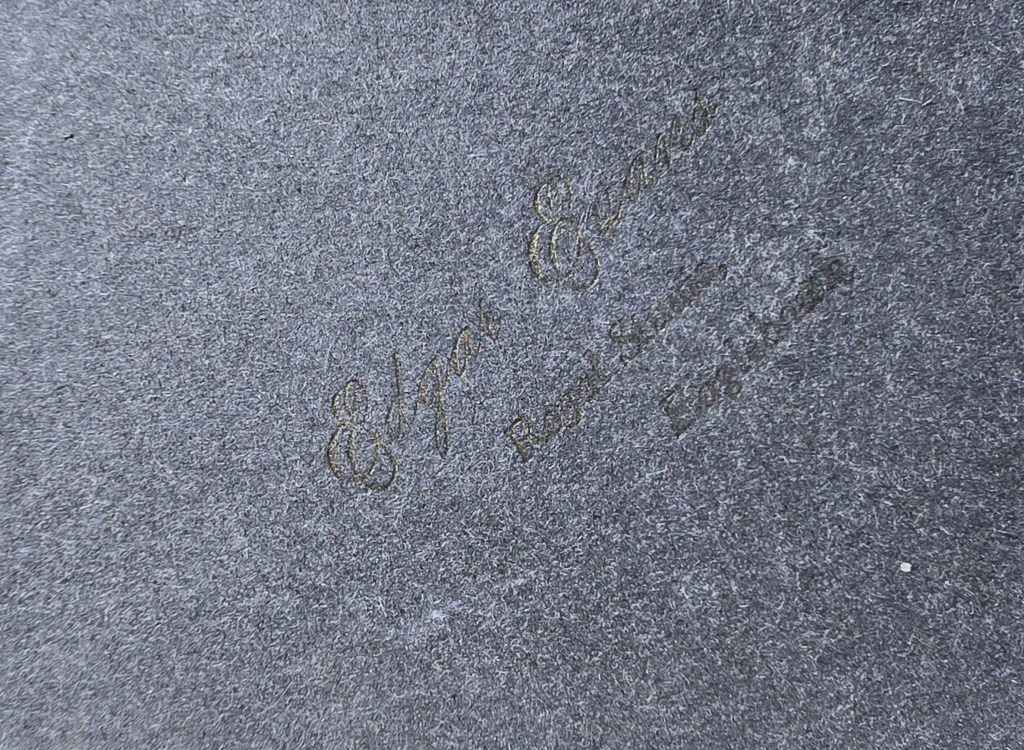
Eaglehawk sits 3.5 miles to the north of Sandhurst (Bendigo). It looks like Edgar was doing the same thing as the Model Studio and not advertising as there are no advertisements for a studio site to visit coming up in Trove.
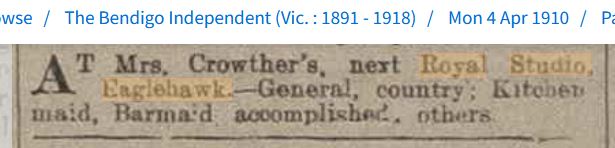
Edgar took over the Royal Studio in Eaglehawk around October 1907.

A quick scan of Trove shows the property sat vacant for about 18 months before this article and was regularly advertised for sale over that time. As shown below.

It looks like Edgar was going to try something different with the use of Canvassers to spread the news of his business. This is the first advert to appear with Edgar’s name attached.

And then this must have been his new idea. Going to a pre-arranged sites and setting up there to take the portraits, if I’m reading these next adverts correctly.

As to who this young baby might be, I’ve got nothing. Well maybe not nothing, I’ve done a quick scan of Ancestry and I can see that Helen’s uncle, Henry Hunter and his wife, Isabel Fraser had six children and most of them stayed in the area and had lots of children themselves. So I suspect that it is a grandchild of Henry and Isabel. Probably the same thing with the two young girls above.
Well that is it people! We have come to the end of Helen’s photo album. What an absolute blast trying to figure out who these potential family members were. I had no idea when I started this post that it would involve, focusing on types of paper, photographic techniques, fashions, hair and a few printed photographer’s names printed on a piece of antique paper, most averaging an age of 140 years old. How lucky to be able to do this.
There is a morale to this story as well. Don’t leave your photo’s unidentified! Write down people’s names, where they were and what they were doing. I guarantee you someone in the future will be really interested to know the story.
 JOHN'S FAMILY HISTORY