Still Exploring the Victorian Connections
Hello, thanks for joining me for the next leg of the tour. We are back on the road, it is still Wednesday the 1st of November, 2023. Alex is still presenting, just not sure if she was still in Newcastle…

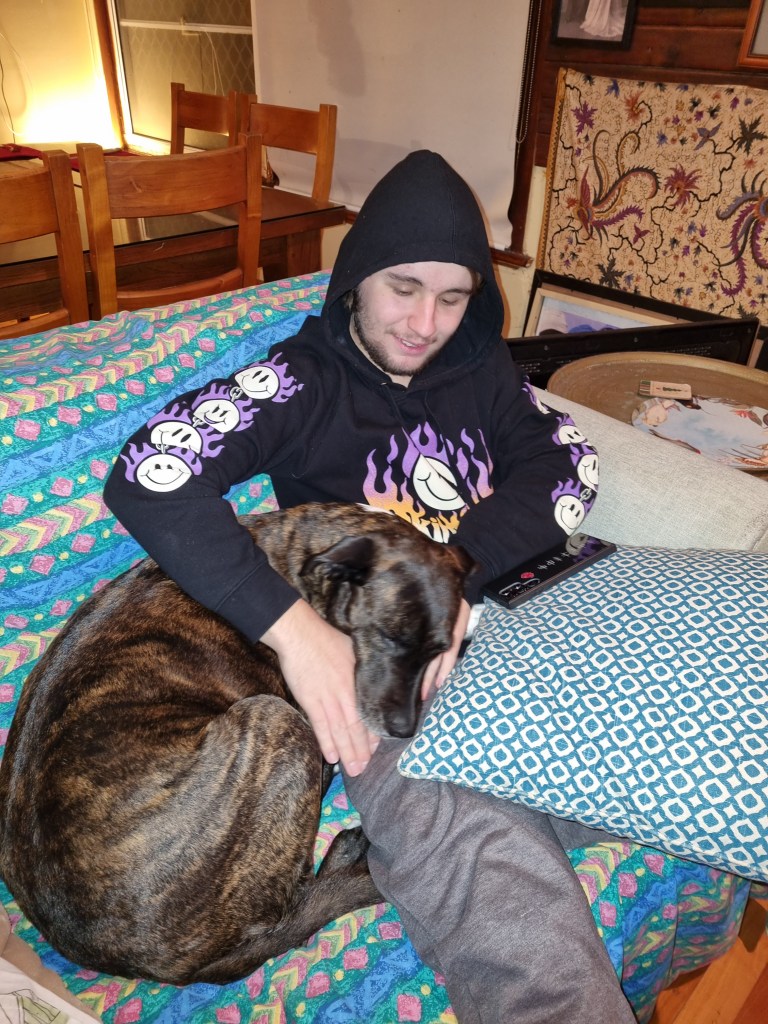
Calan, is in Forster and very kindly looking after Leelo, (who adores him) while Alex and I are off. It’s Calan’s last couple of weeks of school forever and he is also preparing for the Year 12 Formal so couldn’t join us on this trip.

Xander is at Puckapunyal in Victoria and he had just received word that he had passed all his training and would be going to his permanent posting.

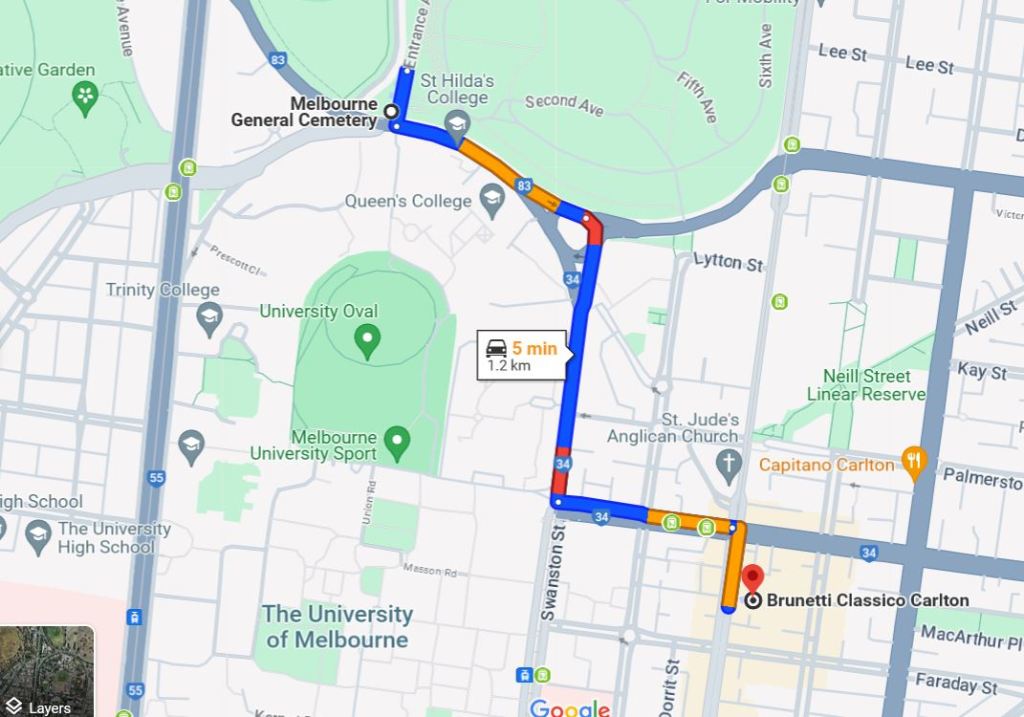
And Anne, my cousin and I are heading to Boroondara General Cemetery. We did do a slight detour for some lunch at a fantastic Italian eatery that Anne recommended, Brunetti Classico Carlton.


It was a great recommendation, the coffee was sensational as too the hot Italian salami toasted roll. After this recharge of the batteries we hit the ground running at Boroondara.

Thankfully I had time to do a bit of prep work again and knew that Rev. Allan and Catherine Macvean’s other daughter Catherine Isabella Barbara Porter, nee Macvean was buried here with her husband and some of his family.
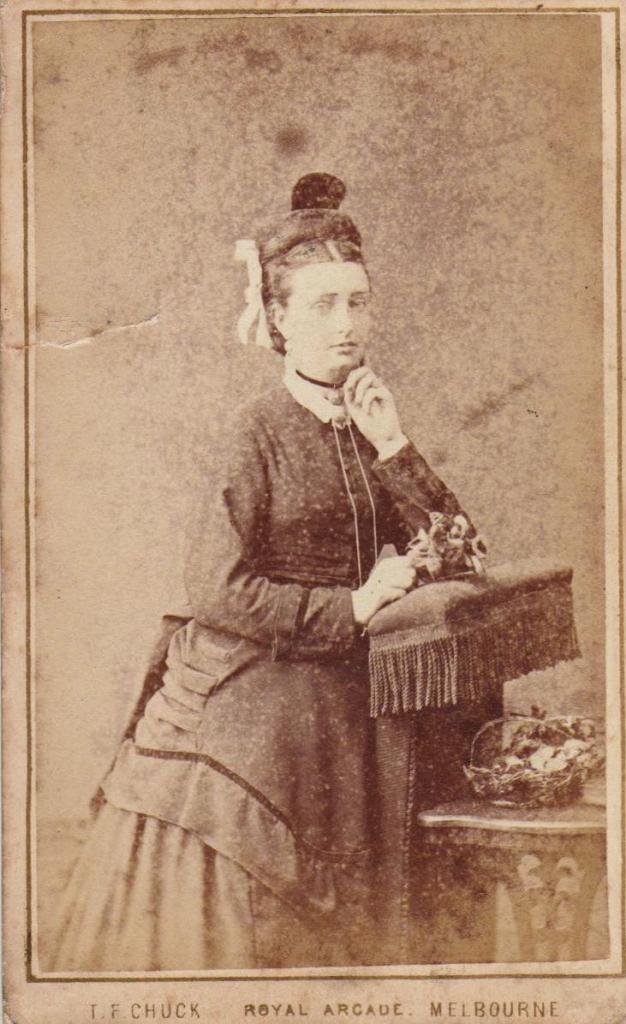
Figure 6a: Courtesy of the Macvean Family Archive, generously shared by, Sally M (Cousin)
The office staff were very helpful and plotted out on this map below, of exactly how to get to the burial site.
We needed to look for the “Halfey Family Angel” monument, turn right when we found it, back track to the big pine tree and they should be resting right around there. Let me tell you this is good compared to some of the grave site hunts I have been on.
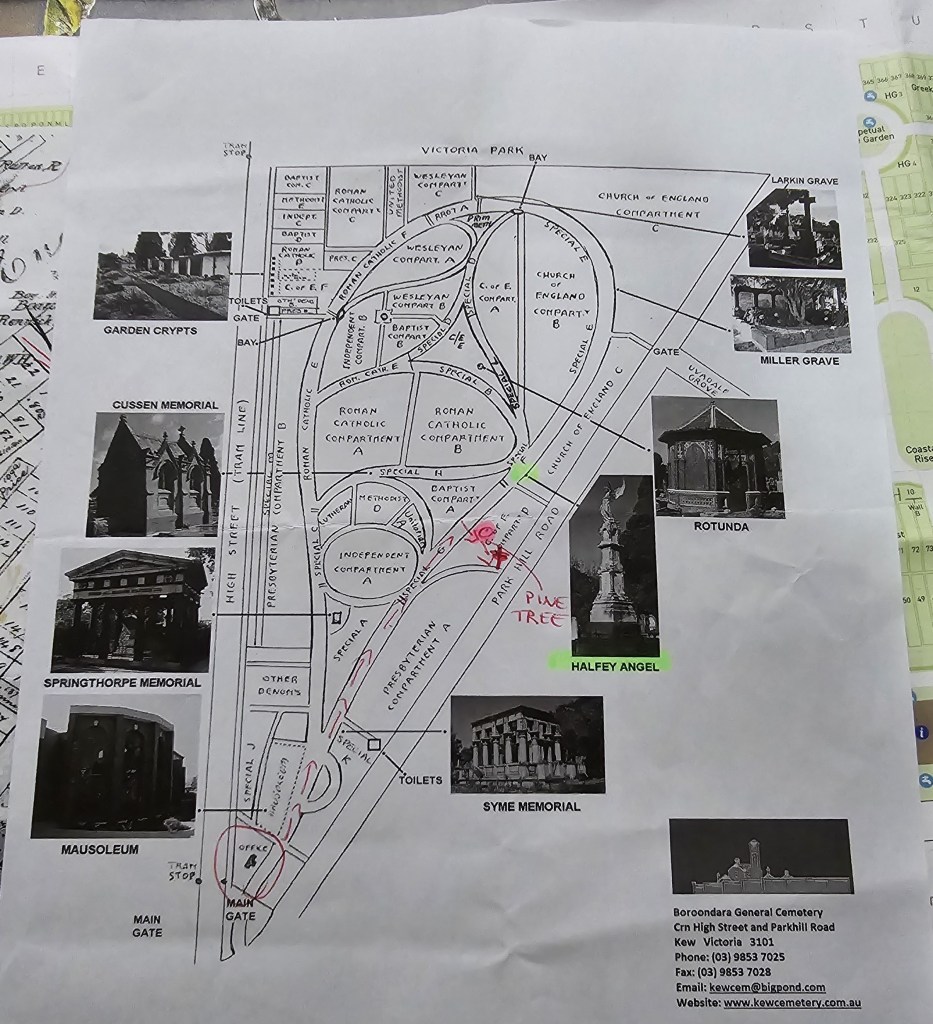
We found it no problems.

Figure 8: Courtesy of the Macvean Family Archives
This is the family plot of John Alfrey Porter and Ellen Porter nee Cullen, Catherine’s parents-in-law.

Figure 9: Courtesy of the Macvean Family Archives
Catherine had married into an extremely influential and insanely wealthy colonial family, her husband, George Edward Porter was the grandson of George Issac Porter and his wife Ester Porter nee Brydon who are considered one of the first pioneering families of European settlement in Melbourne. https://melbourneathenaeum.org.au/wp-content/uploads/2023/06/firstcommittee_porter.pdf
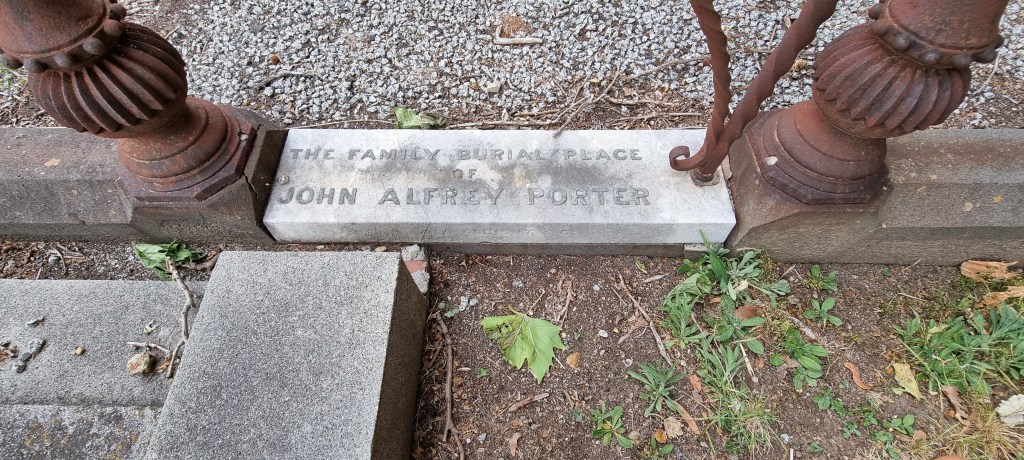
Figure 10: Courtesy of the Macvean Family Archives

Figure 11: Courtesy of the Macvean Family Archives
Catherine’s father-in-law, John Alfrey Porter, was appointed clerk of the Victorian Supreme Court in 1841, and became a solicitor in 1843. Then in 1853 he was appointed Prothonotary of the Supreme Court, a position he held until his death. John built on the wealth of the fortune his father had amassed over his lifetime and with the substantial estate inherited by his wife, Ellen Cussen (her father was Dr Patrick Cussen, one of Melbourne’s first medical superintendents) was able to leave an enormous fortune to his son, George, Catherine’s husband. https://melbourneathenaeum.org.au/wp-content/uploads/2023/06/firstcommittee_porter.pdf
Here is an amazing photo of John Alfrey Porter, Catherine’s father-in-law.
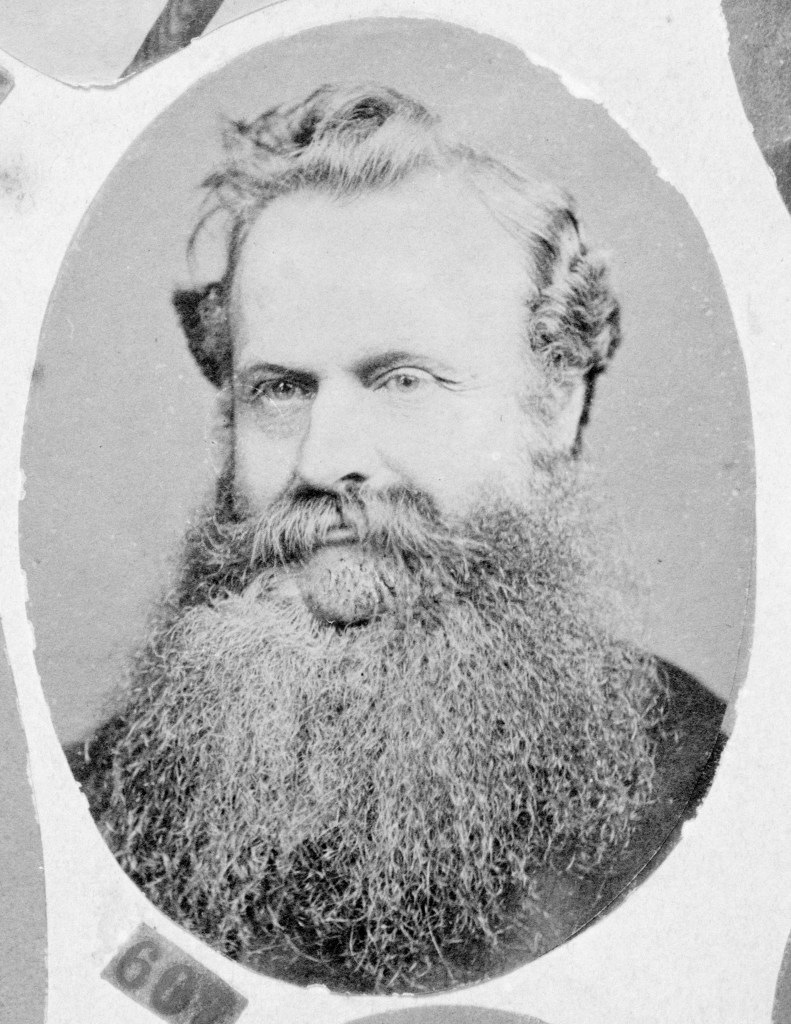
Figure 12: Courtesy of the State Library of Victoria
http://handle.slv.vic.gov.au/10381/17668
The photo below shows Catherine and George’s side of the family monument.
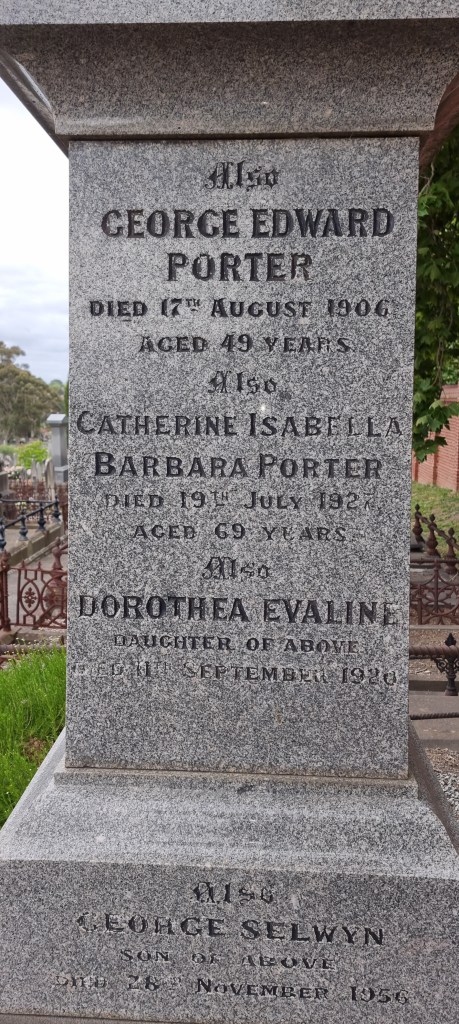
Figure 13: Courtesy of the Macvean Family Archives
There is no photo of George, Catherine’s husband, that I can find so far but I did manage to come across a copy of his signature from his sister’s marriage registration that he had witnessed. This is in 1878 two years before he and Catherine marry. His sister, Annie Esther Porter married John Walker.
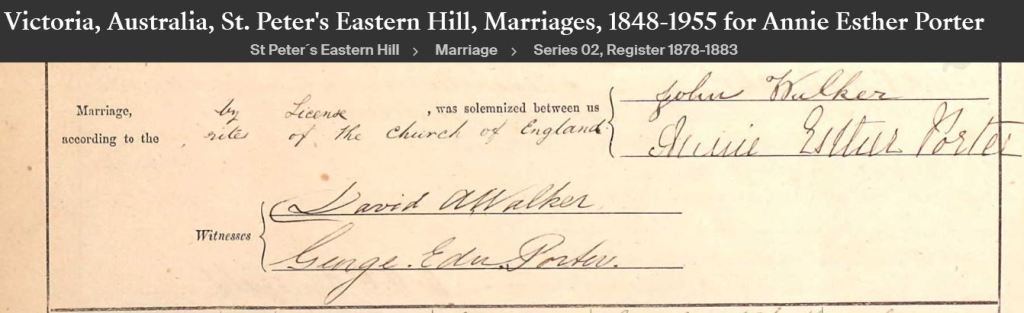
Figure 14: Courtesy of Ancestry.com.au
Esther you will note appears on the headstone in Figure 11 but no mention of John or the Walker name. Esther passes away four years after her wedding to John, at the age of twenty eight and on the very day probate on her father’s will was granted.
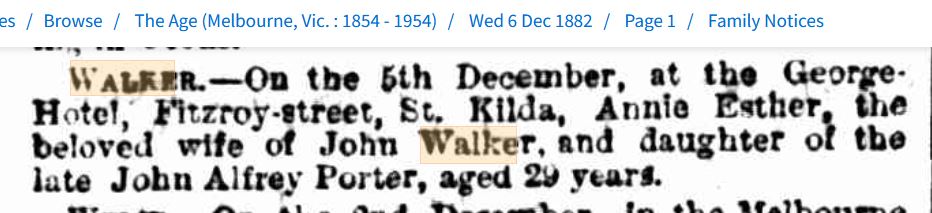

According to Thom Blake an Australian Historian, who has developed his own program for calculating historical money rates for Australia, £163 000 in 1882 has roughly the buying power of $25,544 428 in today’s market. https://www.thomblake.com.au/secondary/hisdata/calculate.php
Back to Figure 13, Catherine was born in 1856. There is no birth notice coming up in the online newspapers in Trove but her birth appears in the Victorian Births Deaths and Marriages registry.


You’ll notice the place of birth above, PHILIPSTN. This is an abbreviation for Philipstown, and according to a piece on the “Brunswick Voice” website, it is referring to a small section of south west Brunswick bounded roughly by Grantham, Union, Brunswick and McKay Streets. https://brunswickvoice.com.au/where-was-phillipstown/
Here is Philipstown on a Google Map of today. I have marked 114 Park Street where the Manse once stood (discussed in Part One) where presumably Catherine was born as I’m sure the Manse was close enough to fit into the Philipstown boundary.

Figure 16: Courtesy of Google Maps
Catherine and George Edward Porter were married on the 3rd of February 1880, also at the Brunswick Presbyterian Manse, by Catherine’s father, the Rev. Allan Macvean.

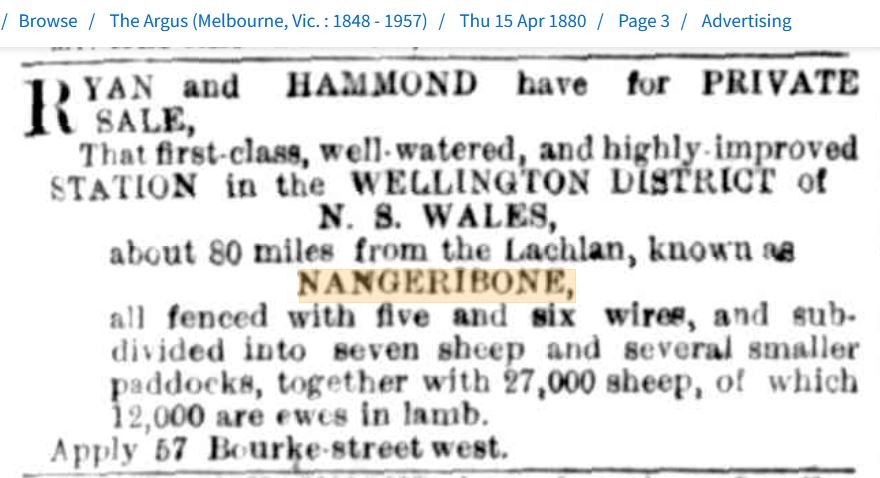
Nangeribone Station where George was living, is situated in central New South Wales. I couldn’t find anything that specifically stated exactly where it was but these next couple of finds on Trove point us in the right direction.
The first is actually a for sale notice from two months after the wedding. If George did own the property I think this pretty much confirms that Catherine never moved out there.
The second is a Publican’s Licenses Gazette listing from 1915 that plots the Nangeribone Hotel which I’m assuming probably wouldn’t have been too far from the station. I know, a big assumption.

Hah, I just found it on Google Maps when I went tracing 20 miles from Nymagee on the Nymagee-Condobolin Road as mentioned in the listing above.

With the new spelling, “Nangerybone” and the fact that the coordinates were listed on the “Explore-oz” website I was able to locate the exact location of the station and it looks like it is still in operation today. https://www.exploroz.com/places/18968/nsw+nangerybone
Here below, is an aerial shot of the station thanks to Google Maps.

Figure 21: Courtesy of Google Maps
I wonder if that is the remnants of the original homestead that George lived in, on the right. There is no information I can find to indicate that he and Catherine ever moved here after the wedding.
Catherine gives birth to the first of their seven children, Ellen, a year later on the 12th of February 1881, in Middle Brighton, Melbourne. There is no house name mentioned in the printed birth notice so I am unable to say exactly where they were living at the time.

Their next two children, John and Katie Isabella (Queenie) are born at a house called “Cleveland” in Elsternwick in 1882 and 1883.


I managed to find out from the University of New South Wales website, “The AIF Project”, that Cleveland was situated at 96 Orrong Road, Elsternwick. It was listed as the home address for a Private Howard Smith Davis, when he enlisted into the AIF.
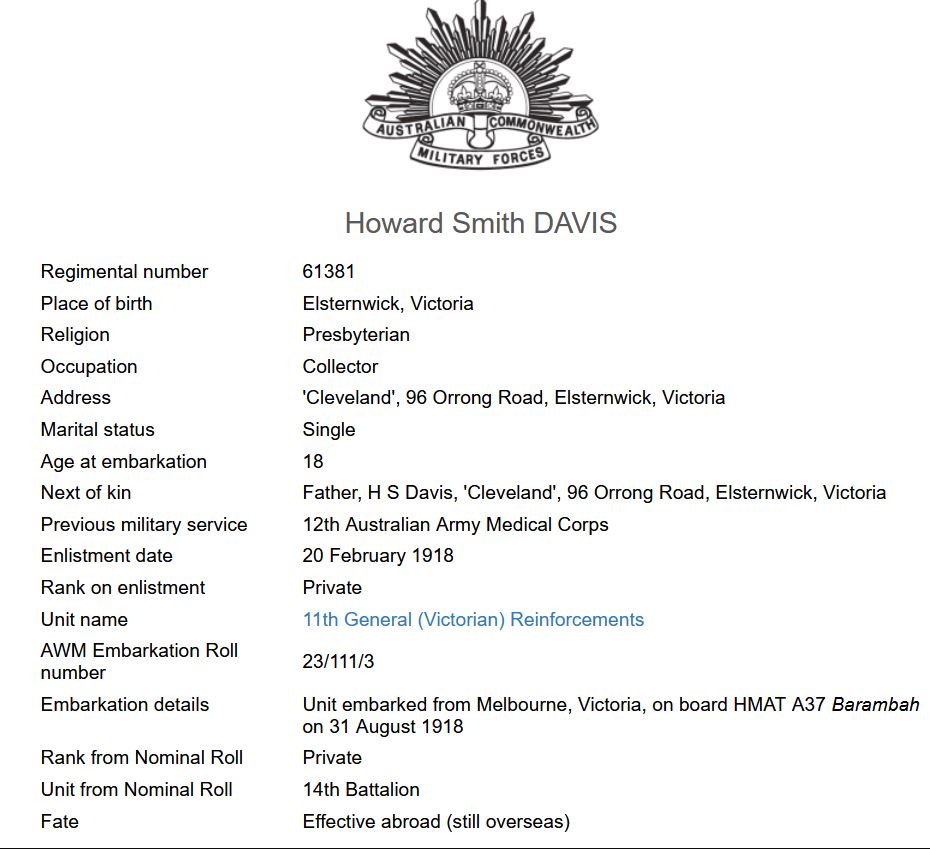
https://www.aif.adfa.edu.au/showPerson?pid=74450
I found the property on the Melbourne and Metropolitan Board of Works plans from 1902.
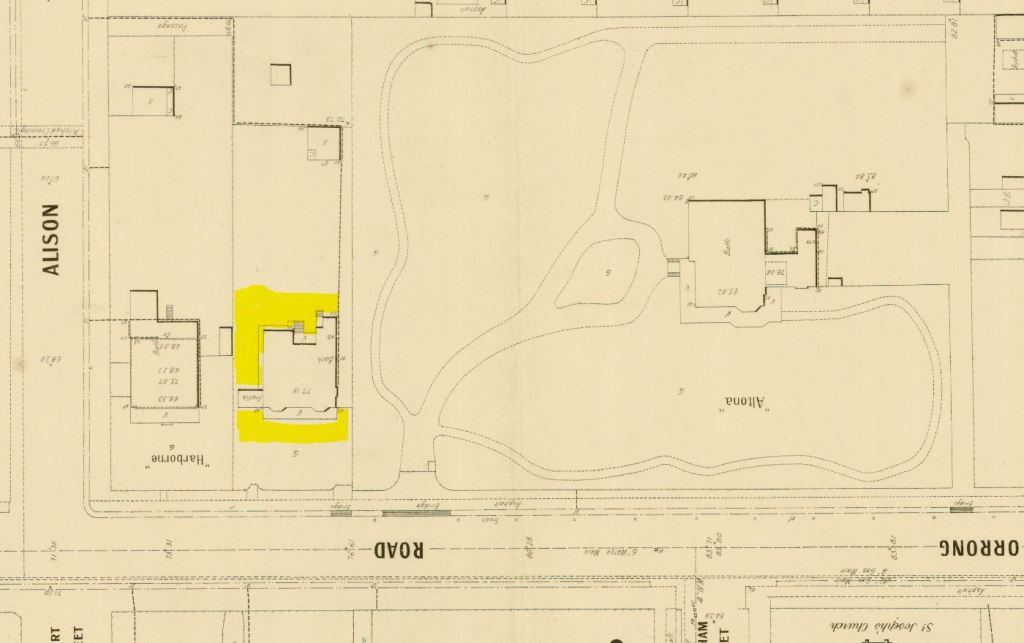
Figure 26: Courtesy of State Library of Victoria
http://handle.slv.vic.gov.au/10381/125121
Again I was hoping for “Cleveland” to be noted on the map but it isn’t, as you can see but this is definitely the site. Checkout “Altona”, next door, what a property this must have been. I checked, it is long gone, demolished.
This is 96 Orrong Road pictured below, back in 2013. This building was still standing there as late as September 2022, the latest image from Google Maps. I can’t be certain that this is the original Cleveland house but it is certainly the spot where Catherine and George were living.

Figure 27: Courtesy of Google Maps
Next we come to George Selwyn Porter, I know we have skipped Dorothea who is next to appear on the headstone in Figure 13 but George is the next in the order of births and his printed birth notice leads us to some fascinating information.

So this is three years after Queenie’s birth and the family have moved to a new address, Hartpury in St Kilda. Now we have discussed this property previously in Part One of this Victorian Tour post. It was mentioned in Catherine’s sister, Mary’s death notice, except it was incorrectly spelt as Hautpury.

I started digging on Trove for any information on the property and found a listing for a public Trove list curated by another user, named harnold. The description accompanying this list gives some amazing insight into the history of the property that is just too good not to share.

So two properties and homes built by two brother’s, the Smiths. I found both properties on the Melbourne and Metropolitan Board of Works Maps and they were directly opposite each other on Milton Street.
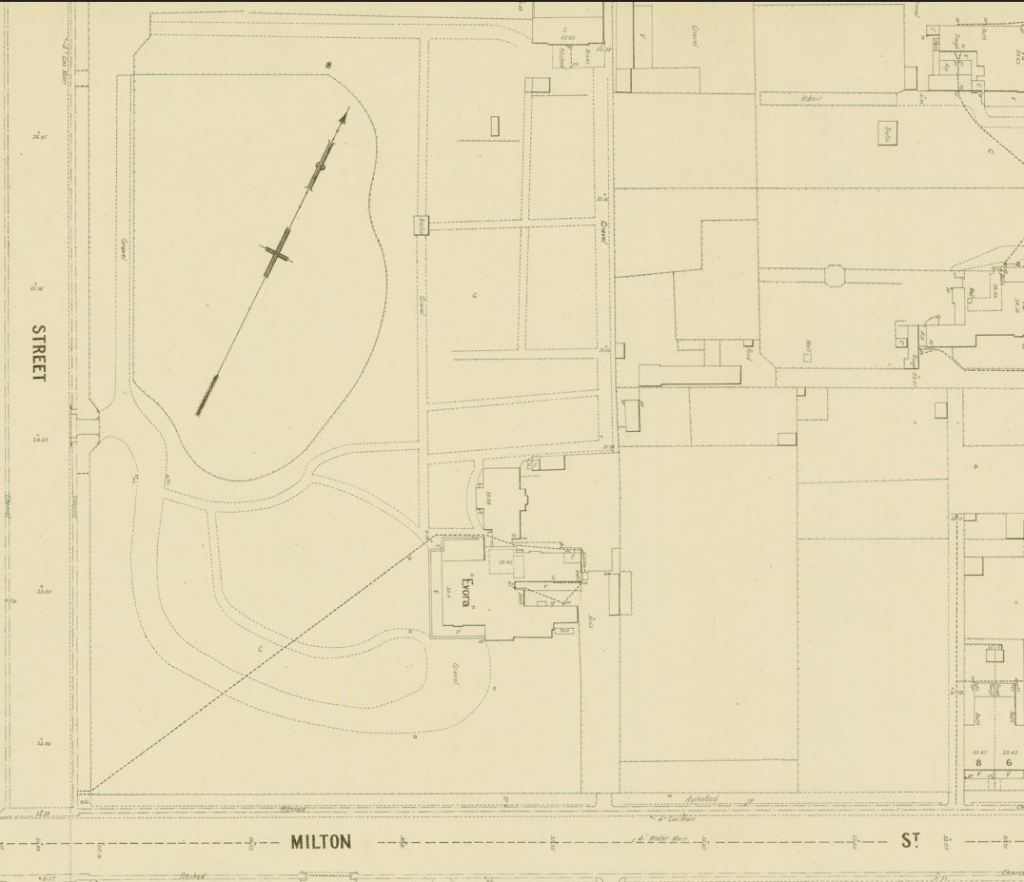
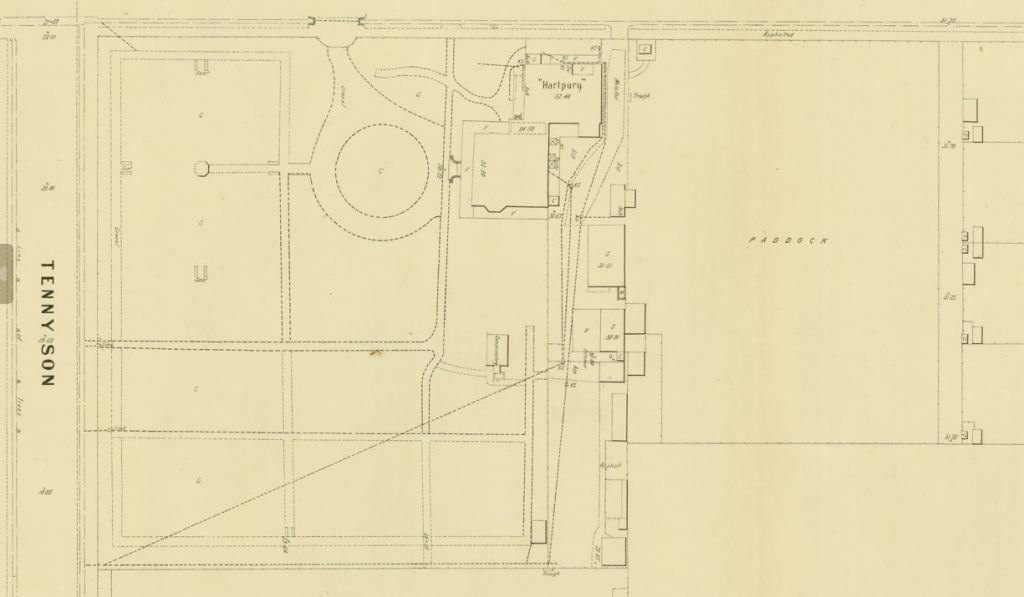
Top Map: https://viewer.slv.vic.gov.au/?entity=IE7319566&mode=browse
Lower Map: https://viewer.slv.vic.gov.au/?entity=IE7318411&mode=browse
Catherine, George and their three children, Ellen, John and Queenie move into Hartpury sometime in early 1884 having purchased the property in January of that year.
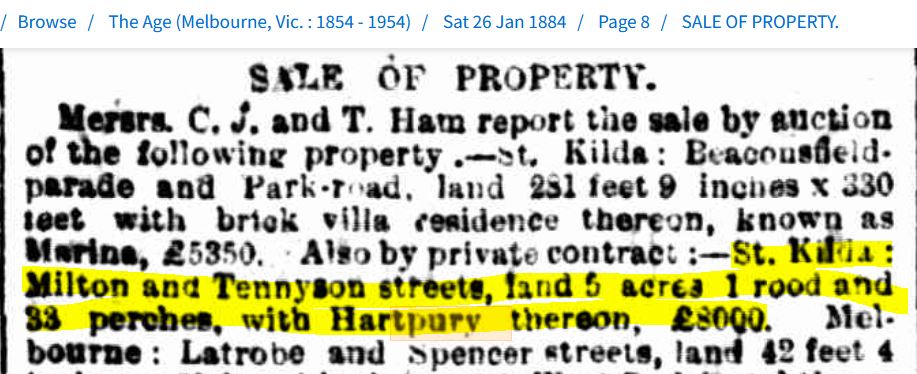
There is no actual printed notice with George’s name listed as the purchaser but this next notice of a St Kilda Council meeting held on the 16th of June 1884, confirms they are in possession of the property.
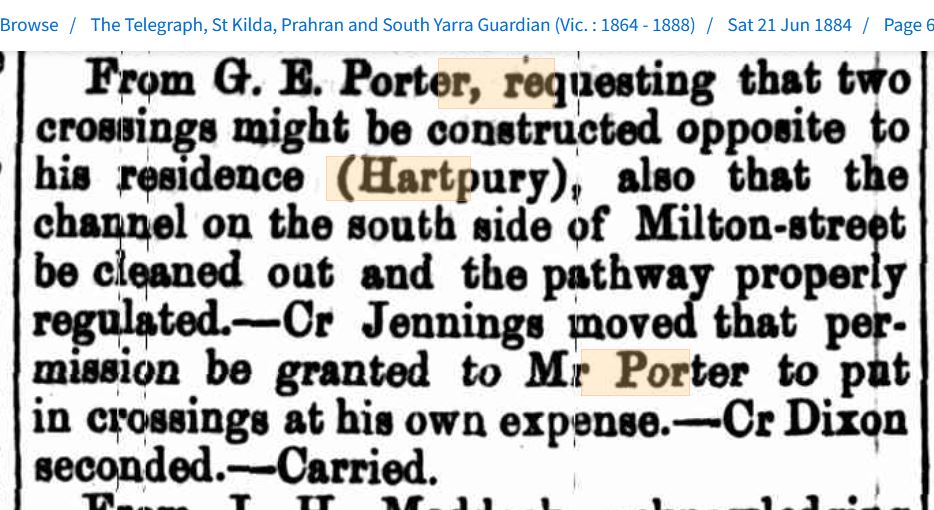
Now it took a bit of digging, (when doesn’t it?) but I came across an historic photo of Hartpury and Evora, thanks to the St Kilda Historical Society. First, Evora and what a beauty this photo is.
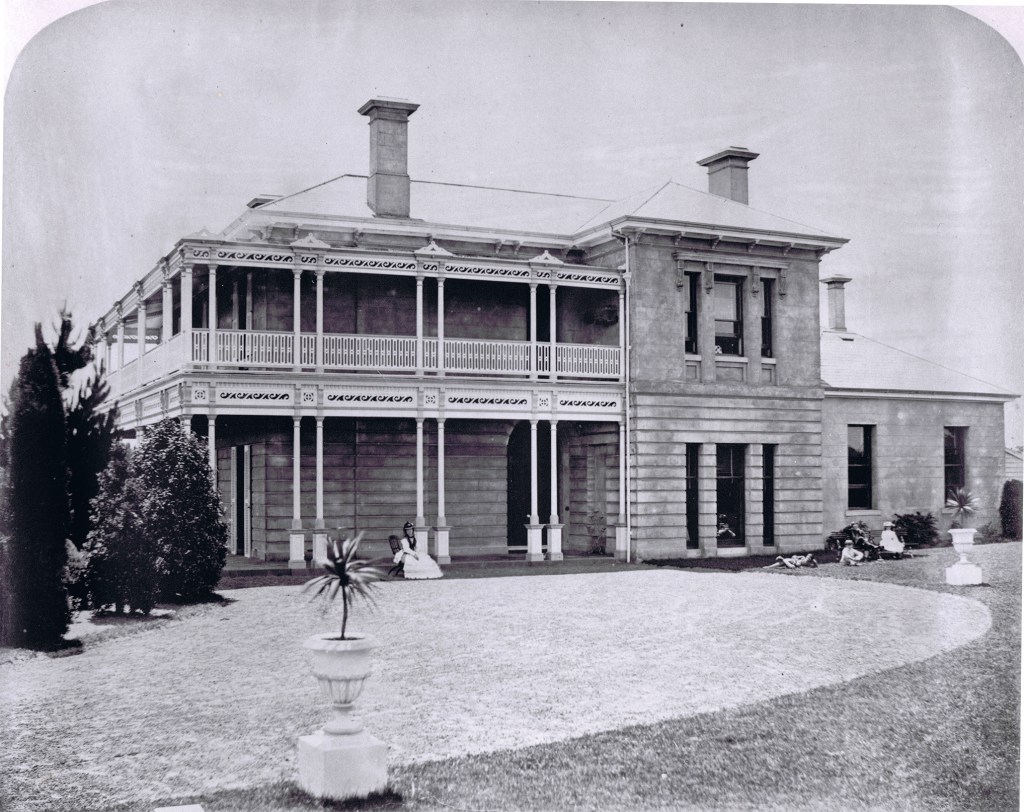
Figure 32: Courtesy of the St Kilda Historical Society
https://stkildahistory.org.au/media/k2/items/cache/9e02f79f72eca3ca589ae757d97a7173_XL.jpg
This is an aerial shot of the site, as shown in the top section of Figure 29 above. This shot is from December 2022.
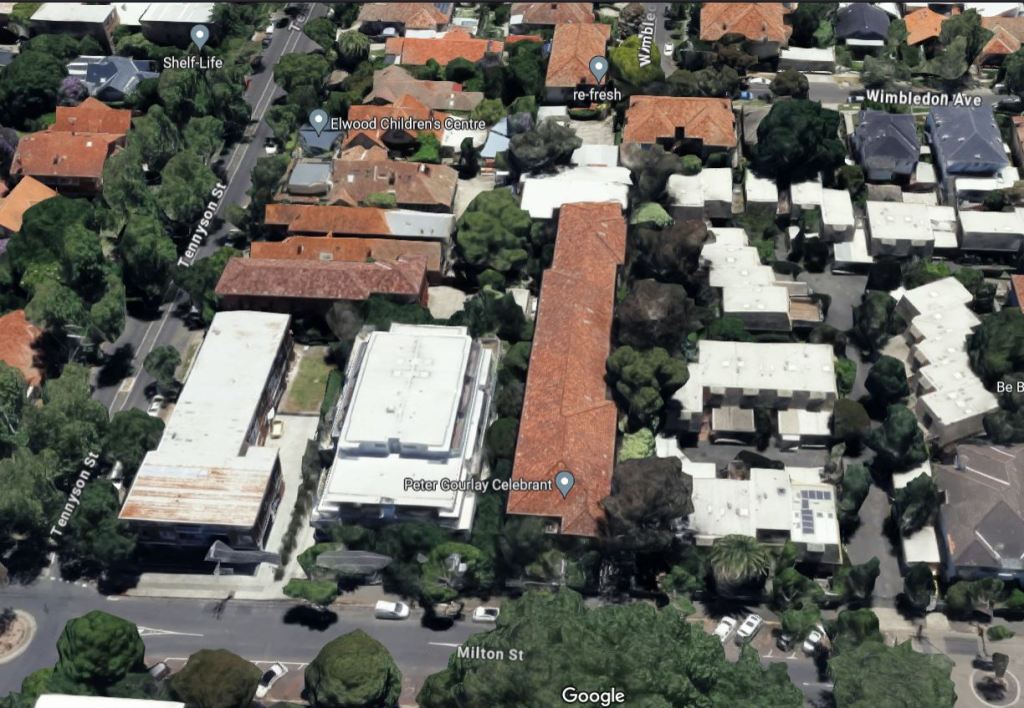
Figure 33: Courtesy of Google Maps
Evora was built in 1865 for, Frank Grey Smith and when he passed away in 1908 the property was sold out of the family holdings. It stood there till 1980 and was then demolished to make way for all of this above. https://stkildahistory.org.au/news-and-events/newsletters/newsletters/issue-225?highlight=WyJldm9yYSJd
Hartpury was built by Frank’s brother, Harold Selwyn Smith in the same year as Evora, 1865. Like Evora this is the one and only historic photo I can find of the property and this one is very special.

Figure 34: Courtesy of the St Kilda Historical Society, photo kindly shared by the John Villiers Trust
https://stkildahistory.org.au/news-and-events/newsletters/newsletters/issue-236?highlight=WyJoYXJ0cHVyeSJd
How amazing is that? Not only a photo of the house but there is Catherine, her three children at the time and her sister Petrena. What an absolute find. I have reached out to the John Villiers Trust to see if there is some way to get a copy of the original.
And in an absolute stroke of good luck, Hartpury still stands today, 159 years since it was built. From what I have read so far online it has gone through a number of restructures and additions but most of the structure remains exactly how it was in Catherine and George’s time.
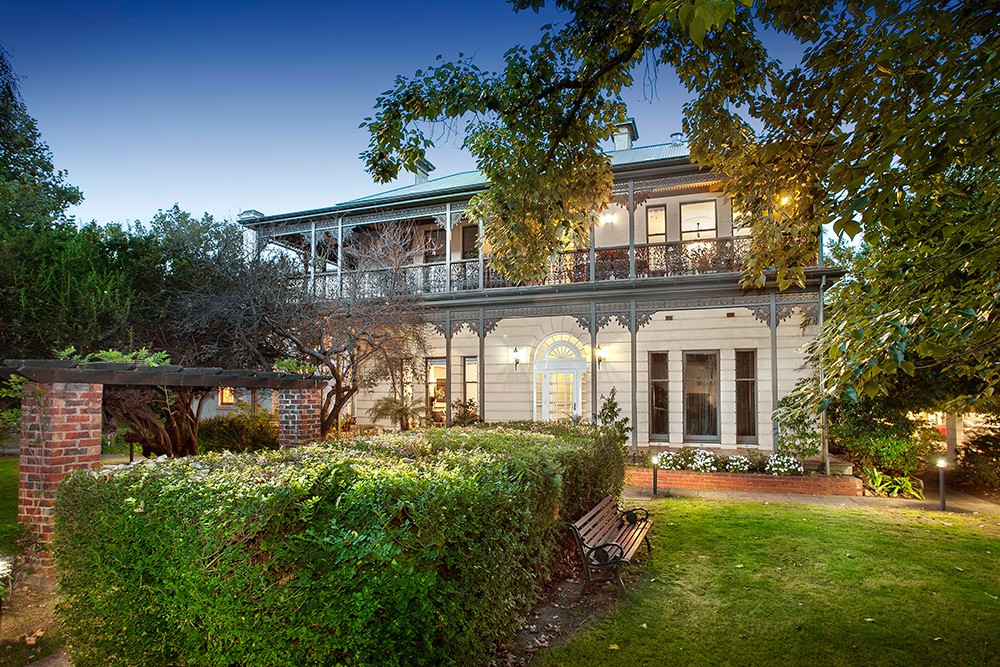
Figure 35: Courtesy of Chisholm & Gamon
https://chisholmgamon.com.au/properties/20-9-11-milton-street-elwood-vic-3184-5799
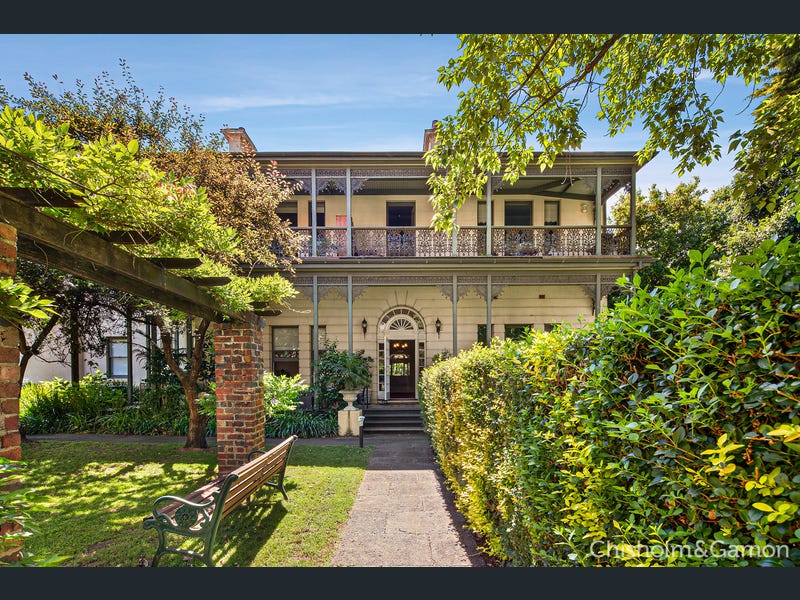
Figure 36: Courtesy of Chisholm & Gamon
https://chisholmgamon.com.au/properties/20-9-11-milton-street-elwood-vic-3184-5799

Figure 37: Courtesy of Real Estate.com
https://www.realestate.com.au/sold/property-apartment-vic-elwood-137828134
The ornamental gardens facing the house were well known and well regarded having been established at the time of building in 1865. This next article gives a fascinating description of the gardens in 1869 just four years after their establishment.

Here is Mr Barnes’s hard work being discussed 42 years later when Catherine was selling the estate.

A large portion of the gardens were unfortunately sacrificed in the 1920s to build “Hartpury Mansions” positioned facing the original house. I found an amazing expose of this new building featured in “The Australian Home Beautiful” from January 1st, 1927.

The Mansions like Hartpury have survived and still stand today. A two bedroom unit on the left of the building pictured above sold in 2017 for $1.3 million. That is just one unit.
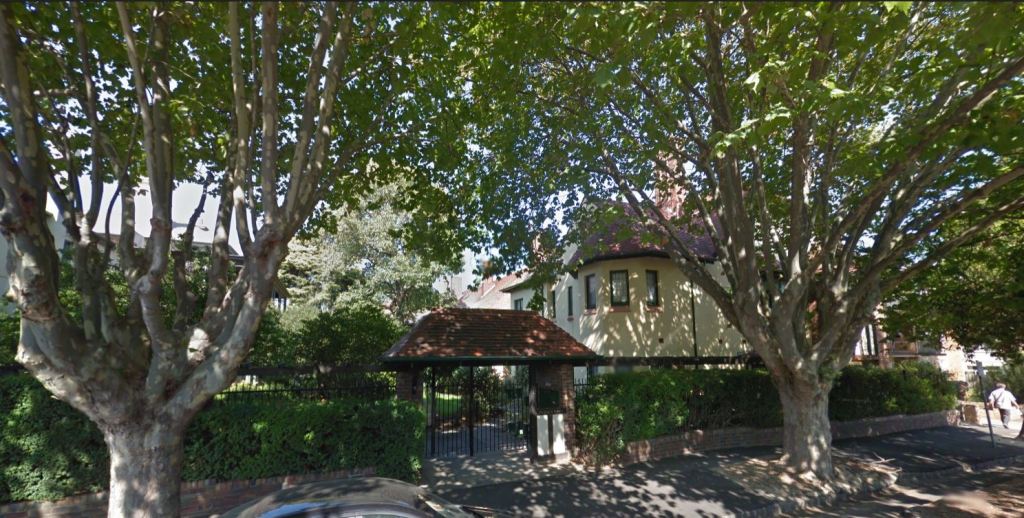
Figure 41: Courtesy of Google Maps
I know that this has been a bit of a deep dive on Catherine and George’s house but it was obviously such a big part of their lives and it is fascinating to see where their lives played out.
Their remaining three children after George, were all born at Hartpury as well. First of the three was, Mary Ida Porter born in November 1888.

Next was Vyvyan Kinsley Porter born January 1892.

Then finally, Dorothea Eveline Porter born August 1893.

Hartpury is also where George’s mother, Ellen Porter, nee Cullen was living when she passed away in 1900.

And of course Hartpury is also where George passes away in 1906.
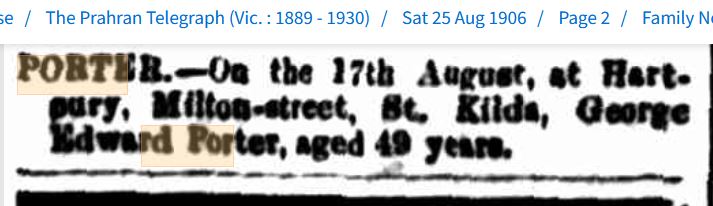
It was also the site for the wedding reception of Catherine and George’s eldest daughter, Ellen (Nellie) when she married Mr Norman C. Parbury on Wednesday 23rd of January 1907.

In addition to all of these events I also discovered that one of Catherine’s grandchildren was born at Hartpury as well. This was Katie Isabella’s (Queenie) first born son to her husband James McDonald Leith-Buchanan and his name was, John Wellesley McDonald Leith-Buchanan.
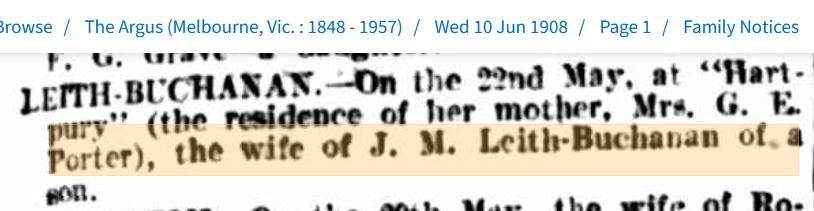
Just before we finish with Hartpury, there a few more amazing facts about the house and the links to the family that I want to let you know about.
The first relates to George Selwyn Porter, Catherine and George’s son. When considering his name, I wondered if his middle name was anything to do with the original owner of the house, Harold Selwyn Smith or was it just a coincidence? Harold had been living in New Zealand in the 1870s but moved back to Sydney in 1880 and was still in Sydney when the Porter’s took ownership of Hartpury in 1884 so definitely the potential for crossing paths was there.
I can’t find anything to link Harold with Catherine and George but I found this interesting article below that suggests that there was a link between them and the Smith family. This notice is for George’s mother’s probate notice and checkout who the solicitor is. It is Harold’s brother, Francis Grey Smith, builder and owner of Evora, sister home to Hartpury.
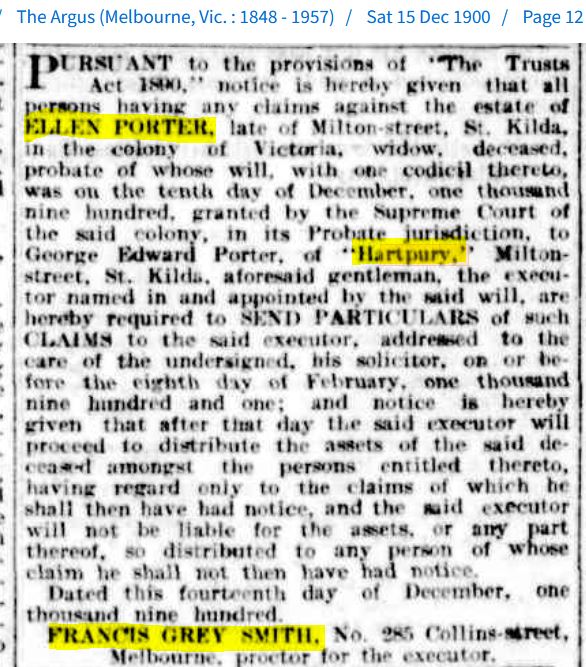
I know it is only one small example of a potential link but I’m grabbing it. I think this definitely supports my assumption that there was a connection between Catherine, George and Harold Selwyn Smith and that he was held in some high regard by them. I think this regard was manifested in their bestowing his middle name on their son. I went looking for more information on the Smith brother’s.
I stumbled upon this amazing photo of Harold Selwyn Smith, no photo of Francis, unfortunately but this discovery lead me to an amazing story about the brothers.
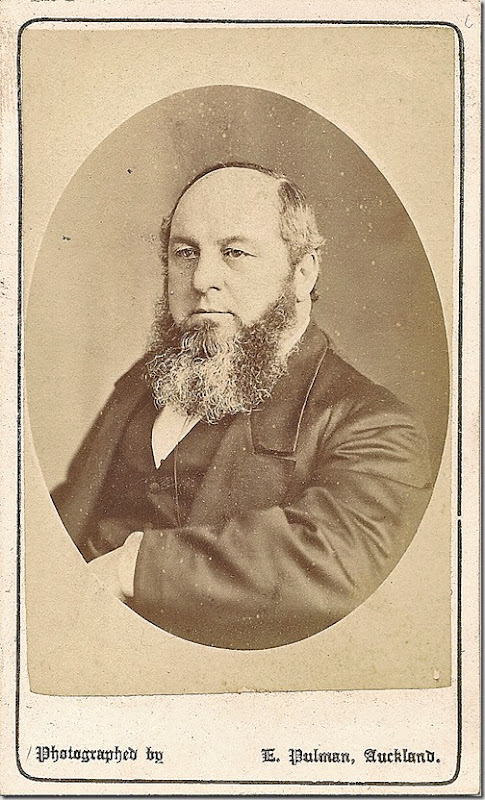
Figure 47: Courtesy of By Gone Days Photography
http://bygonedaysphotography.blogspot.com/2016/06/harold-selwyn-smith-1828-1891.html
It is a phenomenal rumor really and it is this. That Harold and Francis were in fact the illegitimate grandsons to King George IV. https://www.heraldsun.com.au/leader/inner-south/hartpury-house-in-elwood-150-years-old/news-story/ef1647df3a71a00b4713af61a97401af
Apparently their father, the Reverend John Jennings-Smith was believed to be the illegitimate son of King George IV and one Sarah Jennings. Apparently the birth records don’t list the King as father but rather a Thomas Smith but it is widely believed that the name was false and that the King was his father. https://boydellancestry.wordpress.com/2012/04/22/reverend-john-jennings-smith-2/

Regent from 1811-1820, then King from 1820-1830
Figure 48: Courtesy of National Galleries Scotland
https://www.nationalgalleries.org/art-and-artists/2522/george-iv-1762-1830-reigned-regent-1811-1820-king-1820-1830
I wonder if any of this story was common knowledge at the time Catherine and George were living at Hartpury? We will never know. But what I’m sure was known was that Reverend John Jennings-Smith, Harold and Frances’s father was, in his younger days, actually tutor to the young Princess Victoria teaching her English and History. It was after Rev. John finished his contract with the Royal Household that he decided to come to Australia. https://boydellancestry.wordpress.com/2012/04/22/reverend-john-jennings-smith-2/
This is the Reverend John Jennings-Smith.
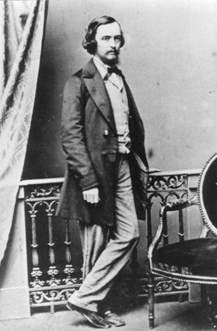
Figure 49: Courtesy of boydellancestry https://boydellancestry.wordpress.com/2012/04/22/reverend-john-jennings-smith-2/
So, once again, back to the headstone in Figure 13, Dorothea Eveline Porter passes away in 1920.

There are a couple of electoral roll listings for Dorothea that are coming up further down the page in this post but apart from them, there is no other mention of Dorothea except for this small notice about her will published six months after her death.

Now back to George Selwyn Porter, Dorothea’s brother, he passes away on the 29th of November 1956 and there is no death notice printed for him. I can’t find any marriage details for George either so it looks like he might have died a bachelor.

Ancestry had a few other details on George. I don’t know where this next bit of information came from but it is noted in most of the Family Trees in Ancestry, that George died at the Pleasant View Mental Hospital in Preston, Victoria. The building the hospital operated from was built in 1887 in the Italianate style and was one of the biggest mansions ever built in Preston, and originally named “Lyonsville”. Luckily, it has survived and still stands today. It is now once again a private residence. https://vhd.heritagecouncil.vic.gov.au/places/24284
I found a heritage photo of the mansion from the mid 90s just after the mental hospital ceased operations and just as it was being readied for a major renovation.

Figure 51: Courtesy of Victorian Heritage Database
https://vhd.heritagecouncil.vic.gov.au/places/24284
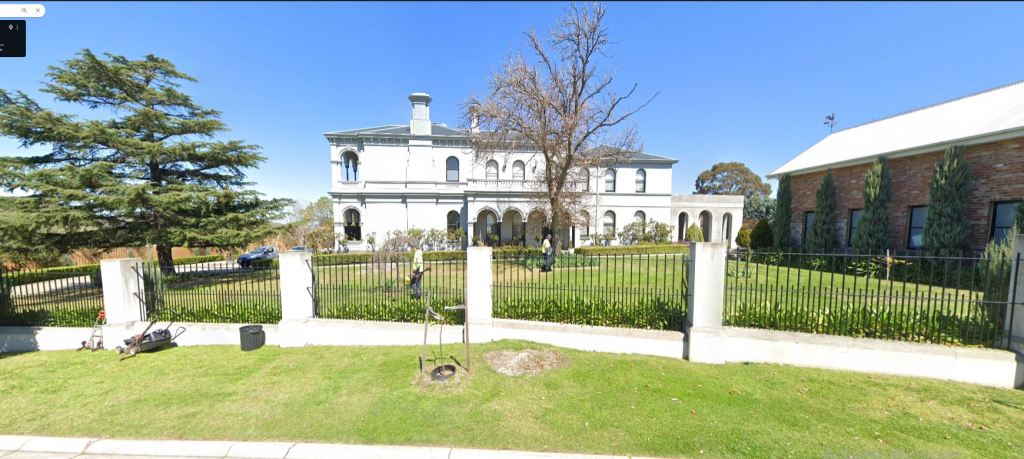
Figure 52: Courtesy of Google Maps
The following electoral roll listings from Ancestry provide additional insight into George’s identity. This listing for 1909 below is the earliest I can find for George. He is 23 years of age and still living at Hartpury, 9-11 Milton Street, St Kilda. This is two years after his father’s death.
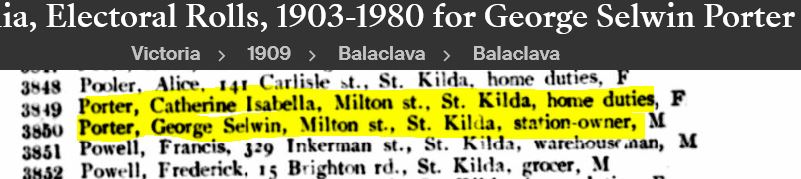
There are no electoral listings for Catherine in 1910 or 1911 but then 1911 is when Catherine puts Hartpury up for sale so she may have missed the printing cut off date. (This is four years since George, her husband’s death.) In fact the next electoral listing for Catherine is not until 1916.
I found an advert from May 1911 relating to the sale of all of the household goods from Hartpury and it gives us a tiny clue as to where Catherine might have been in those intervening years.


It looks like Catherine made the trek back to the mother country. By the time of the sale of Hartpury, Catherine’s daughter, Queenie, her husband James Leith-Buchanan and John their son had moved to Scotland and were living in Edinburgh, so she certainly had a reason to visit.
There are also no further listings for George until 1914. Obviously with the sale of the family home he too would have had to have set himself up somewhere, we find him in East Melbourne.

36 Clarendon Street was a very interesting address to move to. It is a double storey Italianate mansion that was built in 1881 for James Liddell Purves, Q.C. https://emhs.org.au/category/building_names/mosspennoch

Figure 53b: Courtesy of State Library Victoria
http://handle.slv.vic.gov.au/10381/55425
Mosspennock as it was known survives but it sat derelict and crumbling for decades until it was rescued, being restored and redeveloped into 6 luxury apartments in 2016. https://emhs.org.au/catalogue/emvf0907

Figure 53c: Courtesy of Google Maps
By 1916, George had moved and was living at the Melbourne Mansions on Collins Street. This is when his mother, Catherine reappears in the electoral rolls again and is listed as living with his sister Dorothea at 91 Collins Street, Melbourne. Dorothea is 23 years of age at this time. I wonder if she accompanied her mother on her trip to Europe? She was 18 in 1911 when Hartpury sold and unmarried and I’m sure Catherine would have liked to have kept her safe with her rather than leaving her behind at that age.

Interestingly, when I started digging into where these two properties were on Collins Street, and how close they might have been to each other, I discovered they were actually one and the same. Melbourne Mansions were located at 91-101 Collins Street, Melbourne.
Below are a couple of fantastic photos I found of the mansions, one from the 20s and one from the 50s. I’m not sure why the electoral listing for Catherine and Dorothea was missing the title of Melbourne Mansions.
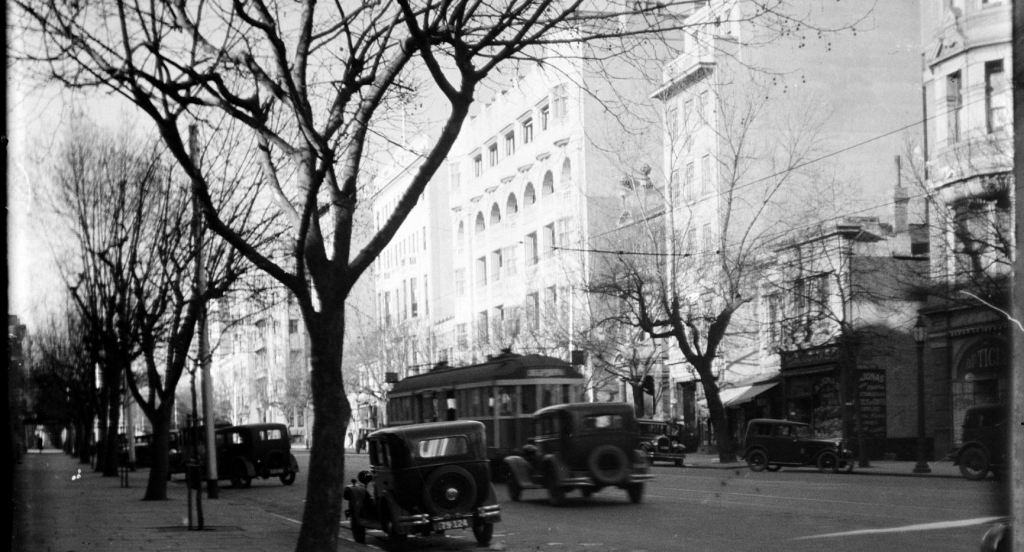
Figure 55: Courtesy of State Library Victoria
http://handle.slv.vic.gov.au/10381/107125
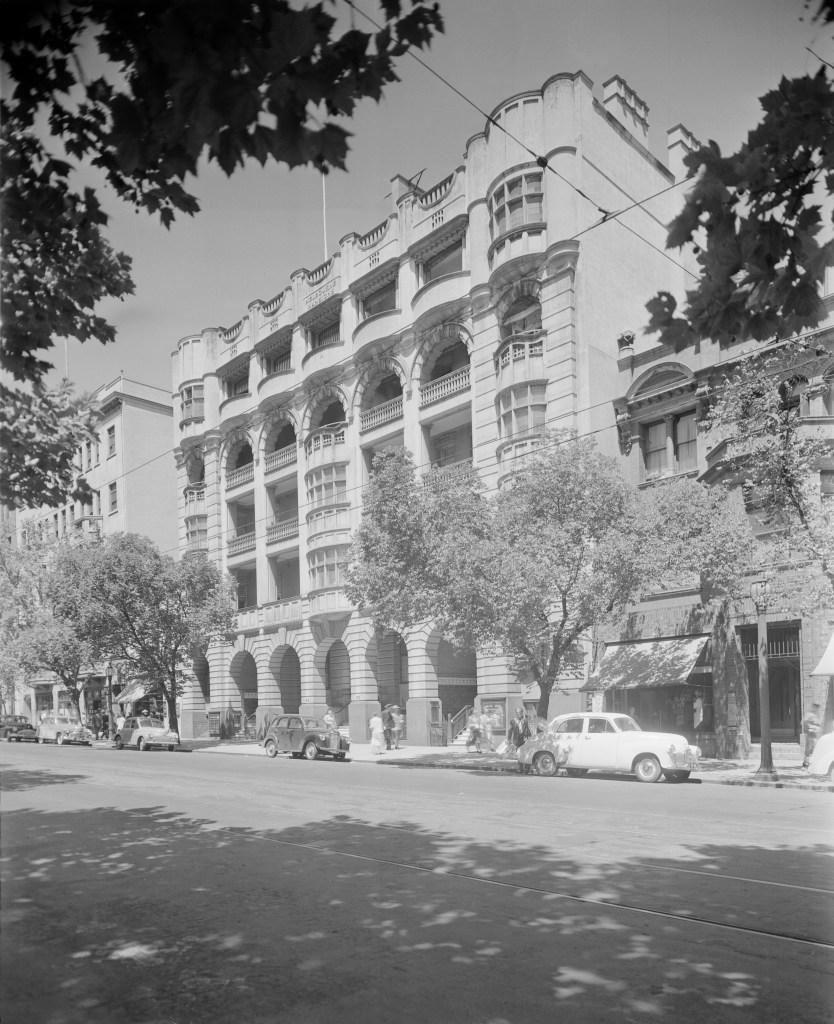
Figure 56: Courtesy of State Library Victoria
http://handle.slv.vic.gov.au/10381/252159
The Melbourne Mansions were built in 1906 and were the first purpose built residential apartment block in the city. Originally there were three types of accommodation to chose from. Large suites with a kitchen and servant rooms, large and smaller sized suites with no kitchen, who relied on meals delivered by central service elevators and those suites who’s occupants dinned exclusively in the ground floor dinning room. https://en.wikipedia.org/wiki/Melbourne_Mansions
The building stood till 1958 when it was demolished. This is the site today.
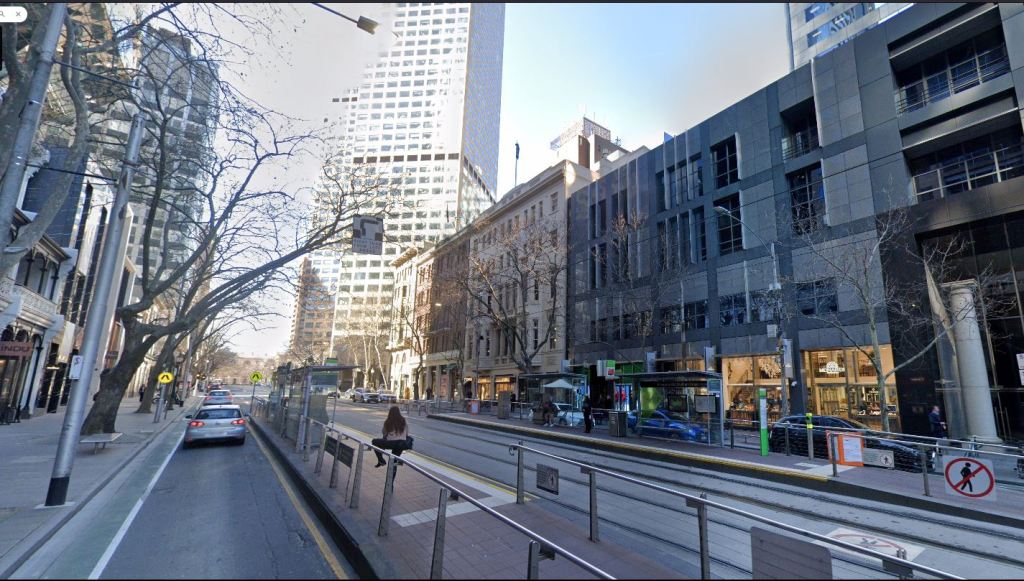
Figure 56a: Courtesy of Google Maps
(Note that the cream building with the flag pole on top has survived over 100 years, it appears in all three photos.)
The following year, 1917, George is still at the Mansions but Catherine and Dorothea had moved out to Lister House.
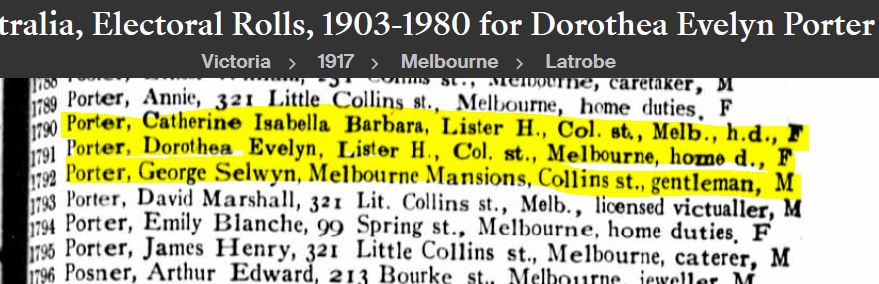
Lister House was on the same side of Collins Street as the Mansions and just up on the next corner of Exhibition Street. It is the building on the right in this photo below with the domed roof on the top.

The Intersection of Collins Street and Exhibition Street (looking up Collins St)
Figure 58: Courtesy of State Library Victoria
http://handle.slv.vic.gov.au/10381/103169

Figure 59: Courtesy of State Library Victoria
http://handle.slv.vic.gov.au/10381/103169
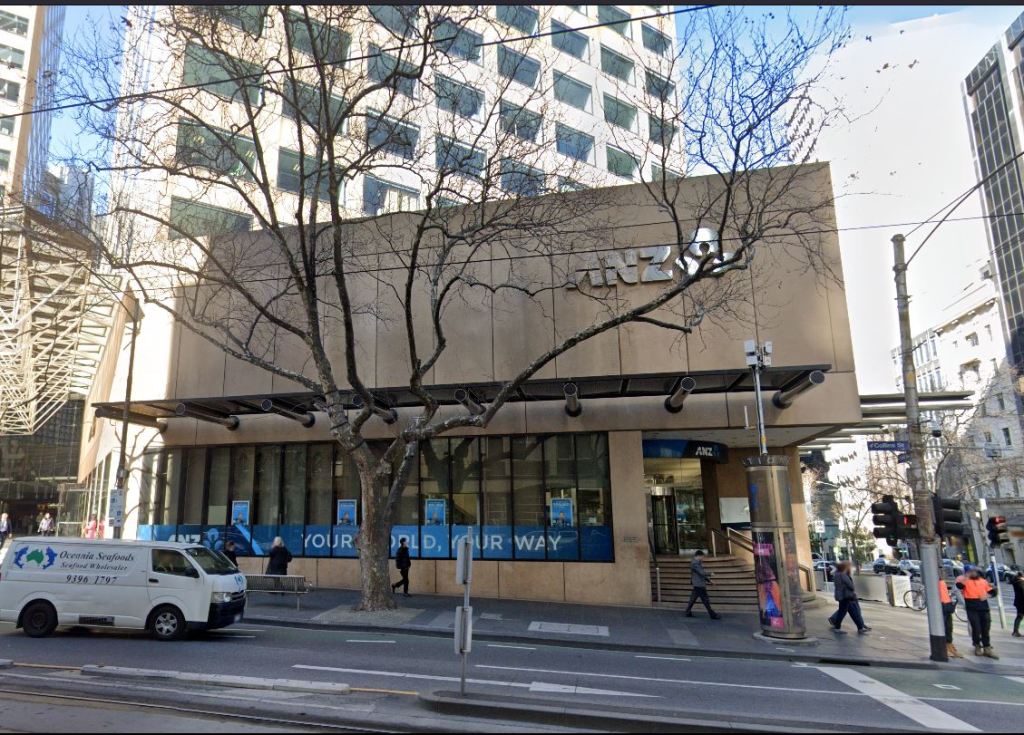
Lister House was brand new when Catherine and Dorothea moved in, construction having just been completed that same year, 1917. The top three floors were the exclusive apartments and the rest of the building was designed with medical and office suites in mind. https://balancearchitecture.wordpress.com/2017/01/25/melbournes-lost-architectural-treasures-part-2/
Here is the site in 2019, I wonder if that is the same tree out the front as shown in the 1950s photo? It looks to be in the same position.
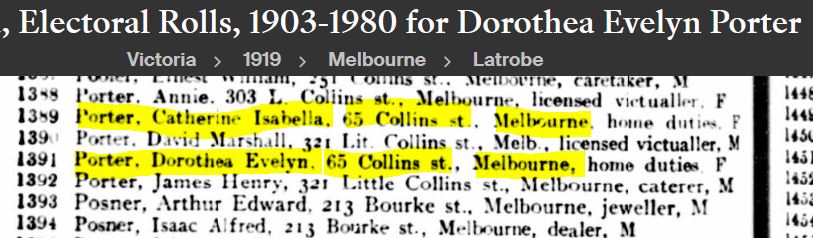
Even though this next listing for 1919 indicates that Catherine and Dorothea had moved to 65 Collins Street, they in actual fact hadn’t moved at all, it is still Lister House.
I found this corner of Collins & Exhibition Street on the good old Melbourne and Metropolitan Board of Works Maps. It is from 25 years earlier than Catherine and Dorothea’s residency but it clearly shows the numbering. I have highlighted Lister House, 61-65 and then the next corner being no. 71. I have also highlighted 101 Collins Street which will be the site of the future Melbourne Mansions, which will be built in 11 years time from this map date.
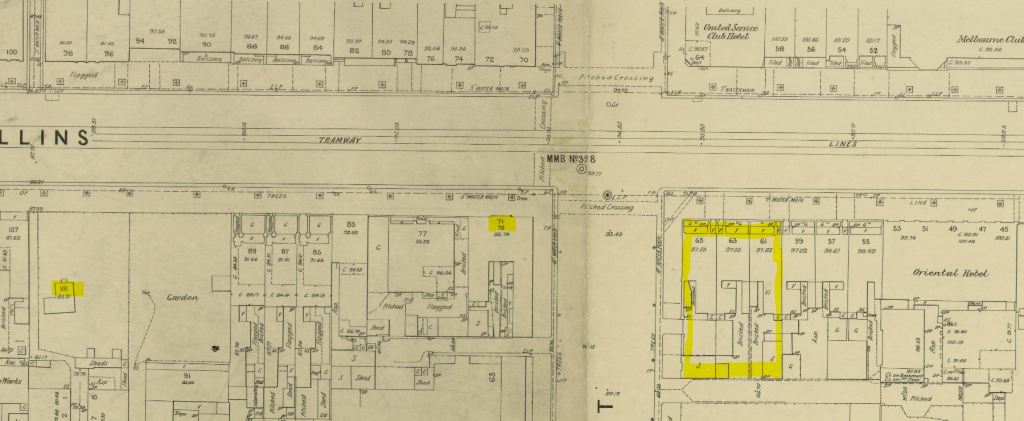
Figure 62: Courtesy of State Library Victoria
http://handle.slv.vic.gov.au/10381/115980
George’s listing for 1919 shows that he has moved out of the city to a town called Diamond Creek about 30kms north east of the city. He is living in a house called “Marathon” and working as an orchardist. This is a huge surprise considering that he has been listed as a Gentleman of independent means up to this point and the fact that he is from a family with an insane level of wealth.
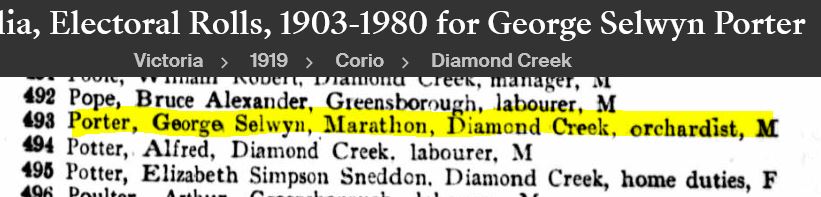
I was lucky to find a couple of articles from Trove confirming the details of the house George was staying in and the orchard he was working at. The first is just a random wedding notice for a Melbourne high society couple who were going to spend their honeymoon at the house.

The couple were Miss Leonie Peterson daughter of Professor Franklin Peterson of Melbourne University and Captain Harry Llewellyn Mackworth, D.S.O. son of Sir Arthur William Mackworth of Monmouthshire.

Again I can’t but help think, why did George take this course of action? Did he still have access to the family fortune or was there a disagreement with his Mother that lead to him being cut off, or was it just George wanting a sense of purpose in his life?
This rural life was obviously working for George as he was there at Diamond Creek for the next four years.

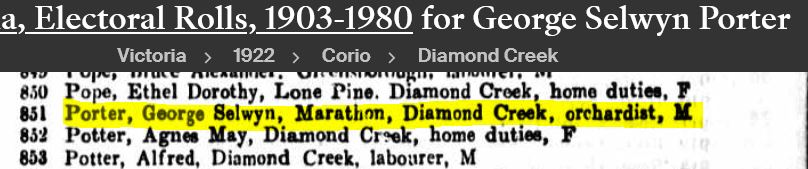

I didn’t have to wonder for too long about how George ended up at Diamond Creek. I found an article in the “Mercury and Weekly Courier” that covers the areas of Heidelberg, Fairfield, Alphington and Diamond Creek, discussing a local solicitor by the name of Mr George Bryden Porter and his father, a Mr George Wallick Porter. I discovered through Ancestry.com.au that they just happen to be our George’s cousin and uncle.

So I think it is safe to assume that George Selwyn Porter was working on one of his Uncle’s properties, which I’m assuming his cousin George Bryden Porter inherited on his father’s death in 1903. I did manage to find a picture of George’s uncle, George Wallich Porter and here it is pictured below.
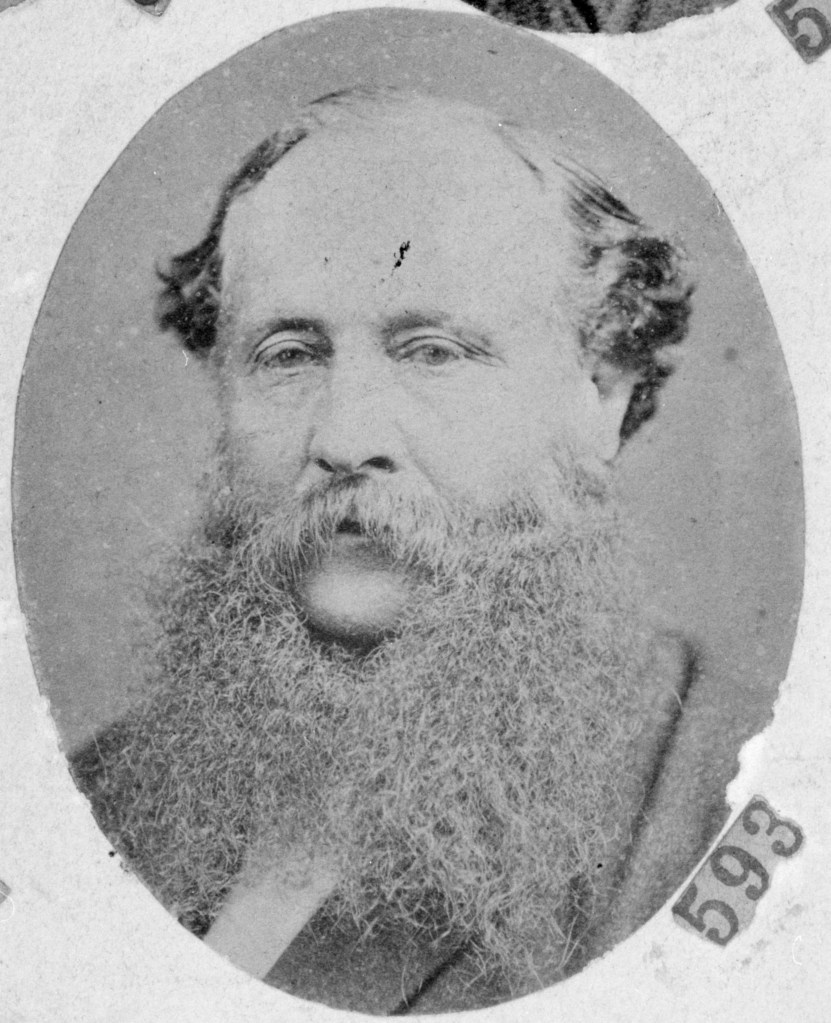
Figure 70: Courtesy of State Library Victoria
http://handle.slv.vic.gov.au/10381/18161
By 1925 George had moved to another orchard in the Mount Eliza area, which is about 65kms south of Melbourne on the Mornington Peninsula. I can’t find any details on this particular orchard, but I did discover a “Buloke Close” (listed below) in Mt Eliza and wonder if this might be named for the farm or farm house that was part of the orchard in that area.

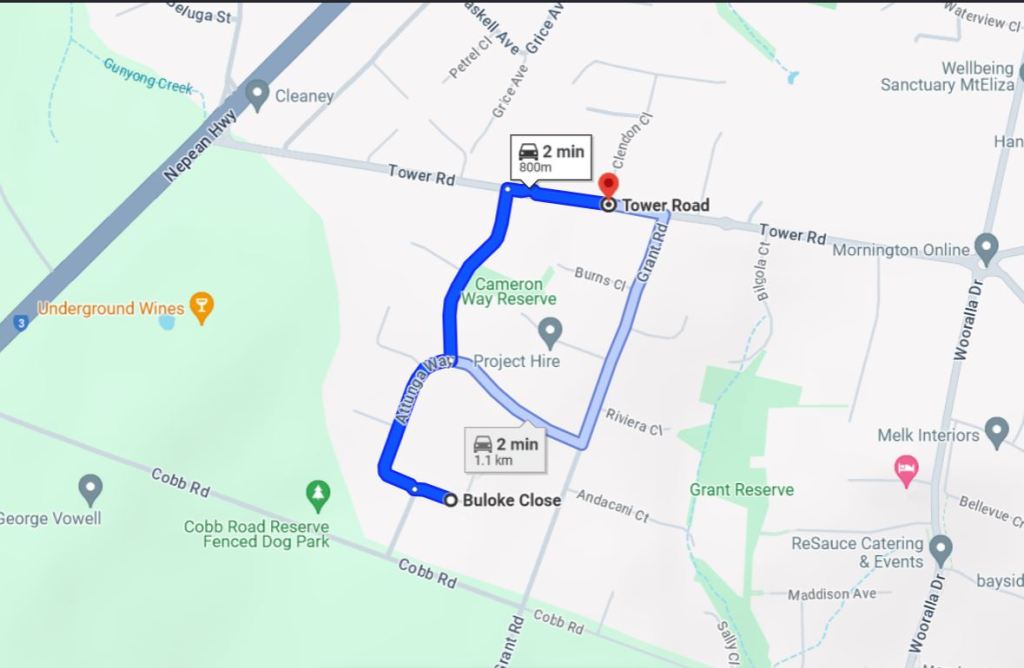
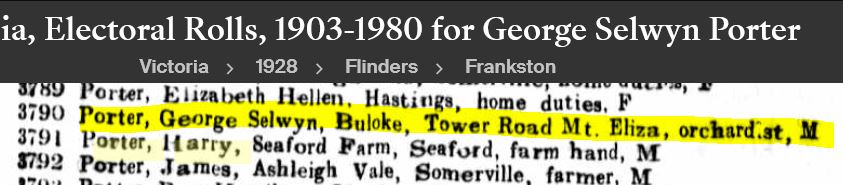
I’m not sure how long George was in Mt Eliza as there is no other electoral listing for him until 1931 which indicates that he had moved back into Melbourne City.

The Florida Mansions were situated at 601 St Kilda Road and they were still standing in the 1980s. Thanks to this Flickr User for sharing some old Melbourne Council photos, we get to see where George was living.
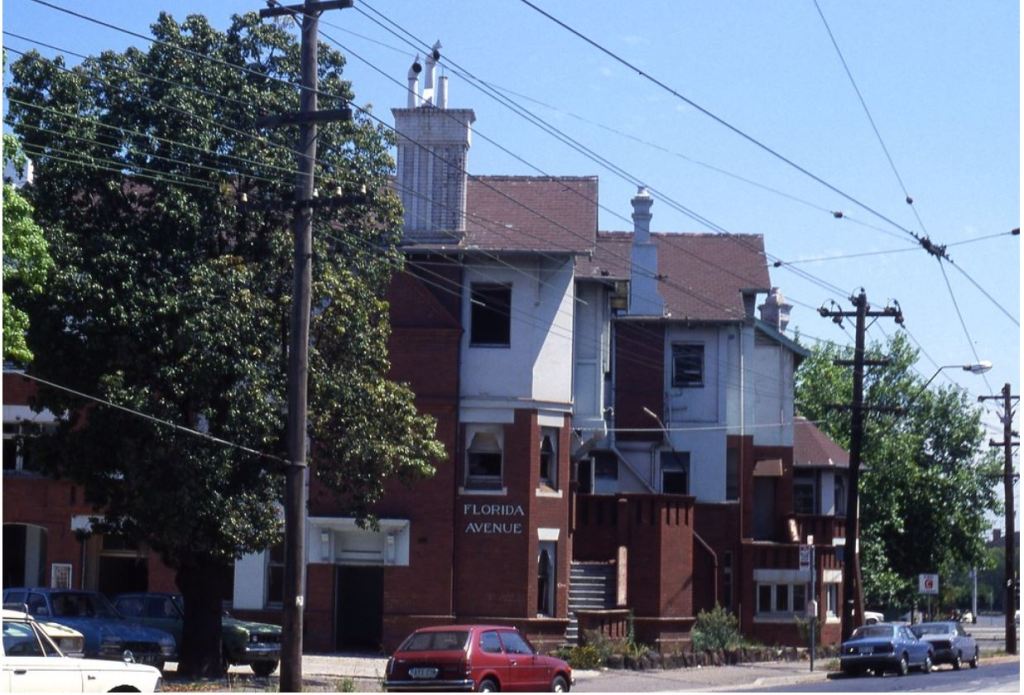
Figure 75: Courtesy of Graeme Butler Flickr User
https://www.flickr.com/photos/7849945@N02/27279420655/in/photostream/
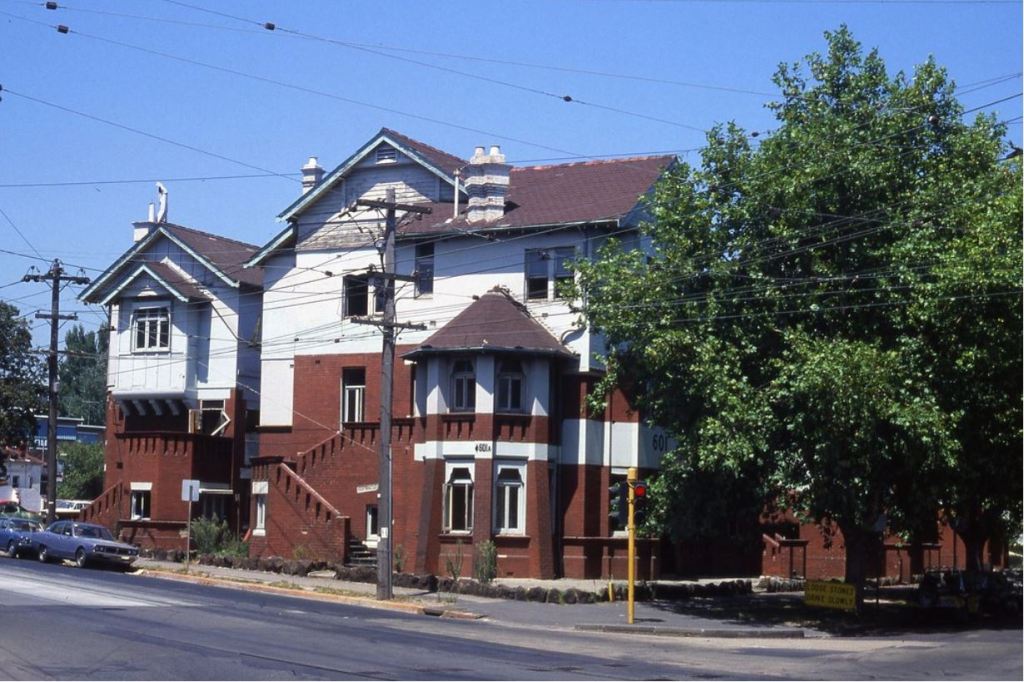
Figure 76: Courtesy of Graeme Butler Flickr User
https://www.flickr.com/photos/7849945@N02/27279417755/in/photostream/
In these photos they look like they are wearing every one of those fifty years of wear and tear from George’s time. They were demolished not long after these photos were taken and this photo below is of the exact same corner today.

Figure 78: Courtesy of Google Maps
Once again, I think they might be the same trees in front of the property as in the photos from the 80s.
The next listing we have for George is 1936 and he has moved 5kms to the east on the other side of South Yarra.

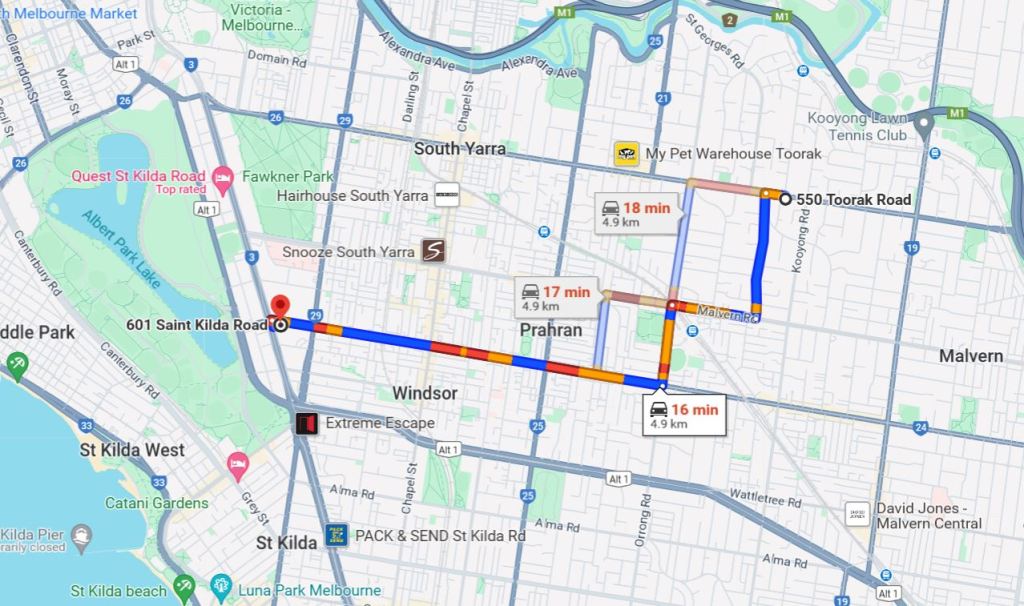
Here is 550 Toorak Road in February 2023, I can’t find one bit of historic information about the building unfortunately. The building standing there today is named Beltana and I wonder if it might be the original building that George lived in, just renovated. It is made up of eight luxury apartments

Figure 81: Courtesy of Google Maps
I’m also unable to dig up any historic photos of 550 Toorak Road but here is a picture of the historic Toorak Village just 900 meters from Beltana’s front door. This is a sight George would have been very familiar with.

Figure 82: Courtesy of Toorak Village Facebook Page
https://www.facebook.com/toorakvillage/photos/a.810131902337914/6420621404622241/?type=3
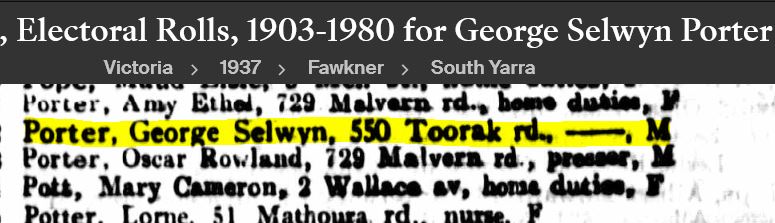
Again I am unsure as to how long George lived there as our next listing for George is six years later and he has moved again. This time to Adelaide Street, just 2kms away.


Now this property is a stunner, and it has survived and is still sitting on the corner of Adelaide Street and Malvern Road, Armadale.

Figure 86: Courtesy of Google Maps

Figure 87: Courtesy of Google Maps
I can confirm that it is the same building that George would have lived in, as I found it on the Melbourne and Metropolitan Board of Works maps from 1902. The house was called “Stokell” and you can see that the footprint of the building matches with what we can see of the house in the Google photos above.
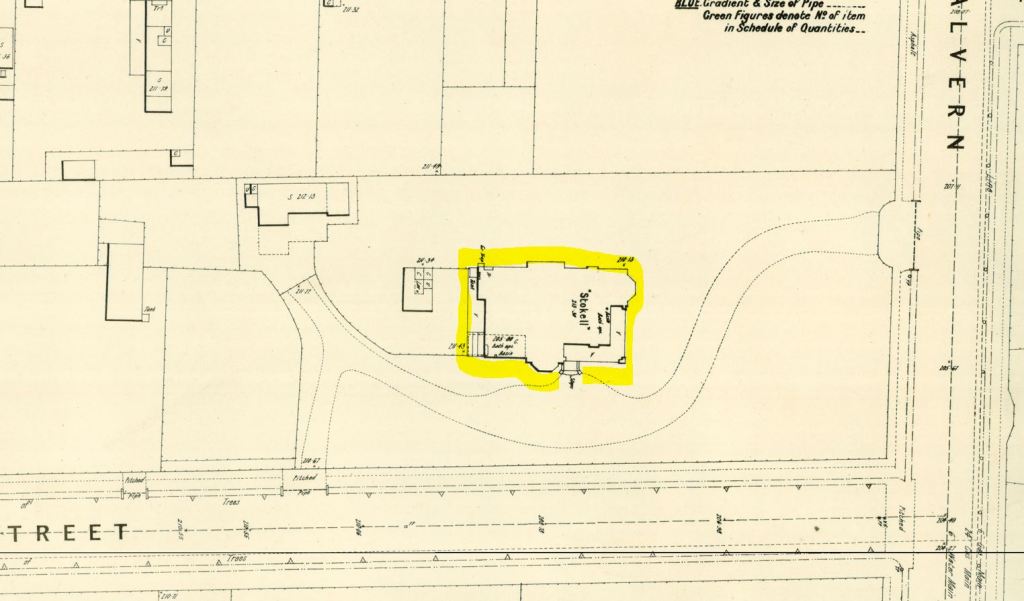
Figure 88: Courtesy of State Library Victoria
I then found a Heritage Citation prepared originally in 1992 by Nigel Lewis and Richard Aitken Pty Ltd and then updated by Extent Heritage Pty Ltd, in 2022 that gave some fantastic insight into the history of the building and ultimately to what might have been happening for George in 1943.
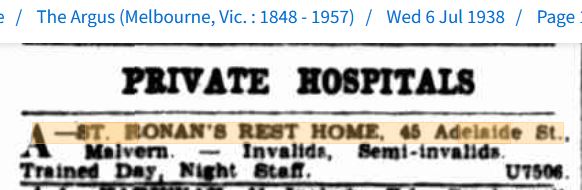
The citation states that Stokell was under construction by 1889. It was being built by a local builder and owner, Stephen Armstrong who was known for his superior craftsmanship in building in the elaborate Italianate style which he employed in the construction of Stokell. The building was named after his wife’s maiden name. After Armstrong’s ownership ended in 1911 Stokell had a number of prominent owners over the next twenty five years and a name change to “Ambo”. Then in 1938 it became a private hospital known as “St Ronan’s Rest Home”.https://hdp-au-prod-app-ston-connect-files.s3.ap-southeast-2.amazonaws.com/9116/7591/5721/HO1_-_49-51_Adelaide_Street_Armadale_-_Citation_Individual_FINAL.pdf
By the time George was in residency in 1943, Stokell had been operating as a private hospital for five years. There is nothing out there explaining definitively what it was principally operating as. However, these next couple of notices below, give the impression that it might have been that George had suffered some sort of loss of functioning that required some longer term assistance than an ordinary hospital admission could provide.

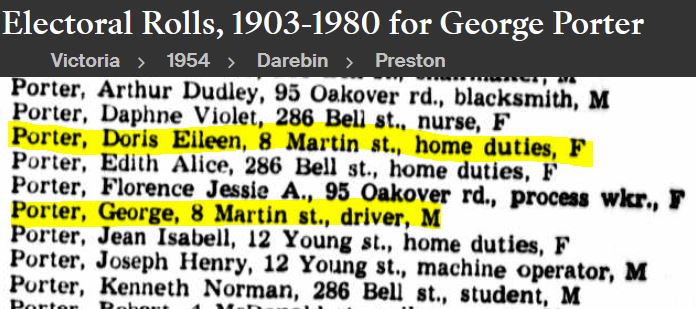
We have one final listing for George before his death notice, which we have already discussed and shown above in (Figure 51). It is an electoral listing in Preston in 1954 but there is just one problem, I don’t think it is our George. I know a coincidence, since we can be certain our George, George Selwyn Porter dies at Pleasant View Mental Hospital in Preston (Figure 52) but this George, shown below, is living with a wife at the same address. I know it is this George’s wife as their marriage registration is listed on the Victorian Birth Deaths and Marriages site. No other Ancestry tree on Ancestry has a marriage listed for our George, so these details don’t match up with him.
And then that is it for George Selwyn Porter, no death notice, no funeral notice and no probate notice. George was 70 years of age at the time and I suspect he died alone at the hospital. He only has two of his sisters left alive at the time. Mary Ida Tuthill who was living in Spain and Ellen Parbury, who was living at Currumbin Beach, Gold Coast, Queensland. I do hope they got the chance to at least talk before he passed.
Next I want to take us back to Catherine for a moment. We delved straight into the story of her wedding with George Edward Porter and then Hartpury above before we had a chance to continue on with the rest of her story. We last left Catherine and her daughter Dorothea living at 65 Collins Street in 1919, Figure 61, at Lister House, pictured in Figure 59.
She buries Dorothea in the September of the following year, 1920 and then the next electoral listing in 1922 has Catherine living at the Menzies Hotel on Bourke Street.

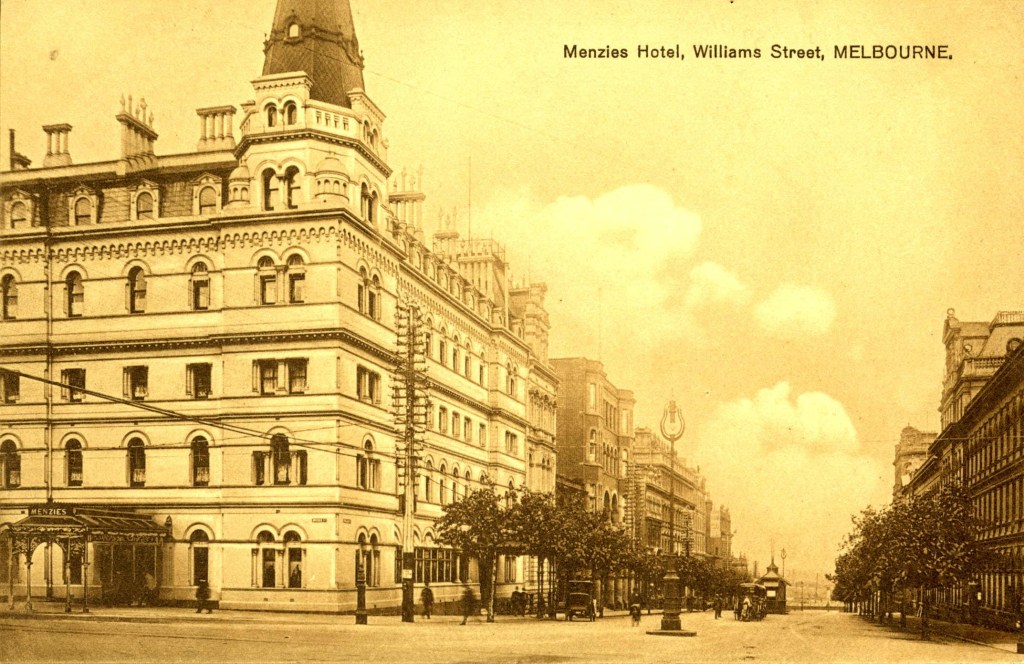
Figure 93: Courtesy of State Library Victoria
http://handle.slv.vic.gov.au/10381/383797
I did find a notice on Trove from December 1921 that suggests that Catherine had moved into the hotel sometime earlier that year.
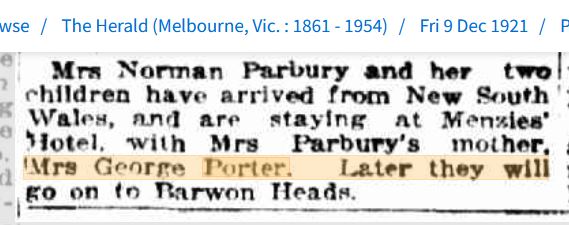
Mrs Parbury happens to be Catherine’s eldest daughter, Ellen (Nellie) Porter. At this stage in 1921 she and Norman have five children so I’m uncertain as to who the two visiting grandchildren might have been.
This is the type of environment that Catherine was living in and that the family would have been enjoying when they visited.

Figure 94: Courtesy of Skyscrapercity.com
http://www.thecollectormm.com.au/gallery/postcards/1920s-1980s/slides/Menzies1.jpg

Figure 95: Courtesy of Skyscrapercity.com
http://www.thecollectormm.com.au/gallery/postcards/1920s-1980s/slides/Menzies2.jpg
This next notice is two months after the one above mentioning Nellie’s visit.

I can’t find a departure date for either Catherine or Nellie but I wonder if the wording of this next article suggests that Catherine did make the trip and has just returned from overseas. It is dated 12 months after the one above.

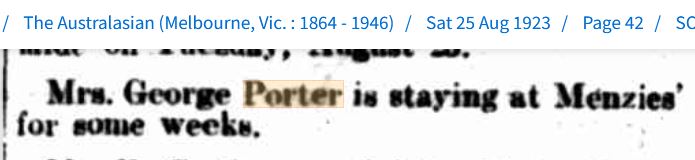
Obviously the Menzies was working as a home base for Catherine as she is still there two years later at the end of 1925.


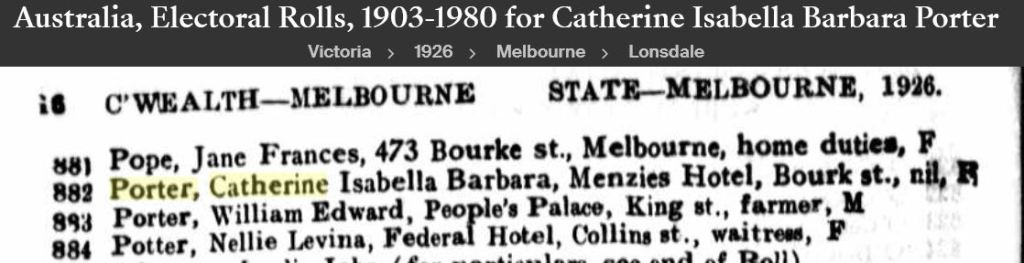
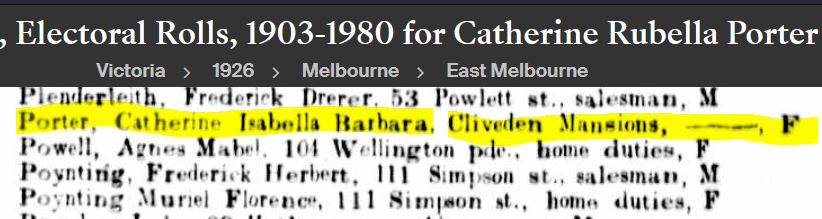
Then in 1926, Catherine has two electoral listings appear in Ancestry, which is strange, I have never seen this before.
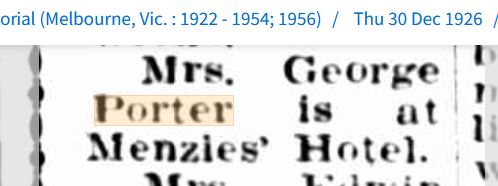
This is the final social notice that I can find for Catherine from December 1926 suggesting that she is still at the Menzies.
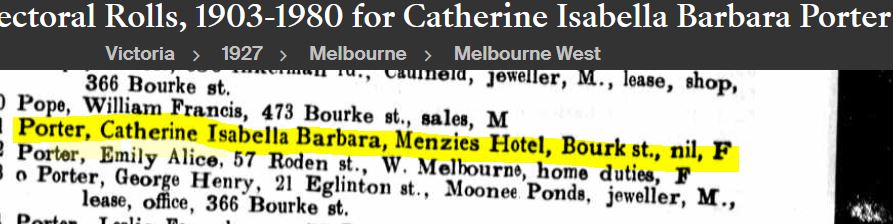
This anomaly of the two electoral listings is repeated again in 1927, the year Catherine passes away.

I found a probate listing for Catherine’s estate and it lists the Cliveden Mansions as her place of residence, it is also listed as a place of residence for her son George Selwyn Porter. Perhaps this was his city apartment when not working at the orchard in Mt Eliza and perhaps Catherine leased the apartment for George and this is why she is listed twice in the Electoral Rolls by mistake.
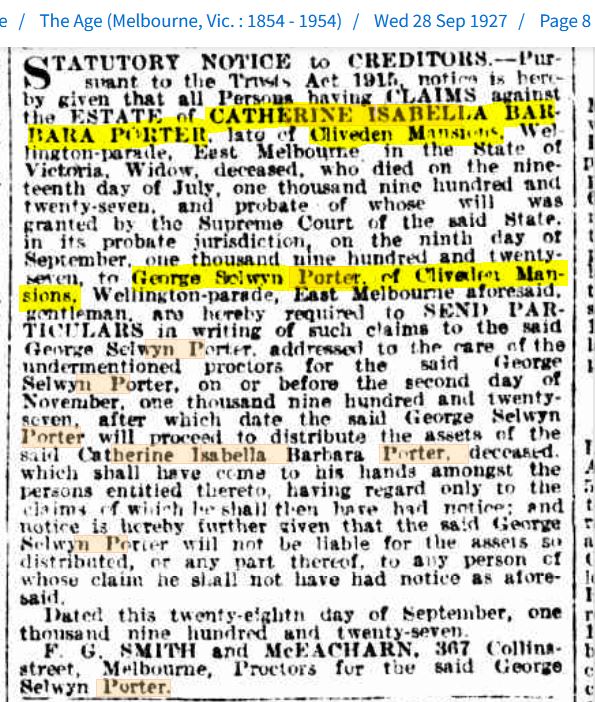
I wondered also if this meant that Catherine was living with George when she passed away? So many questions that will be left unanswered unfortunately.
To finish off, this is the Cliveden Mansions below, on the corner of Wellington Parade and Clarendon Street, East Melbourne, it had an amazing history.

Figure 102: Courtesy of Radicalterrace.com Tumblr Blog User
https://radicalterrace.com/post/37860324678/cliveden-mansions-east-melbourne
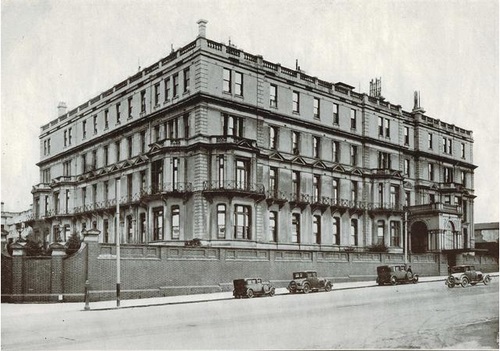
Figure 103: Courtesy of Radicalterrace.com Tumblr Blog User
https://radicalterrace.com/post/37860324678/cliveden-mansions-east-melbourne
The Museum of Lost Things website explains, that “Cliveden” as it was originally known was built in 1887 by Sir William Clarke, Australia’s first Baronet, in recognition of his philanthropy. Cliveden when completed was known as Melbourne’s largest house. https://www.museumoflost.com/cliveden-melbournes-largest-house/

Figure 104: Courtesy of The Museum of Lost Things
https://www.museumoflost.com/cliveden-melbournes-largest-house/
Clarke dies in 1897 and then when his wife, Lady Janet Clarke passed away in 1909 their heirs decided to sell the property, this is when another floor was added and the building reconfigured into 48 luxurious apartments. https://www.museumoflost.com/cliveden-melbournes-largest-house/
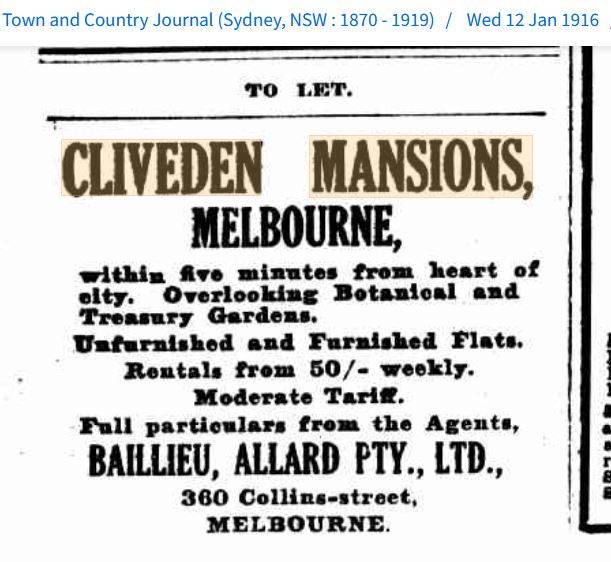
The apartment Catherine would have leased had the option to came fully furnished. This is a phenomenal example of what it might have looked like at the time Catherine and George were living there.

Figure 105: Courtesy of The Museum of Lost Things
https://www.museumoflost.com/cliveden-melbournes-largest-house/
One thing that the Cliveden Mansions prided itself on was that the apartments did not have their own kitchen. It was one of its main selling points.
‘Kitchenettes are unknown at “Cliveden Mansions”. All meals are prepared in the up-to-date kitchen presided over by a highly-accomplished French chef, and served in the dining room by a courteous and efficient staff. The dining room is solely for the use of tenants and their guests.’
– From an advertisement for ‘Cliveden Mansions’
https://www.museumoflost.com/cliveden-melbournes-largest-house/

Figure 106: Courtesy of The Museum of Lost Things
https://www.museumoflost.com/cliveden-melbournes-largest-house/
What a way to live, so far removed from where most of us are in this current cost of living crisis in 2024. The Cliveden Mansions were successful till they weren’t. After World War II they began to lose their appeal. By the 1960s they had become tired and badly in need of repairs.
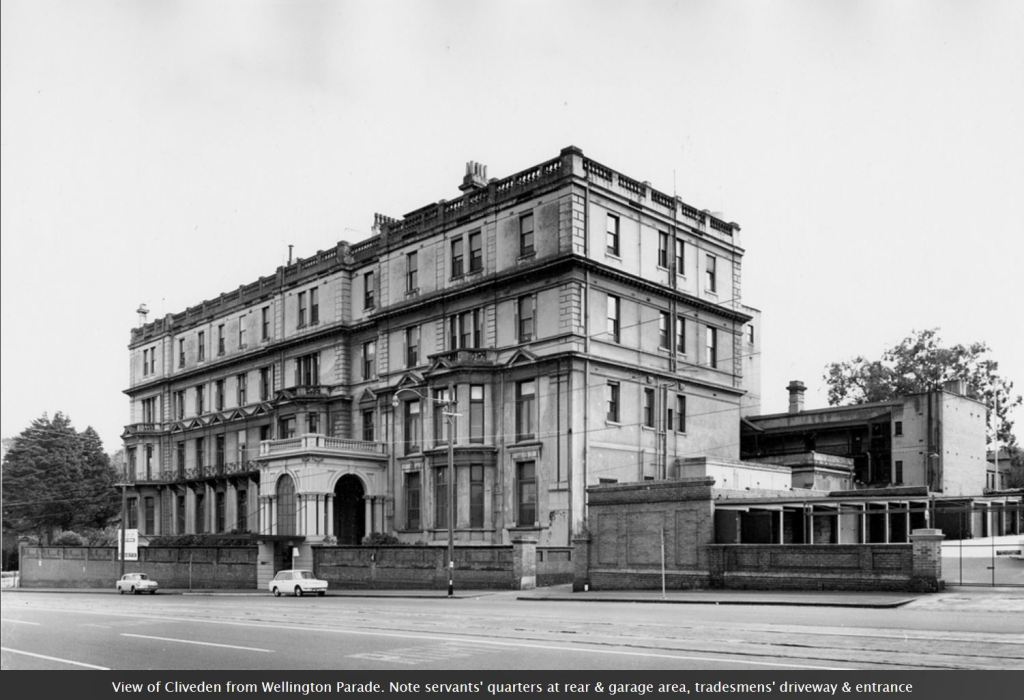
Figure 107: Courtesy of the East Melbourne Historical Society
https://emhs.org.au/catalogue/emdf0408
The building was demolished not long after the photo above was taken and in its place rose the Melbourne Hilton.

https://collections.museumsvictoria.com.au/items/2407750
Here is the Hilton in the late 2010s just before it became the Pullman Hotel which it remains trading as today.
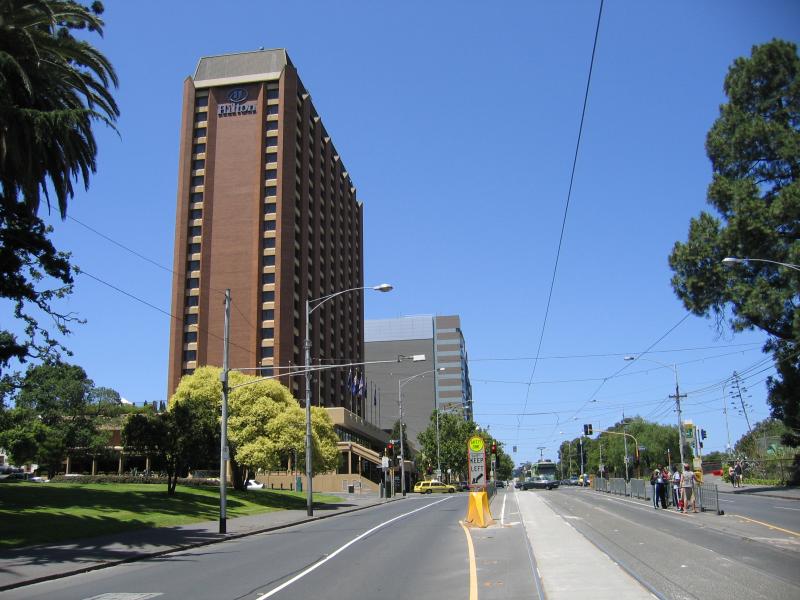
Figure 109: Courtesy of Travel Victoria
https://www.travelvictoria.com.au/eastmelbourne/photos/
And here is the site in 2022, The Pullman Hotel. I bet Catherine and George wouldn’t be able to even conceive the idea of it, that beautiful building gone for this eyesore.

Figure 110: Courtesy of Google Maps
So there it is folks, day two of the tour done. Google Timelines gave me a great little snapshot of my day, which I love as I’m a complete nerd for maps, I know there is no explaining it.

I dropped Anne back to her place and I headed back to the caravan park at Seymour and picked up the most fantastic pizza from this little place on the main street.

Still heaps more to share with you from this family history tour. I do hope you have enjoyed the occasional snippets of information on the current players in the Macvean family drama that have been interspersed with the legacy cast’s stories and I do hope you will be back for the continuation of the tour in Part Three.

 JOHN'S FAMILY HISTORY

Fabulous sleuthing, John! Thanks so much for sharing it!!
LikeLiked by 1 person